









To prepare this guide, our team reviewed Ontario’s Insurance Act and Compulsory Automobile Insurance Act, compared minimum liability requirements across Canada, and examined how coverage works in public, private, tort, and no-fault insurance systems. We also looked at what third-party liability covers, what it leaves out, how it applies to rental vehicles, and why most Ontario drivers carry considerably more than the legal minimum.
Keep reading to learn how third-party liability insurance works, how much coverage your province requires, and whether a $1 million or $2 million limit makes more sense for you.
What Is Third-Party Liability Auto Insurance?
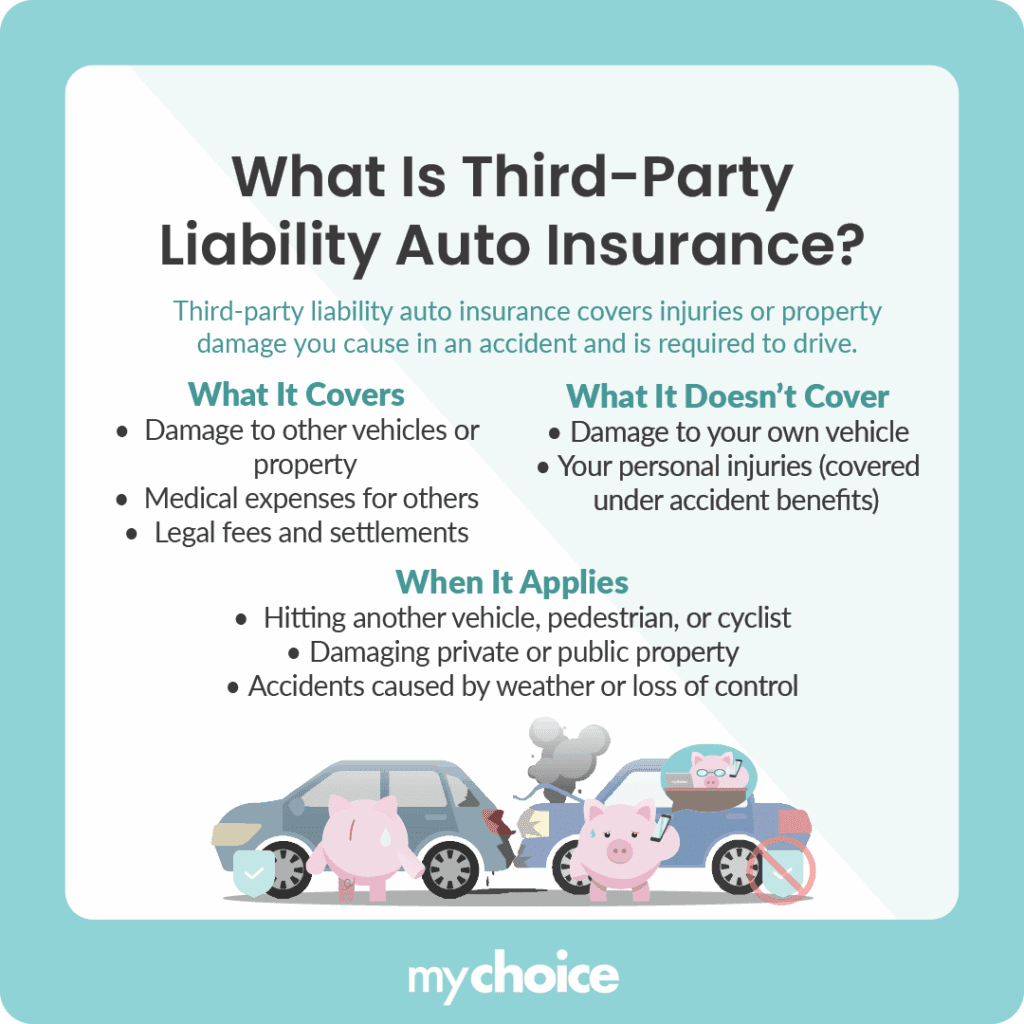
Third-party liability auto insurance provides financial protection if you are found legally responsible for injuring someone or damaging their property in an accident. While available for home and car insurance, it is mandatory for anyone who wants to legally drive a vehicle in Canada.
It works with other elements of your car insurance policy, including the following:
- Accident benefits: Provides medical, rehabilitation, and income-replacement benefits regardless of who caused the accident.
- Uninsured auto insurance: Protects you if you are injured or your vehicle is damaged by an uninsured or unidentified driver, including many hit-and-run situations.
How it Works
Third-party car insurance kicks in under the following circumstances:
- Backing into private property accidentally
- Hitting a pedestrian or cyclist unintentionally
- Losing control of your vehicle due to a malfunction, bad weather, or other external factors
- Causing an accident with another car leading to severe injury or death
When someone files a third-party liability claim against you, your policy will cover this claim up to an agreed limit.
How Much Does Third-Party Liability Coverage Cost?
You can’t buy third-party liability on its own. It is part of a minimum legal requirement across Canada, alongside accident benefits and uninsured automobile coverage.
However, according to MyChoice internal data, an average driver in Ontario with a clean driving record and a long insurance history pays about $300 per year for the third-party liability portion of their car insurance coverage (based on a full premium of $2,132).
What Third-Party Car Insurance Covers
Third-party car insurance provides financial coverage for the following:
- Repair costs for any vehicles damaged in the accident
- Repair costs for surrounding property damage
- Medical costs
- Legal fees and settlements for potential lawsuits
What Doesn’t Third-Party Car Insurance Cover?
Third-party car insurance wouldn’t cover damages to your vehicle or injuries to yourself if you caused the accident. Injuries to you or your passengers are usually covered through accident benefits, while damage to your vehicle may require collision or DCPD coverage, depending on fault.
How Much Third-Party Liability Insurance Do I Need
In Ontario, the minimum third-party liability coverage required is $200,000, although many drivers choose $1 million or $2 million for better protection. The $200,000 floor is set by Ontario’s Insurance Act (s. 251).
If you live outside of Ontario, reference this table to get a better idea of how much third-party liability coverage you’ll need, from the lowest to the highest amount:
| Province | Min. coverage amount |
|---|---|
| Quebec | $50,000 |
| Alberta | $200,000 |
| Northwest Territories | $200,000 |
| Nunavut | $200,000 |
| Prince Edward Island | $200,000 |
| Saskatchewan | $200,000 |
| Yukon | $200,000 |
| British Columbia | $200,000 |
| Manitoba | $500,000 |
| New Brunswick | $200,000 |
| Newfoundland/Labrador | $200,000 |
| Nova Scotia | $500,000 |
*Quebec’s $50,000 looks unbelievably low because injury claims there are handled by the province’s public plan regardless of fault, so the private minimum mainly covers property damage.
Should You Increase Your Liability Limit?
You can increase your third-party liability coverage if you want added protection on the road. In addition, a single accident can easily surpass $200,000, so growing your limit can be beneficial.
There are other reasons you might want to increase your insurance limits, including the following:
- Frequent carpooling
- Using your vehicle for commercial purposes
- Driving across the US and Canadian borders often
- Living in a metropolitan area where more accidents happen
In practice, $1 million is the default limit on most Ontario policies and $2 million is the usual upgrade. You should ask your insurer or broker to be quoted at both limits and compare.
If you own a home, have savings to protect, or regularly drive into the United States, where legal expenses are considerably higher, the upgrade to 2 million in liability might be a good option for you.
Do You Need Third-Party Car Insurance to Rent a Vehicle?
If you already have an existing policy, it will likely cover third-party liability on a rented vehicle. However, it might not cover collisions or other damage to the rental.
If you don’t have insurance, the rental company may request that you add third-party liability coverage to your rental agreement.
What if You Live in a No-Fault Province?
If you live in a no-fault province, each driver typically deals with their own insurer for certain claims, although fault is still determined. You may still sue the at-fault driver in certain circumstances, particularly for serious injuries. Learn more about no-fault insurance in Ontario.
How to Get Third-Party Liability Insurance
As with auto insurance, you must contact a broker or provider to apply for third-party liability coverage. You can easily compare insurance quotes online before choosing your preferred insurer.
When selecting your policy, your insurance rates depend on age, driving history, vehicle, and even marital status. How much deductible you pay can also influence your insurance premiums.
Can You Drive Without Third-Party Car Insurance?
No. Driving without third-party liability insurance is illegal in every province and territory. In Ontario, the Compulsory Automobile Insurance Act requires every car owner to carry a valid car insurance policy to start driving.
Read more: Uninsured Driving Laws in Canada Explained