









How to Get Your G1 Licence in Ontario
A G1 licence marks the beginning of Ontario’s graduated licensing program. Before getting behind the wheel, new drivers need to understand the application requirements, G1 restrictions, insurance arrangements at the learner stage, and the steps that lead from G1 to G2.
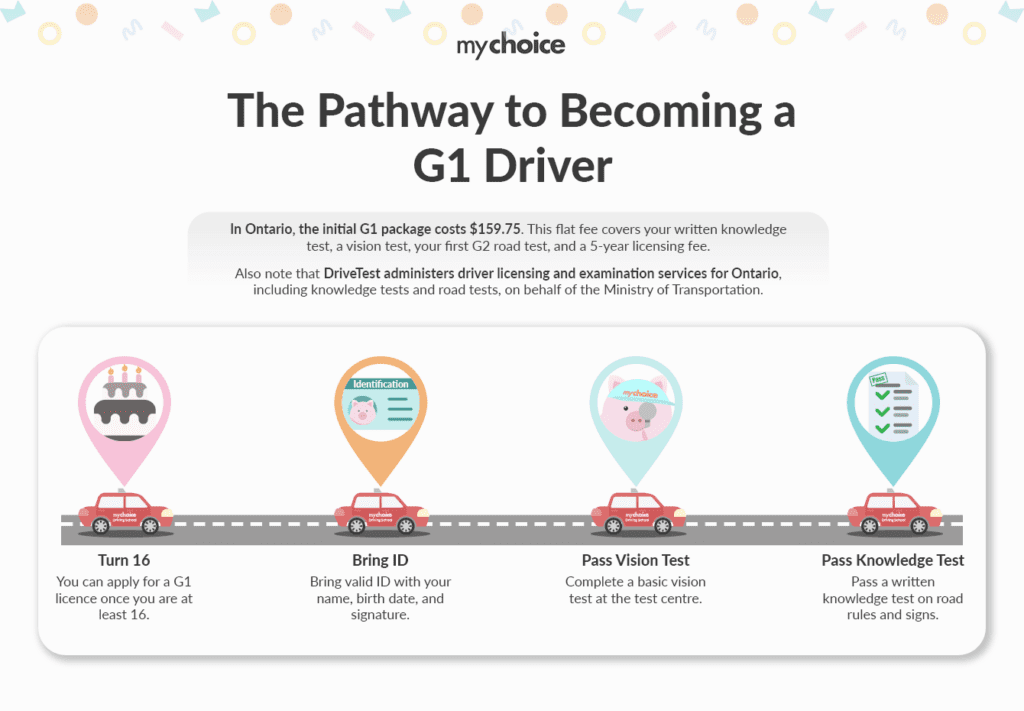
To apply for a G1 licence, you must meet the following criteria.
Eligibility
- Applicants must be 16 years old or older.
- You’ll need to provide original identity documents that show your legal name and date of birth.
- Applicants must live in Ontario. As of May 11, 2026, each applicant must declare that Ontario is their primary residence and that they are legally present in Canada.
- You must take a vision test at the DriveTest centre.
- You must pass a written test on road rules and signs.
The Written Knowledge Test
The G1 knowledge test covers traffic signs and road rules. According to DriveTest, a total result of at least 80% is required to pass.
Cost
The Class G1 licence package is priced at $159.75 as of September 2026. That fee covers one attempt at the knowledge test, a five-year licence, and the Class G2 road test. The full Class G road test must be paid for separately.
How Ontario’s Graduated Licensing System Works
Ontario’s licensing system consists of two learning levels. You’ll start at Level 1 with your G1 licence, progress to Level 2 with your G2 licence and, after passing your second road test, receive your full G licence.
| Stage | Licence | What It Means |
|---|---|---|
| Level 1 | G1 | Learner’s permit. Driving is allowed only under its restrictions and with a supervising driver. |
| Level 2 | G2 | Intermediate licence. Supervision is no longer required, although zero-alcohol and the remaining novice-driver conditions continue to apply. |
| Full licence | Full G | Graduated licensing restrictions end once drivers have their full Class G licence. |
Ontario G1 Restrictions and Requirements
A G1 is a learner’s permit, so its holder must obey strict limits governing when, where, and how driving is permitted.
| Restriction | Details |
|---|---|
| Supervising driver required | The front passenger seat must be occupied by a fully licensed supervisor with at least four years of driving experience. The supervisor’s blood alcohol concentration must remain below 0.05, or at zero if they are 21 or younger. |
| No driving between midnight and 5 a.m. | Even when a supervising driver is present, G1 drivers are not allowed to drive during these hours. |
| Driving on highways | You can drive on 400-series highways, the QEW, Gardiner Expressway, Don Valley Parkway, E.C. Row Expressway and Conestoga Parkway when accompanied by an Ontario-certified driving instructor. |
| Zero blood alcohol | G1 drivers must always have a blood alcohol concentration of 0.00% when operating a vehicle. There are no exceptions to this rule. |
| Seatbelts for all passengers | All occupants must wear a working seatbelt. You can’t carry more people than there are working seatbelts. |
| No handheld devices | Ontario’s distracted-driving law makes it illegal to use or handle a mobile phone while driving. Drivers also cannot use handheld communication or entertainment devices while driving. Novice drivers receive escalating suspensions for violating this law rather than demerit points. |
These requirements are outlined in Ontario’s G1 licensing rules.
How Many Passengers Are Allowed With an Ontario G1 Licence?
A G1 driver’s passenger limit is the number of working seatbelts. The supervising driver must have a full licence and at least four years of experience, occupy the front passenger seat, and be the only other person seated in front. That supervisor must have a blood alcohol concentration below 0.05, or zero if they are 21 or younger.
Are You Allowed to Buy a Car as a G1 Licence Holder?
Someone holding a G1 may purchase a vehicle, although a dealer or lender may set conditions for the sale or financing. Ontario registration requires acceptable identification and proof of insurance.
Do G1 Drivers Need Insurance?
Valid insurance is mandatory for every vehicle used on an Ontario road. Rather than purchasing a separate learner policy, a G1 driver typically practises under the vehicle owner’s coverage. Before any driving begins, the policyholder should ask the insurer whether the G1 driver must be listed and whether adding them changes the premium.
How Demerit Points Affect G1 Drivers
G1 drivers have lower demerit-point thresholds than drivers with a full licence.
| Demerit Points | What Happens |
|---|---|
| 2–5 points | The Ministry of Transportation sends you a warning letter. |
| 6–8 points | You will receive a second warning letter from the Ministry of Transportation. |
| 9+ points | Your licence will be suspended for 60 days. |
A novice driver who violates a graduated licensing rule or commits an offence carrying four or more demerit points may also face Ontario’s escalating sanctions:
- First conviction: 30-day licence suspension.
- Second conviction: 90-day licence suspension.
- Third conviction: novice licence cancellation. The driver must reapply and restart the graduated licensing process.
See Ontario’s current demerit-point rules for novice drivers.
Should You Go to Driving School?
If a Beginner Driver Education course is approved by the Ministry, completing it may provide the following benefits:
1. Your waiting time to take the G2 road test will be reduced to eight months after getting your G1. Otherwise, the waiting period is 12 months.
2. A BDE graduate might also become eligible for an insurance discount. Some insurers offer one, but the eligibility rules, value, and duration differ by company.