









Auto insurance can be filled with complicated terminology, so it’s no surprise that acronyms like PLPD might confuse some drivers. If you’ve ever been told that you “only need PLPD” or have seen it described as the cheapest insurance option, you might be wondering what exactly PLPD includes and what it doesn’t.
What does PLPD mean? Do you need it to drive in Ontario? Are there benefits to getting more coverage? Read on to learn how much protection it provides and whether PLPD-only coverage is enough for your vehicle.
PLPD Insurance at a Glance
PLPD stands for Public Liability and Property Damage. It’s an informal term used to describe the basic level of auto insurance required in Ontario.
You’re legally required to carry automobile insurance before driving in Ontario.
PLPD generally does not cover damage to your vehicle after an at-fault or single-vehicle accident. You would need Collision or All Perils coverage for that.
Direct Compensation Property Damage may cover your vehicle when another driver is at fault, but Ontario drivers can decline it by signing OPCF 49.
What’s Included in PLPD Coverage?
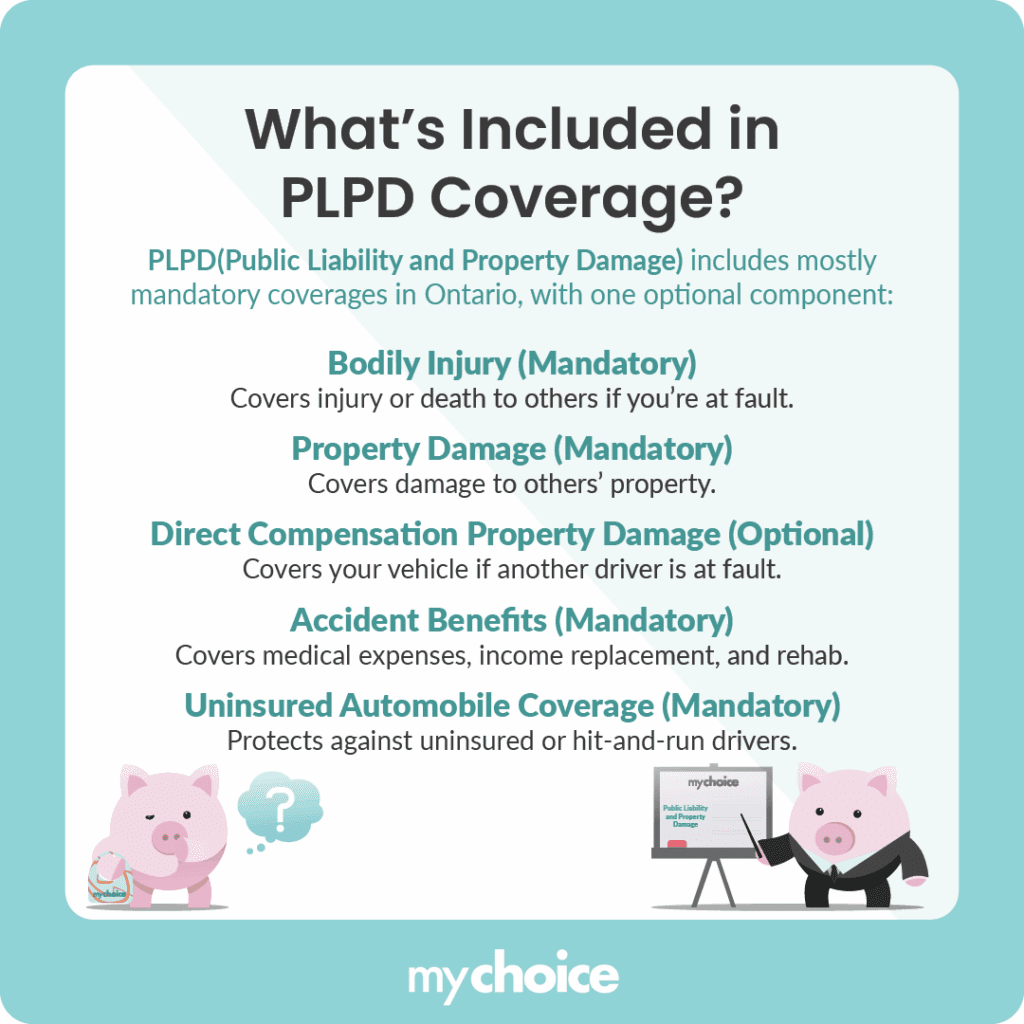
PLPD coverage includes several components, most of which are mandatory under Ontario law. Direct Compensation Property Damage is included in a standard policy, but you can agree not to recover under it by signing Ontario Policy Change Form 49.
Here’s a breakdown of the coverage:
| Coverage | Status | Description |
|---|---|---|
| Third-party liability | Mandatory | Covers injury, death or property damage for which you are legally responsible |
| Direct Compensation Property Damage | Included unless OPCF 49 is signed | May cover your vehicle, its contents and loss of use when another insured driver is at fault and the coverage conditions are met |
| Accident benefits | Medical, rehabilitation and attendant care benefits are mandatory | Provides benefits to eligible people injured in an automobile accident |
| Uninsured automobile coverage | Mandatory | Provides protection in certain accidents involving an uninsured or unidentified driver |
What PLPD Does Not Cover
PLPD doesn’t cover damage to your car in most situations when you cause the accident. It also doesn’t normally cover theft, vandalism, fire or weather damage.
Here are some situations not covered by PLPD and the insurance you may need:
| Situation | Coverage to consider | Description |
|---|---|---|
| Your vehicle is damaged in an at-fault or single-vehicle accident | Collision | May pay for insured collision or upset damage |
| Your vehicle is stolen, vandalized or damaged by weather | Comprehensive | May cover theft, vandalism, fire, hail and falling objects |
| An at-fault driver has insufficient insurance for an eligible injury or death claim | OPCF 44R | Family protection coverage may cover an eligible shortfall |
| You drive, rent or lease a vehicle you don’t own | OPCF 27 | Extends specified coverage to qualifying non-owned vehicles |
| Your vehicle is unavailable after an insured loss | OPCF 20 | Pays eligible replacement-transportation expenses within the stated limits |
| You want protection from certain depreciation deductions | OPCF 43 or 43A | Removes specified depreciation deductions for an eligible vehicle |
Should You Remove Direct Compensation Coverage?
Removing DCPD may reduce your premium, but you’ll be giving up important protection.
Before signing OPCF 49, consider the following:
- You won’t receive DCPD compensation for damage to your vehicle when another insured driver is at fault.
- You’ll also give up DCPD coverage for eligible damage to the vehicle’s contents and loss-of-use expenses.
- The saving may be small compared with the amount you would have to pay after an accident.
- You may not be able to recover the loss directly from the at-fault driver.
Who Should Consider PLPD-Only Coverage?
PLPD-only coverage may be worth considering for:
- Drivers of older vehicles with low market values;
- Drivers who can afford to repair or replace their vehicles without insurance; or
- Vehicles for which Collision and Comprehensive premiums are high compared with the possible claim payment.
You may want more than PLPD if:
- You rely heavily on your vehicle for work or daily life;
- You can’t afford an unexpected repair or replacement;
- Theft or weather damage is a concern;
- You drive a newer or more valuable vehicle; or
- Your vehicle is financed or leased.
A lender or leasing company may require Collision, Comprehensive or All Perils coverage. Check your agreement before removing anything.
PLPD Insurance vs. “Full Coverage”
PLPD and “full coverage” are informal terms. Their exact meanings can vary, so always check the coverage shown on your policy.
| Feature | PLPD insurance | What is commonly called “full coverage” |
|---|---|---|
| Third-party liability | Included | Included |
| Mandatory accident benefits | Included | Included |
| Uninsured automobile coverage | Included | Included |
| DCPD | Included unless OPCF 49 is signed | Included unless OPCF 49 is signed |
| Collision | Not included | Usually included |
| Comprehensive | Not included | Usually included |
| Damage to your vehicle after an at-fault collision | Not normally covered | May be covered |
| Cost | Generally lower | Generally higher |
“Full coverage” does not mean every possible loss is covered. Limits, deductibles, exclusions and endorsements still apply.