









As a car gets older, it’s normal for its owner to pay lower insurance premiums. An everyday vehicle’s resale value goes down as it ages. The replacement cost and the risk to the insurer are also reduced, so premiums typically follow suit. But what if a car becomes vintage or collectible? Should that car’s insurance premiums keep going down as well?
What Is Classic Car Insurance?
Classic or collector car insurance is specialized coverage for vehicles with collectible value that are generally not used as everyday cars. Depending on the insurer, it may differ from standard car insurance in how the vehicle is valued after a total loss, as well as its rules around annual use, storage and eligible drivers.
Classic car insurance can cost less than insurance for an everyday vehicle, largely because collector cars are often driven less frequently and used differently. However, reducing optional coverage simply because a vehicle is older can be risky. If your car has retained its value or become more desirable to collectors, dropping Collision or Comprehensive coverage could leave you paying a significant repair or replacement cost yourself.
Does My Car Qualify for Classic Car Insurance?
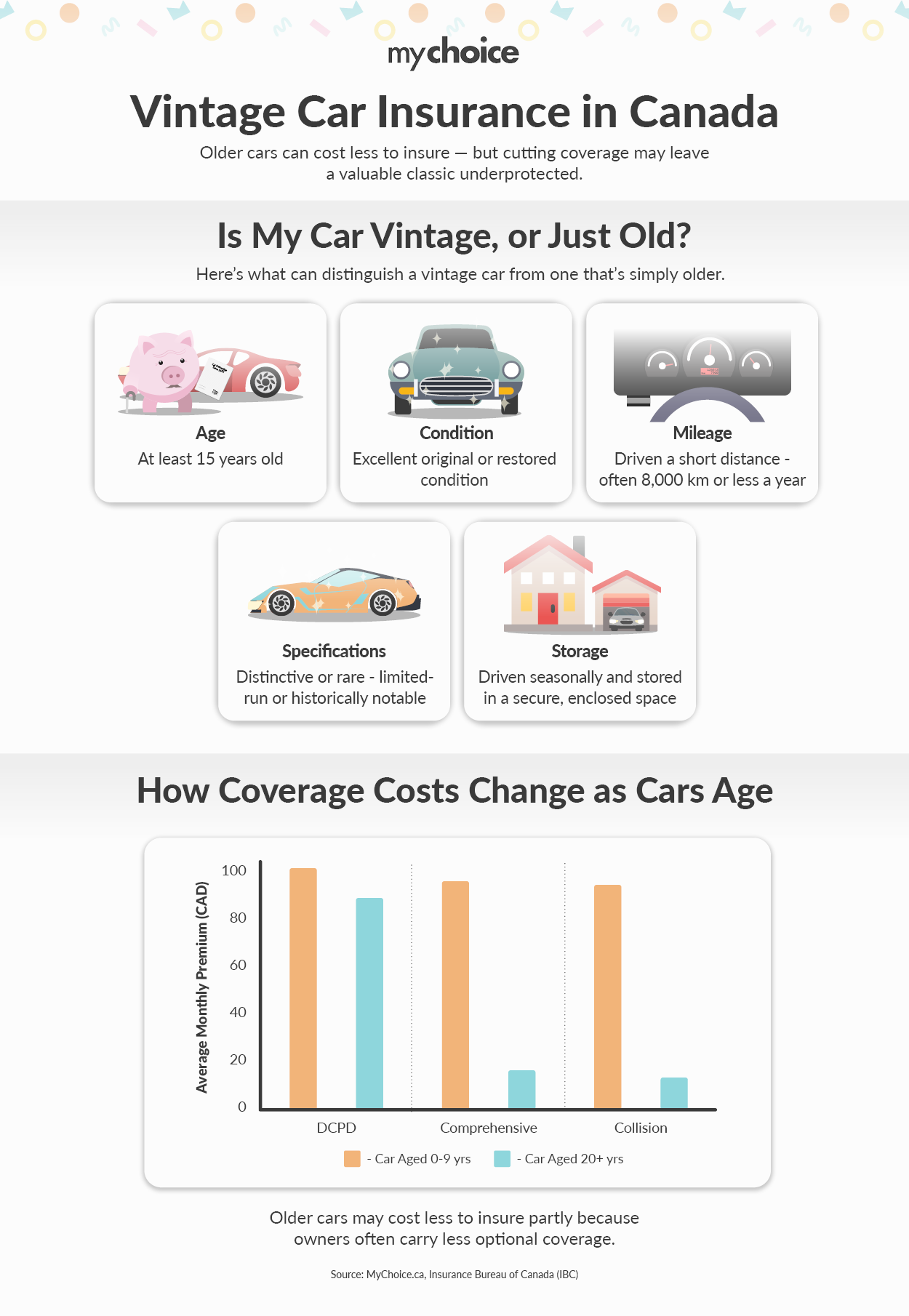
The factors that lead to a car being considered vintage go deeper than its age. Insurers may have different guidelines for categorizing a car as classic, vintage, or historic.
Depending on the insurer, factors used to qualify for collector car insurance may include:
- at least 15 years old
- in excellent original or restored condition
- driven a short distance annually, often 8,000 kilometres or less
- somehow unique (e.g., limited run, historically significant, few remaining examples, etc.)
- driven seasonally and/or stored in a secure and enclosed space such as a garage or dedicated facility
Enthusiast vehicles and newer cars with future potential as collectibles may also merit specialized valuation and insurance coverage.
Owners Tend to Drop Coverage as Their Cars Age
MyChoice.ca data shows that car owners tend to remove vehicle-damage coverage as their vehicles get older.
We analyzed our quote database using an Ontario driver’s standard profile as our benchmark: aged 35 to 44 years with a clean driving record, licensed for five years or more with three or more years of continuous insurance, and owning a vehicle worth $60,000 or less covered with standard liability and $1,000 deductibles.
How Many Drivers Are Keeping the Coverage?
| Vehicle Age | % of Drivers Keeping DCPD Coverage | % of Drivers Keeping Collision Coverage | % of Drivers Keeping Comprehensive Coverage |
|---|---|---|---|
| 0–9 years | 99.6% | 94.0% | 94.2% |
| 10–19 years | 90.8% | 38.3% | 40.4% |
| 20 years | 88.6% | 15.7% | 17.3% |
| 25+ years | 87.7% | 19.2% | 23.3% |
Read More: Should You Keep Collision Coverage on an Older Vehicle?
While 99.6% of drivers fitting this profile choose Direct Compensation Property Damage (DCPD) coverage on vehicles aged 0-9 years, this figure drops to 88.6% once the car is at least 20 years old. For Comprehensive coverage, those numbers go from 94.2% for cars aged 0-9 years to 17.3% after 20 years. Collision coverage sees the most significant drop, from 94.0% for 0-9-year-old cars to 15.7% for 20-year-old cars.
This can be a smart financial decision for a low-value vehicle you can afford to replace. But for a car that’s increasing in value, removing Collision, Comprehensive, All-perils, Loss-of-use, or other vehicle-related endorsements can leave you exposed to huge losses and out-of-pocket repair expenses.
Premium Breakdown by Car Age
Our data shows that standard coverage for older cars may not be as costly as some drivers think. Using the same Ontario driver profile, the average premium for a car aged 0-9 years with mandatory, DCPD, collision, and comprehensive coverage produces an estimated annual premium of $2,125. Under the same conditions, a car that’s 25 years old or more returns a premium of $1,733. That’s $392 less per year, or a reduction of 18.4%, while keeping the same four coverage components in our comparison.
| Vehicle Age | Legally Required Coverage | DCPD | Collision | Comprehensive | Four-Component Subtotal |
|---|---|---|---|---|---|
| 0–9 years | $1,038 | $624 | $266 | $197 | $2,125 |
| 10–19 years | $1,497 | $381 | $129 | $57 | $2,064 |
| 20–24 years | $1,557 | $257 | $68 | $30 | $1,912 |
| 25+ years | $1,422 | $185 | $102 | $24 | $1,733 |
Read More: What Other Coverages Are Available for Drivers in Ontario?
What Type of Insurance Does My Vintage Car Need?
Regardless of your vehicle’s age or status, you must hold mandatory auto insurance coverage to drive a vintage car anywhere in Canada, just as with any vehicle type.
In addition, the Insurance Bureau of Canada identifies classic cars as seasonal vehicles and recommends holding comprehensive coverage even while they are stored. This adds protection for situations like theft, vandalism, and damage from external sources like fire or flooding.
If your car is worth more than other vehicles of its age and condition and its value is increasing, and if your usage aligns with the typical guidelines for insuring classic cars, specialized collector car insurance may be worth considering. Some features to look for that are unique to this type of coverage include:
- the policy starts with an agreed value for the car that is not subject to depreciation
- weekend leisure drives are permitted in addition to parades and car shows
- repairs can be completed by you or at the shop of your choice