









Do I Need Car Insurance as a G2 Driver?
Every vehicle driven on Ontario roads must be insured. Drivers with a G2 licence can drive on their own, so they must be covered by the vehicle’s insurance policy. There are no insurance products specifically for G2 drivers. You will have access to the same auto insurance options as fully licensed drivers.
The cost of auto insurance depends on the insurer and factors such as the driver’s age, driving history, location and type of vehicle. Generally, G2 drivers pay more because they haven’t been driving for very long and have less experience.
10 Cheapest Cars to Insure for G2 Drivers in Ontario
The insurance premiums below are taken directly from our database of Ontario auto insurance quotes. We looked at a standard G2 driver profile: someone under the age of 25 with a limited insurance history and a full car insurance package, including Collision and Comprehensive coverage.
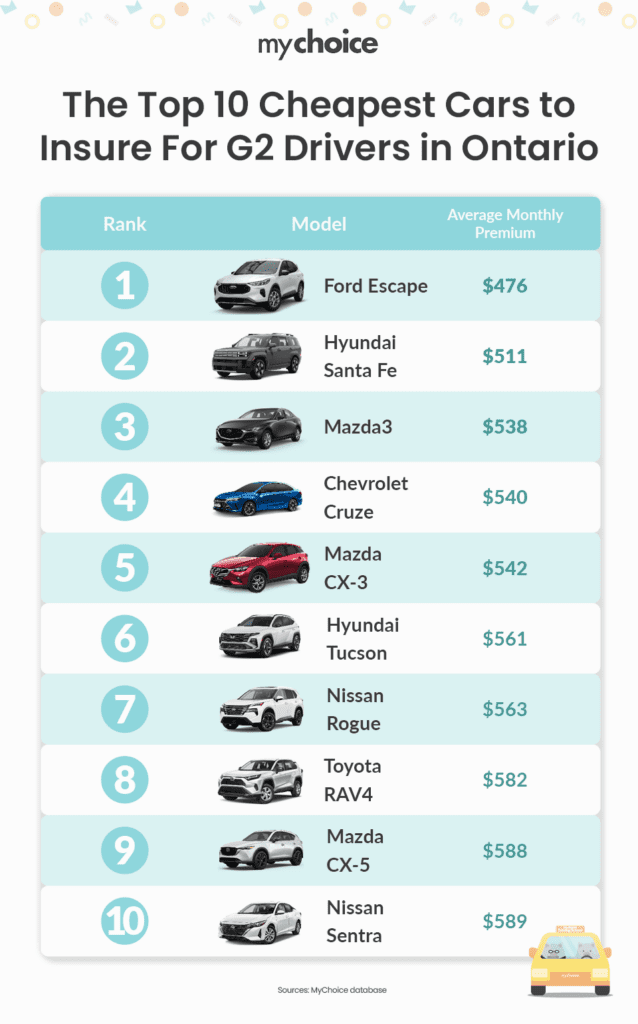
The Ford Escape is the cheapest vehicle to insure for the G2 driver profile we reviewed.
| Car model | Median monthly insurance premium |
|---|---|
| Ford Escape | $476 |
| Hyundai Santa Fe | $511 |
| Mazda Mazda3 | $538 |
| Chevrolet Cruze | $540 |
| Mazda CX-3 | $542 |
| Hyundai Tucson | $561 |
| Nissan Rogue | $563 |
| Toyota RAV4 | $582 |
| Mazda CX-5 | $588 |
| Nissan Sentra | $589 |
Source: MyChoice Quotes Database, 2026.
Why G2 Drivers Face Some of Ontario’s Highest Insurance Costs
Having your own car insurance policy as a G2 driver is expensive. Higher premiums make sense when you consider how little driving experience most G2 drivers have.
If a G2 driver only uses someone else’s vehicle occasionally, they may be listed as an occasional driver on that person’s policy. A G2 driver in the GTA using a newer car with full coverage may pay far more than another G2 driver in a less expensive area who occasionally drives a family car.
Below are some reasons why G2 drivers have higher insurance rates.
| Factor | Why it matters |
|---|---|
| Limited driving history | A limited driving history gives an insurer less proof that the driver can remain claim-free over time. |
| Age often overlaps with risk | Age plays a key role in insurance pricing. Most people with a G2 licence are on the younger side of the age demographic. |
| Independent driving begins at G2 | Because they may operate a vehicle without supervision, G2 drivers have greater exposure than G1 drivers. |
| Location matters | GTA drivers already face higher average premiums than the Ontario average. |
| Vehicle choice matters | Costs may rise when the vehicle is newer, more valuable, frequently stolen or costly to repair. |
| Coverage choices matter | Adding Collision and Comprehensive coverage will result in a higher auto insurance premium. Higher liability limits can also increase premiums. |
| Tickets and claims matter more early | An infraction, at-fault accident or licence suspension can increase your rates. |
Young drivers looking to lower their car insurance costs can start with our list of tips.
When Does It Make Sense to Add a G2 Driver to Your Policy?
A G2 licence holder who lives in your household or regularly uses your car should generally be disclosed to the insurer. How often they drive will usually determine whether the insurer lists them as the principal driver or an occasional driver.
| Situation | What to do |
|---|---|
| G2 driver lives in your household and may use the car | Notify the insurer about the driver and confirm whether they need to be listed on the policy. |
| G2 driver uses the car occasionally | That person may be added as an occasional or secondary driver on the policy. |
| G2 driver uses the car most often | If that person uses the vehicle the most, they will probably need to be listed as the principal driver. |
| G2 driver buys their own car | The usual requirement is a separate policy or a principal-driver rating on that vehicle. |
| G2 driver is away at school and rarely drives | Check with your insurer about its rules when someone else has occasional access to your vehicle. |
| G2 driver has tickets, claims or suspensions | Notify the insurer and confirm how the driver must be listed. |
Read More: Should You Add a G2 Driver to Your Policy or Get Them Their Own?
Ontario G2 Restrictions and Requirements
A G2 licence normally allows solo driving on every Ontario road and at any time of day. The driver must still maintain a zero blood alcohol level and cannot carry more passengers than the vehicle has working seatbelts. Anyone who is 19 or younger also faces additional passenger limits between midnight and 5 a.m. Ontario outlines the current G2 restrictions here.
The principal rules a G2 driver needs to remember are outlined below:
| Rule | What it entails |
|---|---|
| Driving alone | An experienced accompanying driver is no longer required once the motorist holds a G2 licence. |
| Roads | A holder of a G2 licence is allowed to drive on all roads in Ontario, including 400-series highways. |
| Time of day | Unless otherwise specified, there are no restrictions on the time of day that a G2 driver can drive. |
| Alcohol | A blood alcohol level of zero is mandatory for every G2 driver. |
| Seatbelts | Passenger capacity for a G2 driver is capped by the number of working seatbelts in the vehicle. |
| Drivers 19 and under | During the first six months, only one passenger aged 19 or under may be carried between midnight and 5 a.m. After six months, the limit increases to three. This rule does not apply when the passengers are immediate family members or when a fully licensed driver with at least four years of driving experience is in the front passenger seat. |
Can You Cross the Border With Your G2 Licence?
Before travelling, confirm that the province, territory or U.S. state recognizes an Ontario G2 licence and follow its local driving laws. You should always carry your driver’s licence, vehicle registration and proof of insurance.