









Top 10 Best Electric Trucks in Canada in 2026
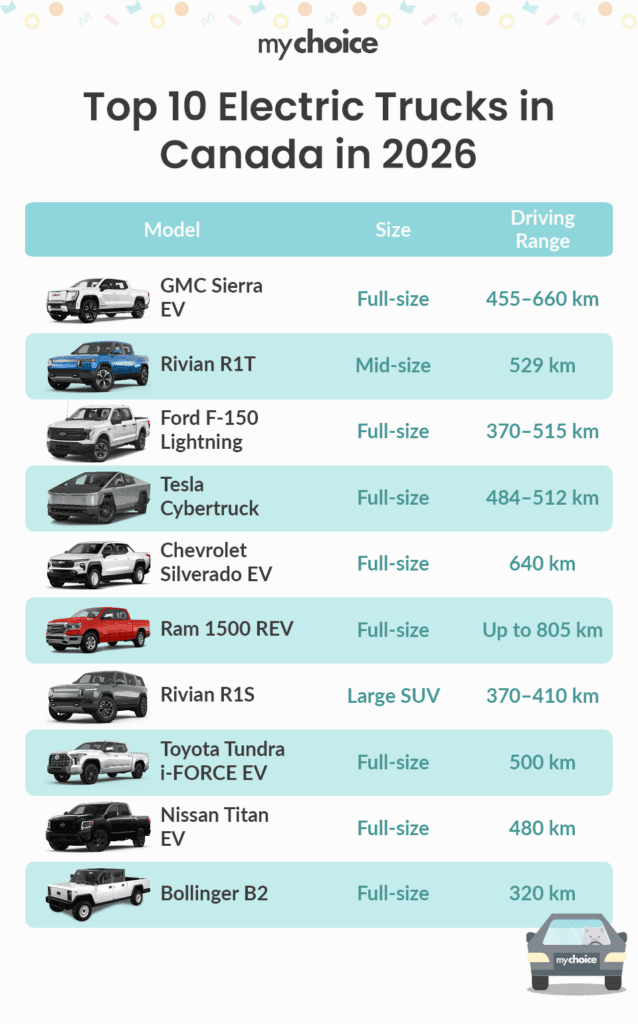
Our 2026 ranking identifies the best 10 electric trucks to buy in Canada. We considered the most relevant aspects for Canadian truck drivers, such as range, payload, towing ability, charging speed, price and value, reliability, and durability.
| Make and model | Driving range | Payload capacity | Towing capacity | Charging speed | Price and value | Reliability and durability | MyChoice score |
|---|---|---|---|---|---|---|---|
| GMC Sierra EV | ~455–660 km | Full-size class | Very strong | Up to 350 kW DC | High price, but strong value | Good (GM Ultium platform) | 9.2 |
| Rivian R1T | ~529 km | ~800 kg (~1,760 lbs) | ~11,000 lbs (~4,990 kg) | ~220 kW fast charge | Premium pricing | Newer brand, decent record | 9.0 |
| Ford F-150 Lightning | ~370–515 km | Competitive | Up to 10,000 lbs (~4,536 kg) | Strong charging network | Good value, broad availability | Excellent brand trust | 8.8 |
| Tesla Cybertruck | ~484–512 km | Solid bed and payload | ~11,000 lbs (~4,990 kg) | Up to 325 kW | Prices are very high in Canada | Mixed reliability record | 8.5 |
| Chevrolet Silverado EV | ~640 km | Full-size payload | Strong towing capability | ~350 kW | Its price is just under the Sierra EV | Proven brand | 8.3 |
| Ram 1500 REV | Up to 805 km | ~1,200 kg (~2,600 lbs) | Up to 14,000 lbs (~6,350 kg) | 350 kW DC fast charge | Competitive pricing (~$78K) | Good early build quality | 8.1 |
| Rivian R1S | ~370–410 km | SUV-based payload | ~7,700 lbs (~3,493 kg) | ~220 kW | Premium pricing | Good build quality | 7.8 |
| Toyota Tundra i-FORCE EV | ~500 km | Strong heritage truck | Strong towing and payload | TBD | Expected high resale value | Excellent brand reliability | 7.5 |
| Nissan Titan EV | ~480 km | Full-size class | Competitive tow rating | TBD | Early-market risk | Good brand reputation | 7.0 |
| Bollinger B2 | ~320 km | Very high utility payload | Heavy-duty towing | Industrial charging setup | High price, limited support | Niche startup brand | 6.8 |
1. GMC Sierra EV
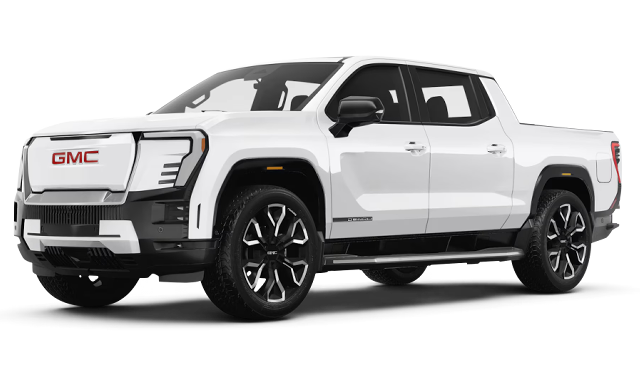
- Size: Full-size
- Range: Up to ~660 km
- Power: Estimated 754 hp and 785 lb-ft of torque in the top Denali Edition 1 trim
- Charging: Up to 350 kW DC fast charge
- Price: Starting around $107,000
Interestingly enough, GM’s advanced Ultium architecture gives the Sierra EV the capability of a full-size pickup and the polish of an upscale electric vehicle. The bidirectional capability is a nice feature, as charging can run tools or even supply a home, while strong acceleration, power, and range make it an appealing Canadian choice for buyers seeking toughness with luxury.
2. Rivian R1T
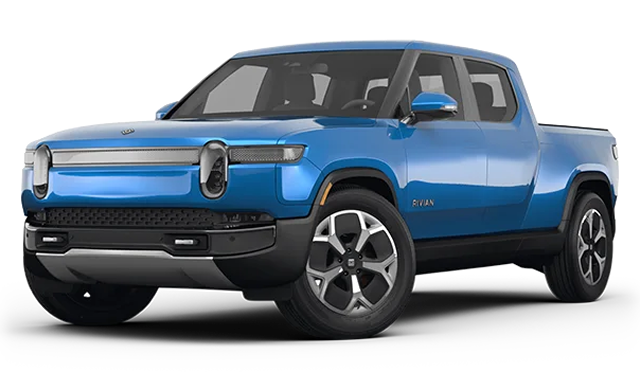
- Size: Mid-size
- Range: 435–529 km
- Power: 533 hp base to 835 hp quad-motor
- Top speed: 200 km/h
- Acceleration: 0–100 km/h in 4.6 seconds
- Price: Starts at approximately $101,900
Rivian effectively created the adventure-oriented electric pickup category with the R1T. Amazon-backed Rivian was the first automaker outside Detroit to take the coveted MotorTrend Truck of the Year title since 2008. The R1T is a full-size electric pickup that checks all of the capability boxes you’d expect, including up to 11,000 lbs of towing, adjustable air suspension, selectable terrain modes, and an innovative “gear tunnel.” Its panoramic glass roof and understated wood accents give the cabin a very outdoorsy, up-to-the-minute feel.
3. Ford F-150 Lightning
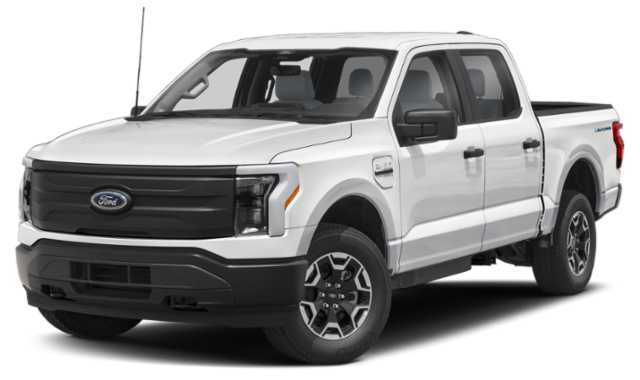
- Size: Full-size
- Range: 370–515 km, depending on the battery
- Power: Up to 580 hp and 775 lb-ft of torque
- Towing: Up to 10,000 lbs (4,536 kg)
- Charging: 150 kW DC fast charge
- Price: Starting around $69,000
The Ford F-150 Lightning remains one of Canada’s most familiar electric trucks. Its proven foundation delivers quiet operation, immediate torque, and enough strength for a sizeable trailer. The battery can also back up a home during rural or storm-related outages, and Ford continues to provide strong parts and service support nationwide.
4. Tesla Cybertruck
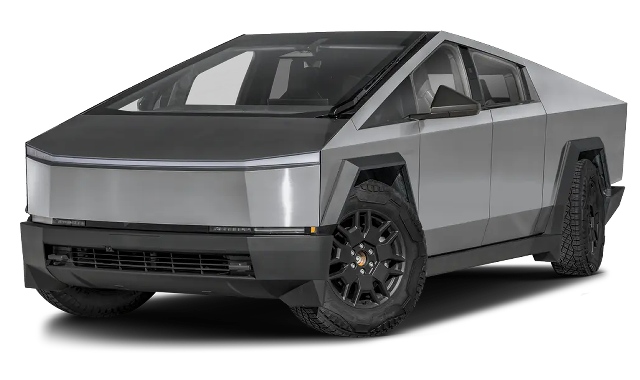
- Size: Full-size
- Range: ~484–512 km
- Power: Up to 845 hp
- Acceleration: 0–100 km/h in approximately 2.7 seconds in Cyberbeast trim
- Charging: Up to 325 kW DC fast charge
- Price: From approximately $108,000
Downsides include the Cybertruck’s size and sticker price, since it’s a “statement truck,” and the fact that Tesla lags traditional automakers when it comes to reliability. But it’s exceptional to drive, and Tesla’s frequent over-the-air updates will only make it better. Plus, the stainless-steel body and air suspension make for a futuristic ride.
5. Chevrolet Silverado EV
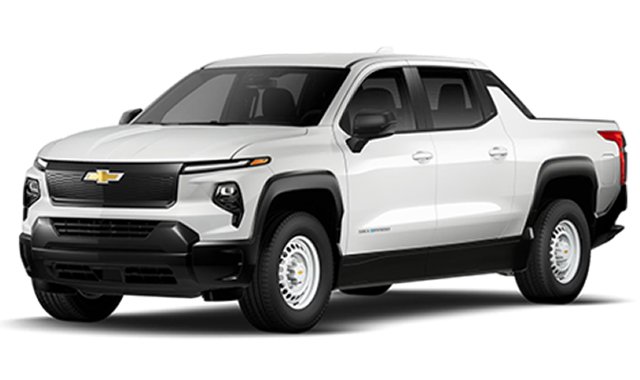
- Size: Full-size
- Range: Up to 640 km
- Power: Up to 754 hp and 785 lb-ft of torque
- Towing: Up to 10,000 lbs
- Charging: Up to 350 kW Price: Starting around $95,000
The Chevrolet Silverado EV is spacious throughout, with a big midgate to haul longer items and a roomy cabin. It is similar under the hood to the Sierra EV but targets a different segment. It’s an electric truck for the person looking for a capable, affordable workhorse that has reassuring tow ratings for long-term ownership.
6. Ram 1500 REV
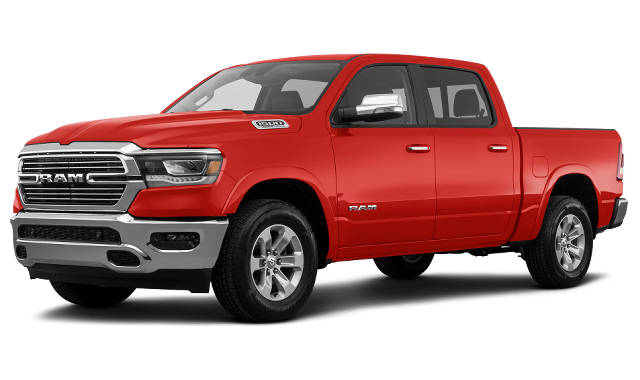
- Size: Full-size
- Range: Up to 805 km with the optional long-range battery
- Power: 654 hp and 620 lb-ft of torque
- Towing: Up to 14,000 lbs (6,350 kg)
- Charging: 350 kW DC fast charge, adding approximately 175 km in 10 minutes
- Price: Approximately $78,000
With the optional long-range battery, the Ram 1500 REV can travel up to 805 km and offers best-in-class towing for demanding jobs or recreational hauling. Its cabin blends function with luxury through a 14.5-inch touchscreen, digital gauges, and an available hands-free driving assistant.
Canadian drivers have long valued Ram’s gasoline pickups for comfort and ability, and the first REV prototypes display similar refinement and sound construction. The Ram 1500 REV is therefore worth watching for buyers who want substantial strength without tailpipe emissions.
7. Rivian R1S
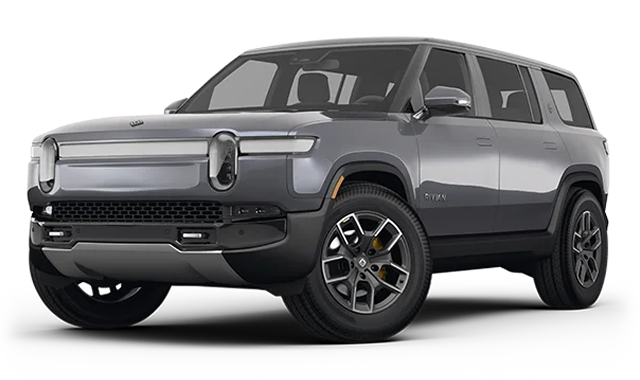
- Size: Large SUV (truck-based)
- Range: 370–410 km
- Power: 533–835 hp
- Towing: 7,700 lbs (3,493 kg)
- Price: Starts around $99,000
The R1S is the SUV counterpart to Rivian’s R1T, using the same quad-motor system and off-road capability while adding passenger space. Its sturdy build and capable winter manners suit active Canadian families that value versatility more than an open cargo bed.
8. Toyota Tundra i-FORCE EV
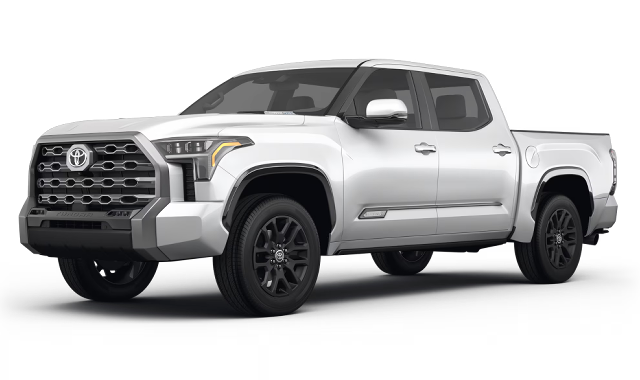
- Size: Full-size
- Range: Approximately 500 km
- Power: TBD, expected to exceed 450 hp
- Towing: Likely over 10,000 lbs
- Price: Approximately $75,000
Toyota’s Tundra i-FORCE EV is expected to carry the gasoline Tundra’s established toughness into an electric model, combining substantial towing ability with greater efficiency and comfort. Buyers can anticipate a useful layout, technology influenced by hybrids, and the durability and resale strength associated with Toyota trucks in Canada.
9. Nissan Titan EV
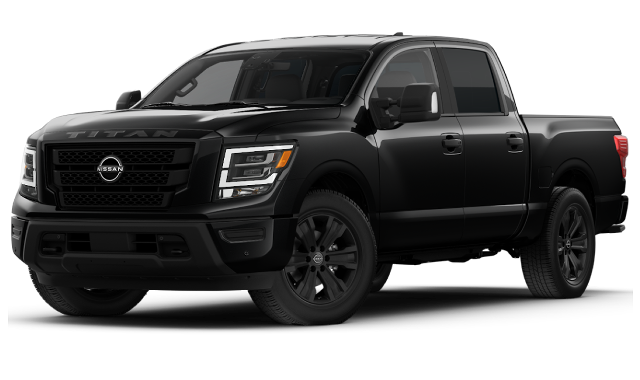
- Size: Full-size
- Range: Approximately 480 km
- Power: Likely in the 400–500 hp class
- Towing: Up to 10,000 lbs
- Price: Around $70,000
Nissan also plans to offer an electrified version of its full-size truck, the Titan, that will go up against Ford and GM. Details are scant at this point regarding the Titan EV, but Nissan scored well in the 2025 dependability rankings. The Kicks SUV topped its segment, and the Murano was number one in its class. If that continues, the Titan EV could be a reliable alternative at a good price.
10. Bollinger B2
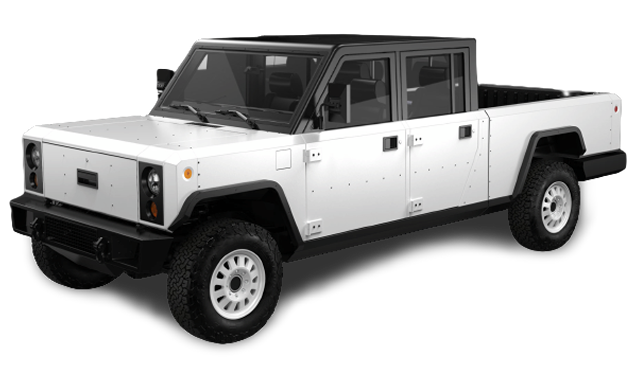
- Size: Full-size, industrial-grade
- Range: Approximately 320 km
- Power: 614 hp and 668 lb-ft of torque
- Towing: 7,500 lbs (3,402 kg)
- Payload: Approximately 5,000 lbs (2,268 kg)
- Price: Approximately $125,000
Straightforward and durable, Bollinger’s utilitarian EV is designed with commercial uses and off-grid applications in mind, making compromises in areas like range and comfort. Its boxy aluminum body has several clever touches, including a full-length cargo pass-through from the front of the truck to the bed for transporting extra-long items. The body panels are removable.
Our Methodology for Ranking Electric Trucks in Canada
Read on for a closer look at each criterion and how we use it to develop each vehicle’s MyChoice Score, including what weight we’ve given each item and why.
Why Should You Consider Buying an Electric Truck in Canada?
Electric pickups have developed rapidly in Canada, and the latest generation now offers capability, range, and comfort that can equal or exceed gasoline-powered alternatives.
Electric trucks can suit Canadian drivers for several reasons:
- Home charging, especially overnight, usually costs less per kilometre than gasoline or diesel. With no oil changes, fewer moving components, and reduced brake wear from regenerative braking, maintenance needs are lighter as well.
- Electric torque means more control and stability in challenging situations like towing or driving up or down hills. It also means quicker acceleration.
- Electric propulsion works without motor roar or high exhaust emissions, an advantage for your personal carbon footprint.
- Several technologies help modern electric trucks perform well in snow and ice, including heat pumps, traction systems, and battery preconditioning.
- Provincial EV rebates are available in many jurisdictions, while federal programs may reduce the purchase cost further.
Are Electric Trucks Expensive to Insure in Canada?
Generally, EV insurance costs slightly more than coverage for a comparable gasoline truck because the vehicles, repairs, and replacement components are more expensive.
One feature that’s common among EVs is Advanced Driver-Assistance Systems (ADAS), which may reduce the likelihood of an accident. Some insurers offer discounts for policies with ADAS.
Prospective EV-truck buyers should compare quotes through MyChoice and ask about EV-specific savings.
Shopping for a new electric truck? Compare prices at MyChoice and find the best-value insurance company for you.