








According to the Ministry of Transportation’s 2022 Ontario Road Safety Annual Report, more than 12,000 collisions in the province that year involved wild animals. The risk is highest on forested roads and highways in central and northern Ontario, especially at dawn or dusk and during the autumn deer rut and migration. However, wildlife collisions can happen anywhere and at any time, and your auto insurance doesn’t automatically cover the damage. Here’s what you need to know.
The coverage definitions in this guide reflect Ontario’s standard auto insurance policy (the OAP 1) and guidance from the Financial Services Regulatory Authority of Ontario (FSRA), while collision-reporting rules follow Ontario’s Highway Traffic Act and the current property-damage reporting threshold. We also used proprietary MyChoice.ca Ontario quote data to estimate the average cost of Comprehensive coverage.
What Type of Auto Insurance Coverage Pays for Wildlife Collisions?
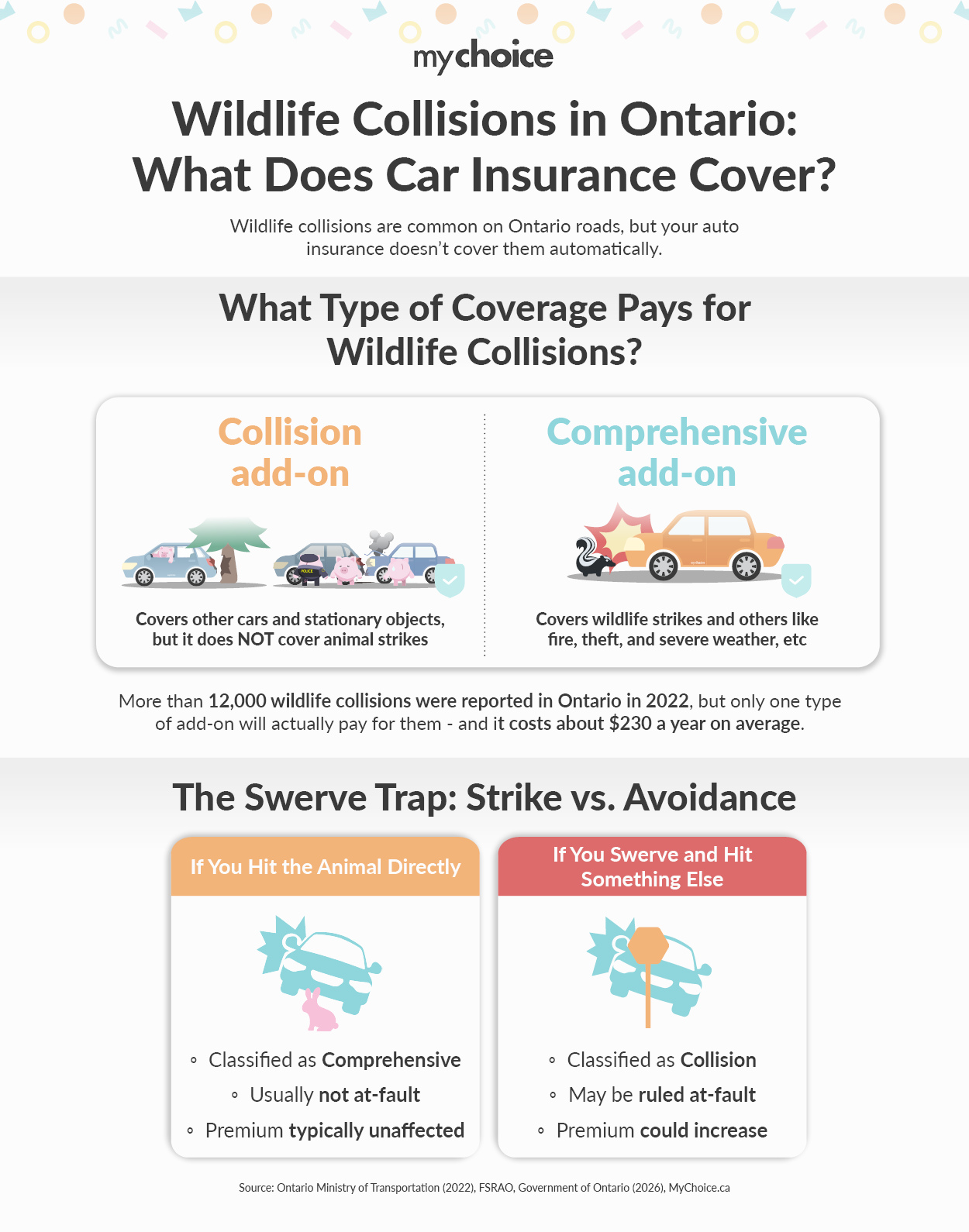
In Ontario, the mandatory auto insurance coverage alone won’t compensate you for any type of collision damage. Selecting a Collision add-on will provide coverage for incidents with other cars or stationary objects, but this doesn’t include animal strikes.
You’ll need a Comprehensive add-on to be covered for wildlife-related incidents, which also includes non-collision-related damage caused by situations like fire, theft, vandalism, and severe weather. As outlined by the Financial Services Regulatory Authority of Ontario, Specified Perils cover only named perils like fire and theft, not animal strikes, so you need Comprehensive car insurance coverage.
For most Ontarians, Comprehensive coverage is affordable and delivers great value. MyChoice.ca internal quote data shows the average insurance premium for Comprehensive coverage in Ontario costs about $230 per year.
The Swerve Trap: Strike vs. Avoidance
In some cases, a wildlife incident may be classified under Collision coverage. If you directly hit an animal such as a deer or moose but nothing else, this is covered under Comprehensive. However, if you swerve to avoid the animal and instead hit another vehicle or an object such as a tree, pole, or guardrail, the incident may instead be recorded as an at-fault collision.
Is a Wildlife Collision At-fault? Will it Raise my Premium?
A direct collision with a wild animal is generally treated as a Comprehensive claim, not an at-fault Collision claim. Because Comprehensive claims are handled differently from at-fault collisions, they are generally less likely to affect your insurance premiums.
The outcome can change if you swerve to avoid the animal. If you miss the animal but hit another vehicle, a tree, a guardrail, or another object instead, the claim is generally handled under Collision coverage. Depending on the circumstances and the provincial fault determination rules, a Collision claim may affect your driving record and could lead to higher premiums at renewal.
That’s why it’s generally recommended to brake firmly while maintaining control of your vehicle rather than making a sudden evasive manoeuvre, unless swerving is clearly the safer option. A controlled impact with a deer is often less dangerous than crossing into oncoming traffic or leaving the roadway.
Your Insurance Deductible: When to Claim or Pay Out of Pocket
The amount you set as your deductible at the start of your policy determines when it’s more practical to pay for damage yourself versus making an insurance claim.
If damage to the vehicle is minor and would cost less to pay for the repairs than your deductible, and if there are no other parties involved in the incident, you may choose not to submit a claim and cover the costs yourself. It’s also important to consider whether the crash would be considered an at-fault collision and could therefore trigger a premium increase. In this case, you may prefer to pay for the repairs even if they will cost more than your deductible to avoid inflating your insurance premiums in the future.
If the repairs will be more expensive than your deductible, particularly if the collision was with the animal only and will therefore be covered under Comprehensive, submitting a claim won’t affect your premiums and is the more cost-effective choice.
Read More: When to File a Claim and When to Pay out of Pocket
What to Do After You Hit an Animal
At the Scene
- Prioritize your safety. Put your hazard lights on and move the vehicle off the road if you can.
- Check yourself and your passengers for injuries. If anyone is hurt or the car can’t be moved and is creating a hazard, call 911 or local emergency services.
- Don’t approach the animal. Injured wildlife can react unpredictably when startled or threatened.
- Record the scene as best you can. Use your smartphone to capture photos and videos of vehicle damage, any markings or debris left on the roadway, and any wildlife warning signs nearby. Note the date and time, the location of the incident, the weather and lighting conditions, and the name, licence plate, make and model, and contact information of other motorists involved as well as that of any witnesses.
- Report the incident to the police if anyone has been injured or if your vehicle or any property has sustained more than minor damage. As of January 1, 2025, the Government of Ontario has redefined the threshold for minor damage in a collision as property damage of $5,000 or less.
Report the Incident to Your Insurer
If you plan to make an insurance claim, do so as soon as possible after the incident and submit all the information and photographs/videos you captured at the scene. Submitting a claim quickly can help speed up the process.