









Collision coverage provides a payout if your car collides with another vehicle or object.
This coverage is optional in Ontario unless required by a lender or lessor. The decision depends on factors such as vehicle value, deductible, premium and ability to pay for repair or replacement.
For this article, our team reviewed FSRA’s July 2026 Ontario Automobile Policy and Ontario’s Fault Determination Rules.
What Does Collision Coverage Include?
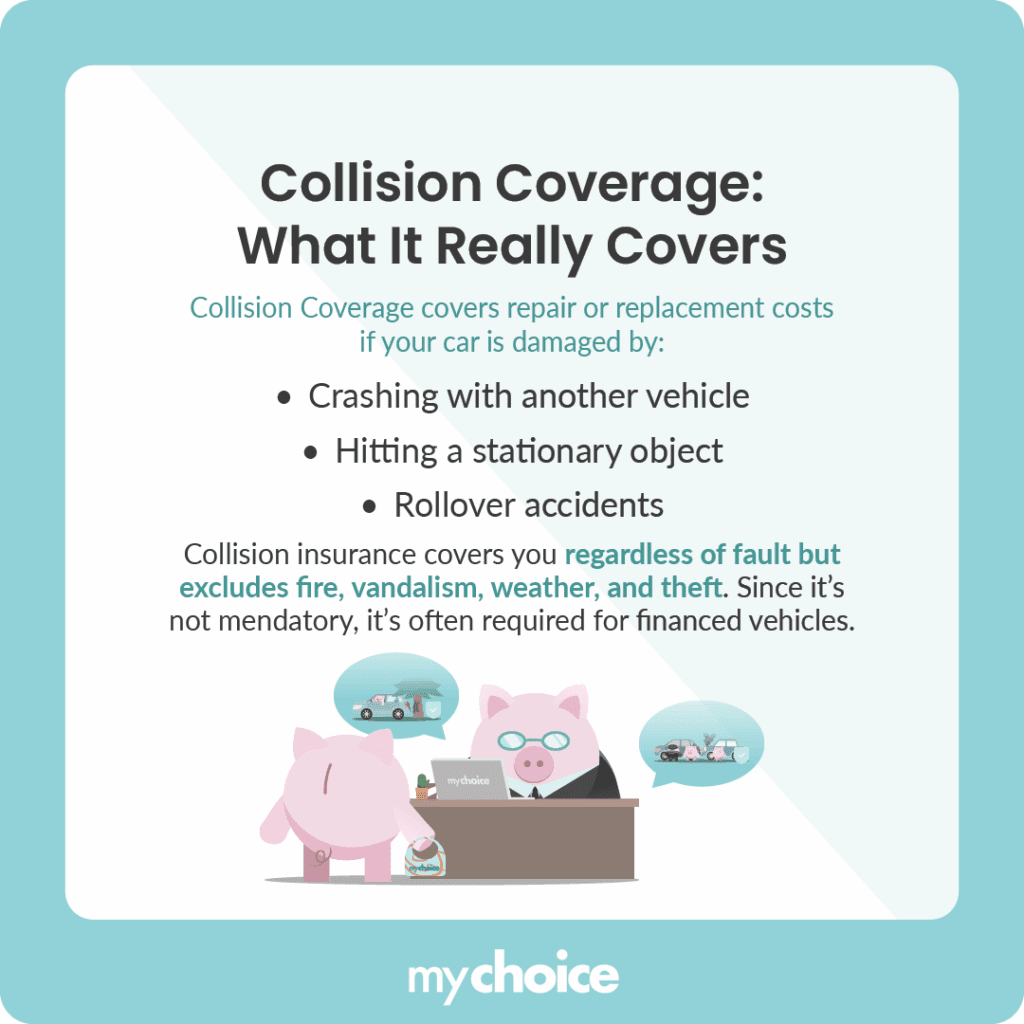
Collision or Upset coverage helps pay for repairs or replacement if your vehicle is damaged by striking or being struck by an object, contacting the ground or overturning. Collision coverage can pay for:
- Damage to your vehicle that is your fault in a multi-vehicle collision.
- The portion of vehicle damage not covered under Direct Compensation–Property Damage (DCPD).
- Damage to your vehicle from a single-vehicle collision, such as a rollover.
The object that causes collision damage can be another vehicle, a guardrail, a post or a pothole. Collision coverage doesn’t pay for damage from wear and tear, rust or mechanical failure unless a covered event caused the damage.
Is Collision Coverage Mandatory In Ontario?
No, Ontario doesn’t require drivers to carry collision coverage. However, if you elect not to recover under DCPD, your insurer cannot offer Collision or Upset coverage for that vehicle. FSRA’s July 2026 Ontario Automobile Policy states that an insurer must not issue Collision or Upset coverage when the policyholder opts out of DCPD recovery.
How Does A Collision Claim Get Paid?
In a total-loss claim, your insurer would pay the actual cash value of your car minus the collision deductible.
Could you afford a new or used car if your vehicle were written off after an accident? If not, you might want to carry Collision coverage.
For example, if an approved collision repair costs $9,000 and the deductible is $1,000, the collision portion can pay up to $8,000. If the car’s actual cash value is lower, the settlement can be lower, and the insurer may treat the vehicle as a total loss. Coverage, exclusions and any other applicable policy section still matter.
How Are Collision And DCPD Different?
| Coverage | When it responds | What to check |
|---|---|---|
| Direct Compensation– Property Damage (DCPD) | Your insurer handles covered vehicle damage for the share of an Ontario collision that is not your fault when the policy conditions are met. | Your fault percentage, DCPD deductible and whether you elected not to recover. |
| Collision or Upset | It handles the covered at-fault share and single-vehicle collisions or rollovers. | Your collision deductible, actual cash value and exclusions. |
| Comprehensive | It handles many non-collision causes, such as theft, vandalism, fire and falling objects. | The cause, comprehensive deductible and exclusions. |
| All Perils | It combines Collision or Upset and Comprehensive and adds certain theft protection. | The All Perils deductible and policy wording. |
Can An At-Fault Collision Affect Your Premium?
We analyzed 50,000 real car insurance quotes in Ontario collected through MyChoice’s car insurance quote comparison tool since the beginning of 2026. The comparison shows the difference between quotes for drivers with a clean record and those with one at-fault accident in Ontario.
The average car insurance rate in Ontario was $2,345 per year with a clean record. With one at-fault accident, quotes averaged $2,969 per year. That represents a difference of $624, or 26.6%.
Your own increase may be different because each insurer uses its own approved rates, and accident forgiveness may apply.
Read More: Learn About Car Insurance in Ontario
Should You Keep Collision Coverage?
Having collision coverage rounds out your protection, and keeping it is generally a good idea. However, you may need to remove some optional insurance protection to lighten the financial burden.
Dropping collision coverage is one of the ways you can cut back on insurance costs, but it needs to be done with consideration to ensure you don’t end up paying more than you need if you get into a car accident.
When to Keep the Coverage
- You can’t afford to repair or replace your car without insurance coverage.
- Collision coverage is part of your car loan or lease terms.
- You’re prone to getting into car accidents.
- You want the peace of mind that car insurance provides.
Read More: Is It Worth Having Collision Coverage On an Old Car?