









When a car is involved in a crash, there’s a hidden cost beyond the damage you can see. A car with an incident on its record may be worth less than one without, even when the repairs are performed well. Because of Ontario’s no-fault insurance system, it’s rare for drivers to recover post-accident depreciation. However, there are steps you can take in some cases to minimize your losses.
Why Is My Car Worth Less After an Accident?
When you submit an insurance claim for a crash, the damage and repairs may become associated with your car’s Vehicle Identification Number (VIN). This means anyone who checks a vehicle history report such as CARFAX may see that it was in an accident. Repaired vehicles may be perceived as more prone to issues and therefore less desirable as used cars than those with clean records. Your car’s actual cash value (ACV) may go down as a result.
Does Ontario Car Insurance Cover a Car’s Lost Value After an Accident?
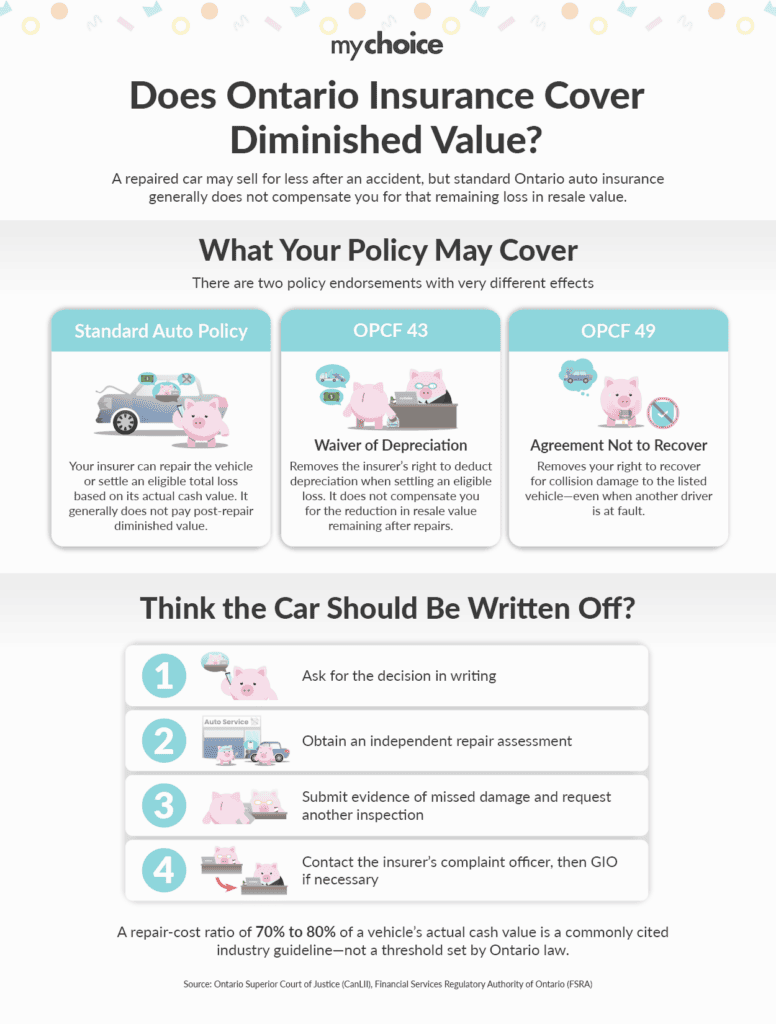
Generally, no. Under a standard Ontario Auto Policy as outlined in the Insurance Act, insurers decide whether to repair or write off an insured vehicle damaged in a crash. However, as confirmed in Ontario Superior Court case Zheng v. Certas Home and Auto Insurance Co, 2019 ONSC 2753, insured Ontario drivers do not have the right to recover lost vehicle value from insurers under the province’s claims process.
Does OPCF 43 Cover Diminished Value?
Not directly. OPCF 43 is a waiver of depreciation endorsement. If added to your insurance policy, it removes the insurer’s right to deduct depreciation when settling an eligible claim for loss or damage. It does not compensate for post-repair diminished value. It’s also different from Guaranteed Asset Protection (GAP) insurance: OPCF 43 can help protect a qualifying vehicle from depreciation deductions, while GAP insurance may pay the difference between a car’s ACV and the amount you still owe on its loan or lease.
Read More: OPCF 43 Endorsement Explained
What If I Signed OPCF 49?
OPCF 49 (aka removal of the DCPD coverage) is an Agreement Not to Recover for Loss or Damage from an Automobile Collision. If you chose this for your policy, you won’t receive compensation for collision damage to the listed vehicle, even if you are not at fault.
Can You Recover the Lost Value from the At-Fault Driver?
Generally, no. Under Ontario’s no-fault insurance system, you deal with your insurer and the at-fault driver deals with theirs. This is confirmed by Ontario Superior Court case Gordon-Taitt v. Travelers Canada Corp. and Jennifer Polak, 2022 ONSC 712, in which an appeals judge affirmed an earlier ruling that Ontario law “prohibits all tort actions for recovery of property damage against a negligent party.”
I Think My Car Should Have Been Written Off. What Can I Do?
Ontario law gives auto insurers the right to decide whether to repair crash-damaged vehicles or declare them a total loss (i.e., write them off). Insurers often consider whether the repair costs would exceed 70% to 80% of the car’s ACV, although this is an industry guideline rather than a legal threshold.
Read More: How Car Write-Offs Work
It’s the insurer that gets the final say. However, assessors and adjusters sometimes miss details that could make a difference in a repair or write-off decision. If you believe this has happened to you:
- Before signing a release or accepting a final payout, ask the insurer to explain its decision in writing.
- Get an independent and detailed repair assessment in writing from a mechanic or shop you trust. Take particular note of any less-obvious damage the assessor may have missed, such as hidden structural damage or higher-cost parts.
- If you’ve made documented upgrades to the car that could change the outcome of the decision, gather this documentation as well.
- Submit this new information to the insurance adjuster and request another inspection.
If the insurer still won’t budge, your options to escalate include contacting the insurer’s complaint officer, requesting a review from the General Insurance OmbudService, reporting possible regulatory non-compliance to the Financial Services Regulatory Authority of Ontario, or seeking legal advice.