









To drive on Ontario roads, you need a valid insurance policy. Learn what the minimum requirements include, how much the standard coverage costs and whether the legal minimum provides enough protection.
To prepare this guide, the MyChoice editorial team reviewed Ontario’s Insurance Act, the Compulsory Automobile Insurance Act, the Statutory Accident Benefits Schedule, the current Ontario Automobile Policy, and FSRA’s guidance on Ontario’s July 1, 2026 reforms.
What is a Minimum Auto Insurance Requirement in Ontario?
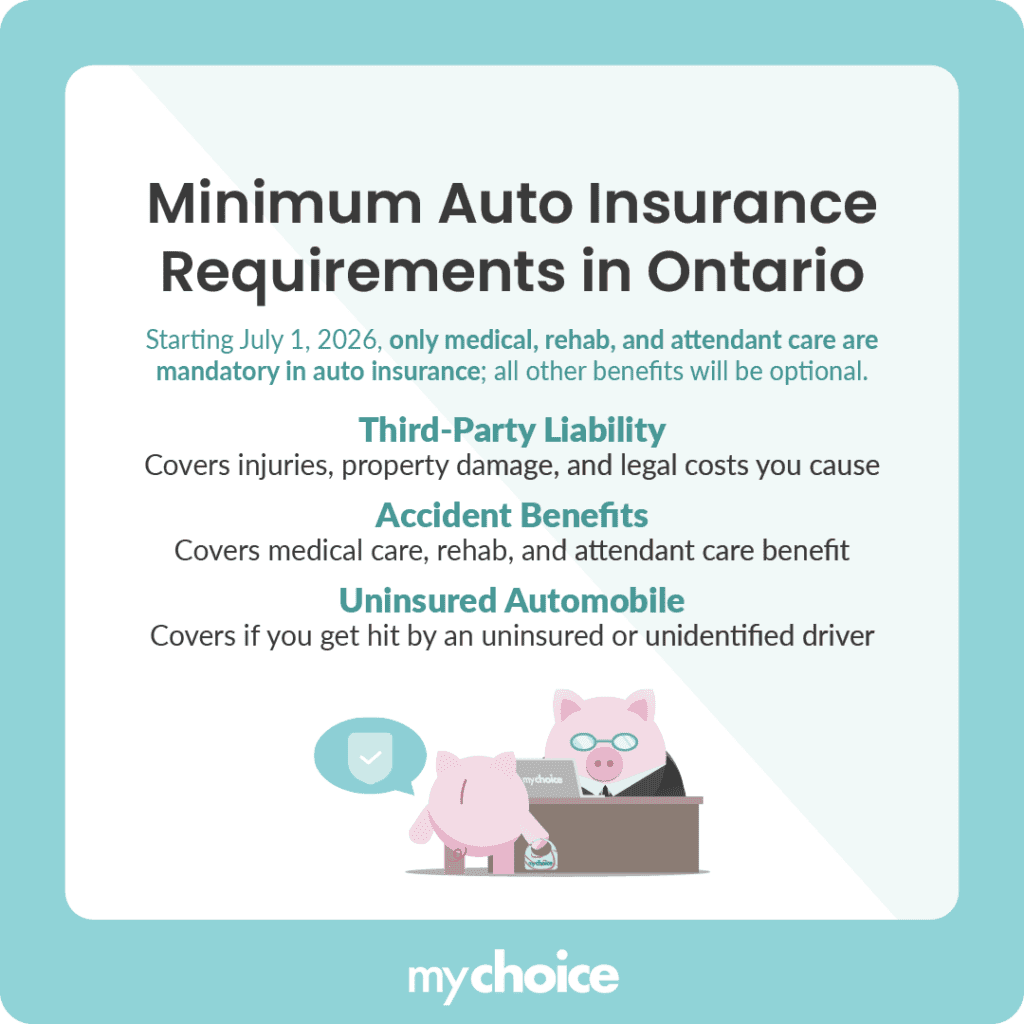
The legal minimum requirement for auto insurance consists of four mandatory coverages: third-party liability, accident benefits, uninsured automobile, and direct compensation property damage (DCPD). DCPD is automatically included unless you remove it by signing the OPCF 49 endorsement.
How Much Does Standard Car Insurance Cost in Ontario?
The table below shows average annual premium amounts allocated to the coverages automatically included in a standard Ontario policy.
| Coverage | What it covers | Average annual premium |
|---|---|---|
| Third-Party Liability | Injury or property damage you cause to others, plus legal costs | $297 |
| Accident Benefits | Medical, rehabilitation and attendant care benefits | $637 |
| Uninsured Automobile | Protection if you’re hit by an uninsured or unidentified driver | $17 |
| Direct Compensation– Property Damage | Damage to your vehicle in a qualifying collision when another driver is at fault | $523 |
| Standard Included Coverage | All listed coverages combined | $1,474 |
Since DCPD can be removed, the total shown above is not the lowest legally possible premium.
Most drivers choose additional coverage to protect their vehicles. For a breakdown of optional coverages, average premiums and rates by driver profile, see our Ontario car insurance overview.
Read More: 2026 Ontario Accident Benefits Reform Explained
Further Breakdown of What’s Included
Compulsory Third-Party Liability Minimums
For a single accident, you need at least $200,000 in third-party liability coverage. If a claim involves both property damage and bodily injury that reach the $200,000 limit, the amount available for property damage will not exceed $10,000.
A serious injury claim can exceed these limits, so many Ontario policies carry $1 million or $2 million in liability coverage.
Direct Compensation–Property Damage
When another driver is fully or partially at fault for a qualifying collision in Ontario, DCPD pays for damage to your vehicle, its contents and loss of use based on your percentage of fault.
Since January 1, 2024, drivers have been able to remove DCPD by signing OPCF 49. Doing so also removes Collision or Upset and All Perils coverage for the listed vehicle. You will not be compensated for collision damage to that vehicle even when another driver is entirely at fault.
Uninsured Automobile Coverage
Every Ontario policy protects you and your family if you’re injured or killed by an uninsured driver or by a hit-and-run driver who is not identified.
It may also cover damage to your vehicle when the uninsured driver is identified, subject to a $300 deductible. The standard limit is $200,000.
Medical, Rehabilitation and Attendant Care Benefits
For non-catastrophic injuries, the combined mandatory limit for medical, rehabilitation and attendant care is $65,000. For catastrophic injuries, the combined benefit is $1 million. Optional coverage can increase these amounts to $130,000 or $1 million for non-catastrophic injuries and $2 million for catastrophic injuries.
For new policies beginning on or after July 1, 2026, these are the only accident benefits that remain mandatory.
If an existing policy renews on or after July 1, 2026, its previous accident benefits generally continue as optional coverage unless the policyholder and insurer agree in writing to change or decline them.
Do You Need More Than the Minimum?
It depends. The standard package protects other people, provides medical and rehabilitation benefits and may cover your vehicle in a qualifying DCPD claim. It does not cover every loss.
Optional coverages worth pricing before you decline them include:
- Collision, which may cover your car when you cause a crash or the at-fault driver cannot be identified
- Comprehensive, which may cover theft, fire, vandalism, hail and other non-collision damage
- Higher liability limits
- Increased accident-benefit limits
- OPCF 44R Family Protection, which may provide additional protection when an at-fault driver’s liability coverage is insufficient
Lenders and leasing companies may require Collision and Comprehensive coverage as a condition of financing.
What Happens If You Drive Without Insurance in Ontario?
Driving without insurance is not a criminal offence in Ontario, but it can carry substantial penalties under the Compulsory Automobile Insurance Act:
- A first conviction carries a fine of $5,000 to $25,000.
- A subsequent conviction carries a fine of $10,000 to $50,000.
A victim fine surcharge is added to the fine. The court may also suspend your licence for up to one year and impound the vehicle for up to three months.
Read More: What Happens If You Drive Without Insurance in Ontario