









If you’re planning to import your dream car from overseas, you should know that doing so can affect your insurance options, costs, and coverage requirements. You’ll need to meet federal import rules, register it in your province, and find an insurer willing to provide coverage.
Our team reviewed Transport Canada’s vehicle import guidance, the Registrar of Imported Vehicles, the Canada Border Services Agency’s vehicle-import rules, and Ontario’s vehicle registration requirements in order to prepare this guide.
Read on to learn if insuring an imported car costs more, whether you can import cars from anywhere, and how to lower auto insurance premiums for imported cars.
Are Imported Cars More Expensive to Insure?
Yes, imported cars are usually more expensive to insure. Most imported vehicles fall into higher-risk categories, even if they’re in good condition. Here are some factors that play a part in the higher insurance premiums of imported cars:
- Repairs may be delayed or cost more due to the limited availability of parts.
- Some imports lack advanced safety features that lower premiums in domestic cars.
- Imported cars may be more prone to theft.
- If the model isn’t sold in Canada, insurers may not have sufficient actuarial data to estimate risks, resulting in a high-risk classification.
Read More: How Much Will Chinese EVs Cost to Insure in Canada?
Unique Insurance Hurdles for Imported Vehicles
Insurers usually consider imported cars a greater liability to cover. Here are a few challenges you might run into when looking to insure an imported vehicle:
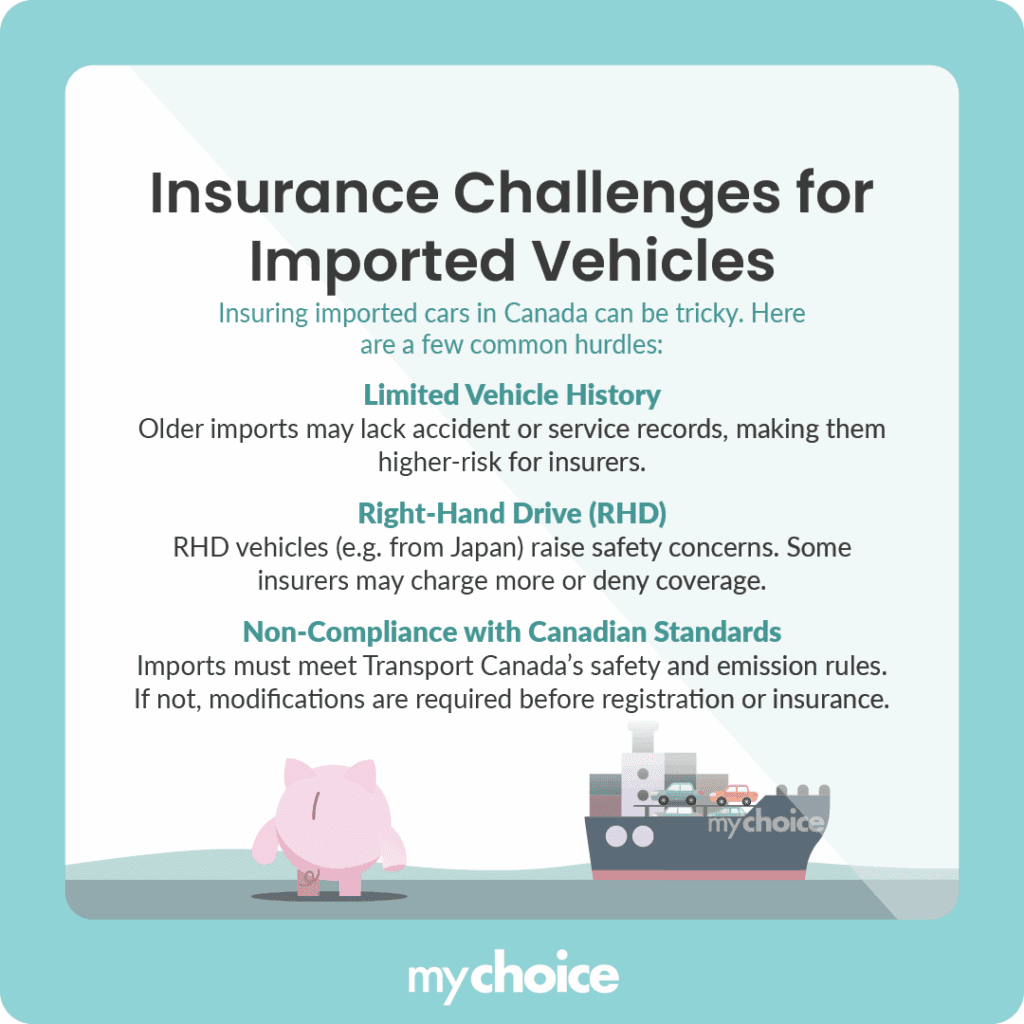
- Compliance with Canadian standards: Federal admissibility and modification requirements depend on the import route. Most vehicles built for markets outside Canada or the United States cannot be permanently imported unless a specific exemption applies, including certain vehicles that are at least 15 years old.
- Vehicle history verification: Older imported vehicles often lack accessible accident or maintenance histories. Without reliable records, insurers treat them as higher-risk assets.
- Right-Hand Drive (RHD) configuration: Vehicles imported from countries like Japan often have right-hand steering. Some provinces have safety concerns with RHD cars, and some insurers may charge extra or refuse coverage entirely.
How to Register & Insure an Imported Car Step-by-Step
The process of registering and insuring your imported vehicle depends a bit on where it’s coming from. Here’s a step-by-step guide to registering and insuring your newly imported car:
How to Lower Premiums on Imported Cars
Imported cars may typically cost more to insure, but there are a few ways to lower those premiums:
- Bundle your insurance policies: Combining auto, home, or tenant insurance with the same provider can net you serious discounts.
- Install a recognized anti-theft device: Ask the insurer for its written list of approved anti-theft or recovery systems for the exact vehicle and whether installation changes a discount, removes a theft surcharge or has no premium effect. Don’t rely on a vendor name alone.
- Increase your deductible: A higher deductible may reduce premium but increases the amount paid after a covered loss. Compare the documented annual saving with the added deductible and your ability to fund it.
- Pay per mileage: Ask your insurer whether an approved low-mileage, collector or usage-based option fits your situation and if you’re eligible for it.
Read More: Is My U.S. Car Insurance Valid in Canada?