









After the federal government’s 2026 trade reset with China, Canada announced an initial annual quota of up to 49,000 Chinese-made electric vehicles at a 6.1% tariff. The quota is expected to increase by 6.5% annually. This replaces the 100% surtax that was put in place in 2024.
This policy change could allow brands like BYD, MG and other Chinese EV makers to enter the Canadian market in larger numbers. However, Canadian claims data for those brands is currently too limited to show what they will actually cost to insure.
Read on to learn how the insurance estimates were calculated, why new vehicle models may cost more to insure and what could change when these vehicles become more common in Canada.
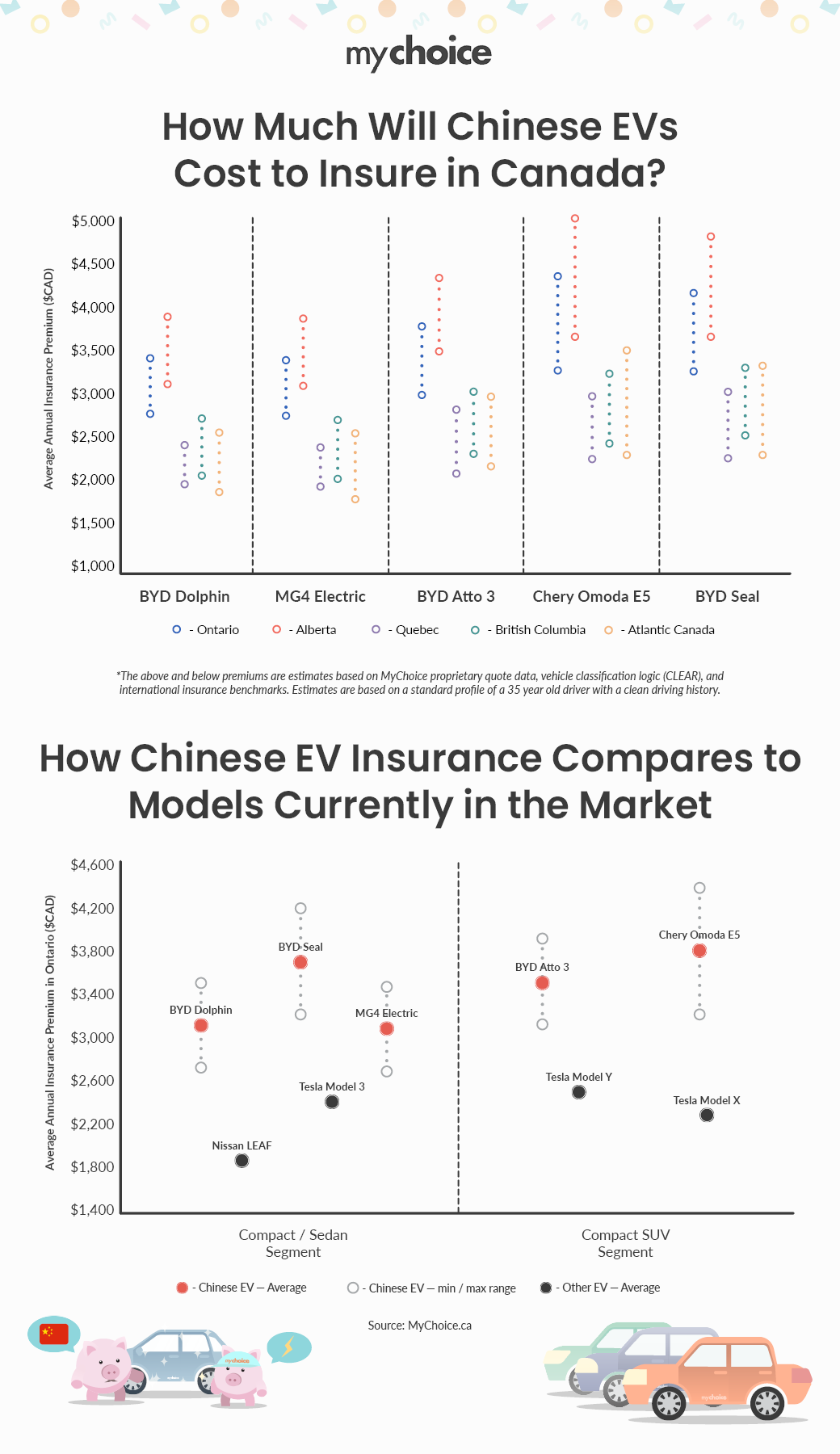
How Much Will It Cost to Insure a Chinese EV in Canada?
Since these vehicles are not yet widely available in Canada, the car insurance premiums below are estimates of what they might cost to insure.
| Model | Segment | Ontario | Alberta | Quebec | British Columbia | Atlantic Canada |
|---|---|---|---|---|---|---|
| BYD Dolphin | Compact hatch | $2,740–$3,480 | $3,126–$3,970 | $1,950–$2,450 | $2,050–$2,700 | $1,813–$2,573 |
| MG4 Electric | Compact hatch | $2,700–$3,450 | $3,100–$3,950 | $1,900–$2,400 | $2,000–$2,650 | $1,780–$2,550 |
| BYD Atto 3 | Compact SUV | $3,065–$3,850 | $3,495–$4,391 | $2,100–$2,750 | $2,300–$3,000 | $2,191–$2,951 |
| Chery Omoda E5 | Compact SUV | $3,226–$4,399 | $3,679–$5,019 | $2,250–$2,950 | $2,450–$3,200 | $2,311–$3,512 |
| BYD Seal | Midsize sedan | $3,226–$4,216 | $3,679–$4,810 | $2,300–$3,000 | $2,500–$3,300 | $2,311–$3,326 |
Estimated annual premiums for Chinese EVs in Canada from 2026 to 2028. These are MyChoice projections, not insurer quotes.
How We Estimated the Insurance Costs
Our methodology included our proprietary quote data, vehicle classification logic and international insurance benchmarks.
Establishing the Baseline EV Insurance Cost Across Canada
We reviewed the cost of insurance for electric vehicles available in Canada. Using thousands of quotes collected through MyChoice.ca in 2025, we focused on a standard driving profile to ensure consistency across provinces.
That profile included:
- A 35-year-old married driver
- Fully licensed
- Clean driving record
- Owns the vehicle outright
- Has comprehensive and collision coverage
ICBC insurance pricing data was used for British Columbia.
Analyzing CLEAR Pricing Logic
Insurance companies in Canada use the CLEAR framework, developed by the Insurance Bureau of Canada. It helps classify vehicles based on:
- Collision frequency
- Comprehensive loss exposure
- Theft risk
- Repair cost severity
When meaningful model-specific claims history is unavailable, CLEAR uses additional information to estimate loss costs.
For our projections, we mapped each model to comparable vehicles based on its segment, weight, MSRP and powertrain. We then applied a 20% early-market adjustment factor.
Read More: The Rising Cost of Car Repairs in Canada
Using International Benchmarks
We also examined markets where Chinese EV brands have already been sold in larger numbers. We used the relative differences between the models to help scale the ranges in our table rather than importing the international premiums directly. Policies in other countries include different coverages, so their premiums don’t translate directly to Canada.
Read More: Are Electric Vehicles More Expensive to Insure?
Why Budget EVs Won’t Automatically Be Cheap to Insure
Even if Chinese EVs are cheaper to buy, insurers still have to factor in repair costs, parts availability and limited Canadian loss data. That’s why early premiums may be higher than many drivers expect.
Even if a car costs $28,000 instead of $50,000, its insurance can still cost more. Insurance pricing depends on:
- Repair severity
- Parts logistics
- Calibration frequency
- Theft exposure
In some cases, lower-priced EVs may reach “economic total loss” thresholds more quickly if repair costs account for a high percentage of the vehicle’s value.
What Could Affect Premiums Over Time?
Four conditions could reduce premiums over time:
- CLEAR ratings are updated as Canadian claims data accumulates.
- Replacement parts are stocked in Canada rather than shipped from overseas, shortening repair times and reducing rental and storage costs.
- More independent repair shops become able to complete battery and ADAS calibration work.
- Theft and total-loss experience comes in at or below the averages for comparable vehicles.
Read More: EV Write-Offs Are Rising