









Between July 2025 and July 2026, the all-items Consumer Price Index rose 3.0%. Passenger-vehicle insurance premiums rose 6.1% over the year, while the price of passenger-vehicle parts, maintenance, and repairs rose 2.2%. Maintenance and repair services rose 3.7%, while the price of parts and supplies rose 1.2%.
For this analysis, our team downloaded Statistics Canada’s current CPI table 18-10-0004-01 and checked the July 2026 CPI release, AIA Canada’s workforce analysis and FSRA’s claims-cost guidance.
Before authorizing work, check the estimate, parts, warranty and insurer requirements. Repair and insurance inflation vary by province and do not always move together.
How Fast Are Car Repair And Insurance Prices Rising?
| Canada CPI category | July 2025 to July 2026 change |
|---|---|
| All items | +3.0% |
| Passenger-vehicle parts, maintenance and repairs | +2.2% |
| Maintenance and repair services | +3.7% |
| Parts, accessories and supplies | +1.2% |
| Passenger-vehicle insurance premiums | +6.1% |
CPI reflects changes in consumer prices in general. CPI does not reflect an insurer’s claim costs, an individual repair bill, or a particular quote given to a particular driver. When comparing CPI with other studies, match the dates and category names.
Repair And Insurance Inflation By Province
| Province | Parts, maintenance and repairs | Vehicle insurance premiums |
|---|---|---|
| Newfoundland and Labrador | -0.1% | +6.6% |
| Prince Edward Island | +1.0% | +5.3% |
| Nova Scotia | +1.9% | +6.8% |
| New Brunswick | +2.1% | +5.0% |
| Quebec | +1.6% | +0.6% |
| Ontario | +3.1% | +1.0% |
| Manitoba | +5.4% | +6.5% |
| Saskatchewan | +3.0% | +4.4% |
| Alberta | -0.4% | +29.4% |
| British Columbia | +2.6% | 0.0% |
The table compares change between July 2026 and July 2025, and is based on indices produced by Statistics Canada. It shows change in price, not average dollar value. Zero or a negative index does not necessarily mean that repair and insurance costs are low. It only means there was no increase in the index over the previous 12 months.
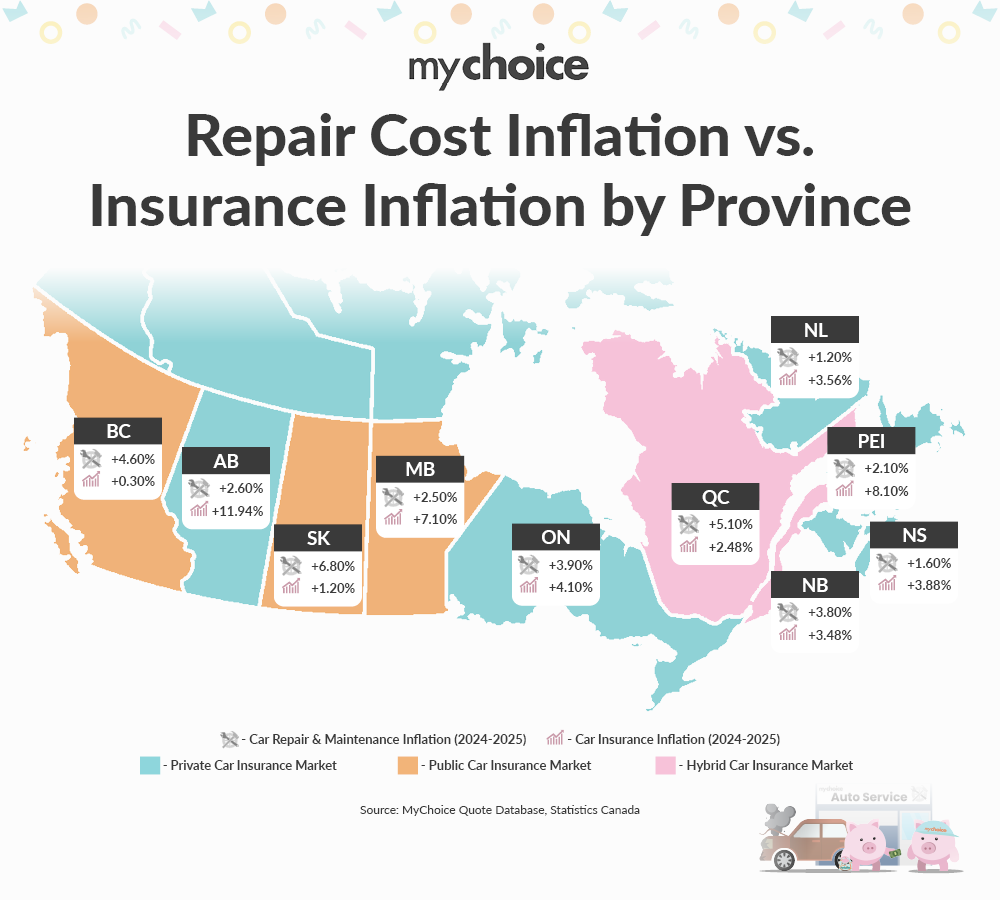
Why Insurance And Repair Inflation Do Not Match
Repair costs are just one element that influences premium rates. The timing of rate changes and insurance pricing systems differ by province. Insurers set rates based on many factors including the chance of an accident happening, the severity of accidents, thefts, weather-related losses, fraudulent claims, accident-benefit costs, injuries, claims costs and the mix of vehicles they insure.
FSRA also noted that technology can make repairing vehicles more complex. Vehicles have many different types of sensors and cameras, such as in bumpers, making physical-damage repairs more complex because you have to repair the technology as well as the vehicle. This can add to insurance claims, including labour and calibration, even when there is minimal physical damage.
Why Skilled Labour Still Matters
In May 2026, AIA Canada cited its 2023 labour research, which found that 65% of collision and mechanical shops it surveyed witnessed higher-than-normal technician turnover in 2022 and saw technician vacancies double between 2021 and 2022.
The complexity of advanced technologies used in vehicles can affect the time needed for repairs and/or shop availability. This can also affect the number of shops able to perform the repair. Electric powertrain technology, driver-assistance technology and diagnostic processes require specialized equipment and training.
What To Check Before You Approve A Repair
Before approving the job, review a written estimate for parts, labour, diagnostics, calibration, shop supplies, taxes and storage. Ask what type of parts will be used: original-equipment, aftermarket, recycled, repaired, etc. Find out about the warranty on the work.
Always contact the insurer before authorizing any teardown/repair. The insurer will advise whether they will be covering the cost of repair/parts and advise of any applicable deductibles or policy limitations. The insurer determines which facilities/parts are allowable. Follow the manufacturer’s recommended maintenance schedule and compare estimates from qualified repair shops.
Read More: See How ADAS Calibration Affects Insurance Claims