









What Is an At-Fault Accident?
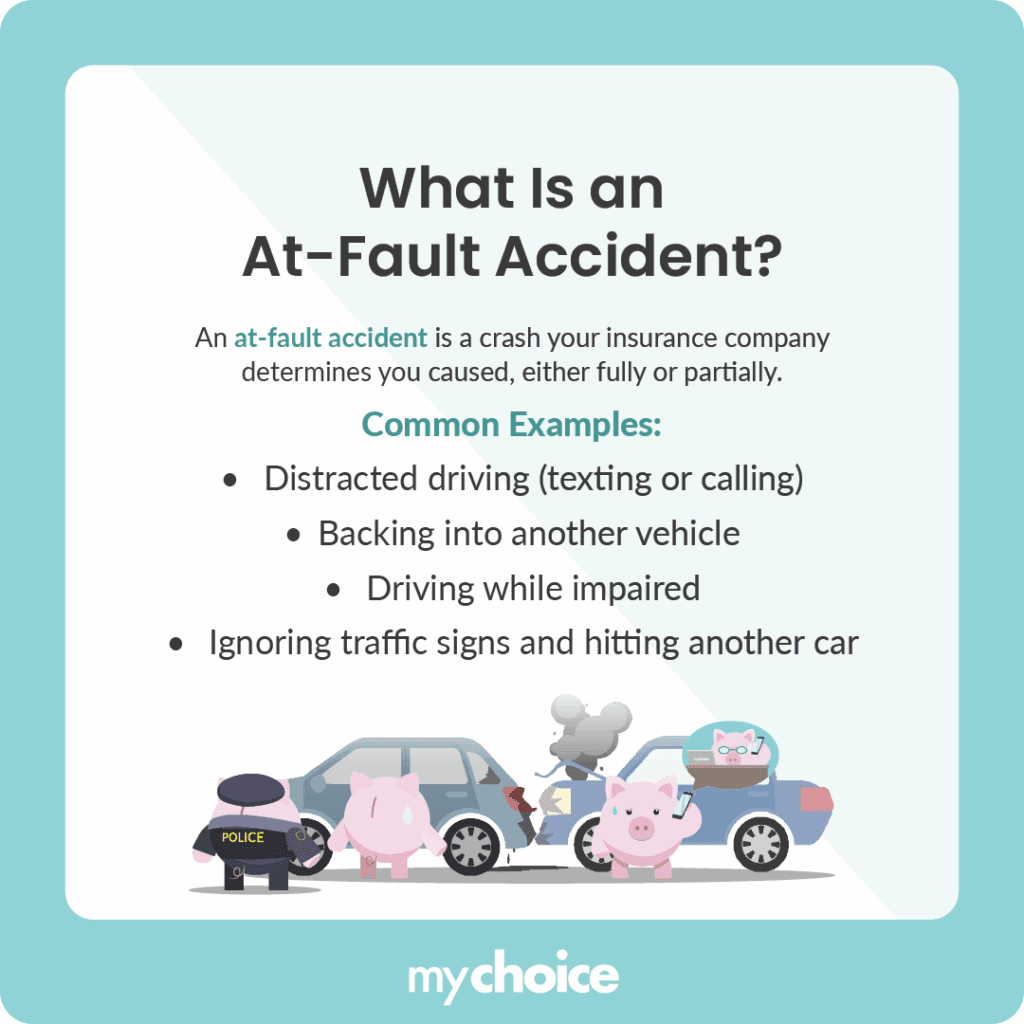
An at-fault accident is a car accident where your insurance company determines that you are wholly or partially responsible. This means that your actions or inactions caused the car accident to take place.
Common car accidents where you may be considered at fault include:
- Distracted driving, such as texting or calling while on the road
- Backing into another car in a parking lot
- Driving while impaired
- Colliding into another car after failing to obey traffic signs
How Much Will My Insurance Go Up With an At-Fault Accident in Ontario?
On average, Ontario drivers see their car insurance premiums increase by 96% after a single at-fault accident.
However, the rate of your car insurance premiums’ increase after an at-fault accident will depend on several factors, such as:
- Your driving record: Generally, drivers with a clean record will have a lower premium increase compared to drivers who’ve been in multiple at-fault accidents.
- Accident forgiveness: If you added this endorsement (aka OPCF 19 in Ontario) protection to your policy and it’s your first accident, your accident won’t cause your insurance premiums to go up.
- Cost of property damage involved: If the car accident was minor and caused property damage valued under $5,000, the Ontario Insurance Act protects you from rate increases. This threshold was increased from $2,000 on January 1, 2025, to align with updated police reporting requirements for Property Damage Only (PDO) collisions.
What Is No-Fault Insurance?
No-fault insurance simply means that drivers deal directly with their respective insurance companies to settle a car accident claim, instead of having each other’s insurance companies dispute who’s responsible and who should pay. This insurance system was adopted by Ontario and other provinces to simplify the claims process and speed up the process of compensating drivers.
Despite the potentially confusing name, “no-fault insurance” doesn’t mean that drivers can’t be found at fault for an accident. Even under no-fault insurance, insurers will determine an accident’s causes for several reasons, such as to decide if a driver is entitled to direct compensation for proper damage or if a deductible should be applied to a claim.
While a police report may have an independent finding of fault or “no-fault” in car accidents, this is used to decide if there was a violation of the Highway Safety Act. This is not the same as your car insurance company’s findings for the claims process or future premiums.
How Will a Car Insurance Company Determine Who Is At Fault?
In Ontario, a car insurance company will assign a claims adjuster to decide who is at fault in a car accident. Your claims adjuster may do the following to establish who is responsible:
- Take statements from you and any other drivers involved
- Examine the police report
- Note physical evidence found at the scene of the accident
- Consult a collision reconstruction company for a better understanding of what happened before and during the car accident
All of the information gathered by these means will be compared by your claims adjuster to the Ontario fault determination rules. Together, these will help your insurer decide who is responsible for your car accident.
What Are Ontario’s Fault Determination Rules?
The Ontario Insurance Act explains fault determination principles by describing different types of auto accidents and the possibilities of their incidence using diagrams. These written and visual examples illustrate the different kinds of collisions that drivers may be involved in, as well as the types of claims.
Apart from covering collisions on roads and highways, the rules also have guidelines for collisions at parking lots and intersections. The act also outlines how to apply these rules in circumstances that aren’t covered by the diagrams.
Using these rules and the fact-finding means listed above, car insurance claims adjusters determine which driver is responsible for an accident.
While 0%, 50%, and 100% are the most common assignments, Ontario’s percentage-based system also allows adjusters to assign fault in increments of 25% and 75% in shared responsibility scenarios, such as specific intersection or lane-change collisions.
If I’m Not At Fault, How Much Does Insurance Increase After an Accident?
If you’re found to be wholly not at fault (0% responsible) or at least less than 25% at fault for a car accident, it’s unlikely that your car insurance premiums will increase. However, even if you’re found to not be at fault, you’ll still have to file a claim with your insurer to cover any vehicle damage and the cost of medical care.
How Long Does a Car Accident Stay on My Driving Record in Ontario?
In Ontario, demerit points for incidents such as car accidents stay on your driving record for two years. After two years, this period “resets”. Note that this driving record is used to track traffic offences, and it differs from the one kept by your present car insurer.
Your car insurance company may have its own point evaluation system to assess the risk of insuring you, as well as the likelihood of potential claims. Generally, points may stay in your insurer’s records for up to five years, increasing your premiums for future renewals.
Another thing to keep in mind is that even if a car accident is no longer on your Ontario driving record. While some insurers may ask about serious criminal convictions from the distant past, the standard industry practice in Ontario is a six-year lookback period for at-fault accidents and a three-year period for Highway Traffic Act convictions. Accidents that occurred more than six years ago typically do not impact your current premium rating or eligibility for standard market coverage.
What Is Accident Forgiveness?
Accident forgiveness is an additional feature offered by car insurance companies to drivers with a clean driving record. Generally, this feature “forgives” the first car accident where you’re found to be at fault. This means your first at-fault accident won’t go on your driving record with your insurer or make your insurance go up.
Note that accident forgiveness has the following restrictions:
- Most auto insurers won’t offer this add-on to your insurance policy unless you’ve been accident-free and claims-free for a specified period.
- Usually, only the first at-fault accident is forgiven. However, some insurers will reset your accident forgiveness after three or more years without accidents or claims.
- You may need to have been with your car insurer for a specified period.
- This feature may not travel with you if you switch car insurers.
- Accident forgiveness doesn’t keep demerit points off your record or prevent you from being charged for offences.
- It doesn’t cover insurance premium increases due to speeding tickets or other driving convictions.
Can a Pedestrian Be Found at Fault for a Car Accident?
In Ontario, the Fault Determination Rules (Regulation 668) explicitly state that the degree of fault for an insured is determined without reference to the actions of pedestrians.
While a pedestrian may be found ‘contributorily negligent’ in a separate court-based lawsuit, they are never assigned a percentage of fault under the regulated insurance rules used by adjusters to process claims and set premiums.
Key Advice from MyChoice
- Remember that accident forgiveness is a company-specific loyalty feature. If you switch insurers, your new provider will see the at-fault accident on your report and will charge you for it, which could increase your quote by 25% to 50%.
- Double-check your coverage with your insurer. Starting July 1, 2026, Ontario is shifting to an “à la carte” model, where accident benefits such as income replacement and death/funeral coverage become optional. If you are injured in an accident and have opted out of these to save on premiums, you may have no automatic financial support.