









Even if you’re an incredibly safe driver, accidents happen. An at-fault collision may affect your premium. OPCF 39 can change how a qualifying accident is treated, but it doesn’t erase the accident or freeze the entire renewal premium. Learn how accident forgiveness works, the eligibility requirements and the limitations you should know.
Our team reviewed Ontario Regulation 664, section 5(2.1)–(2.3), FSRA’s optional-coverage guidance and approved policy forms and rating rules to explain how Ontario’s statutory minor-accident rule differs from contractual accident forgiveness. We also reviewed internal data collected since January 2026 to see how much Ontario drivers pay for this endorsement.
What Is Accident Forgiveness And What Does It Cover?
Accident forgiveness can protect drivers from the accident-related rating effect of their first eligible accident.
It’s important to distinguish between:
- The contractual benefit of accident forgiveness outlined in your insurer’s certificate or endorsement, often called OPCF 39
- The minor-accident protection outlined in Ontario Regulation 664, section 5(2.1)–(2.3)
Read More: No-Claims Car Insurance Discount: How It Works
How Much Does It Cost To Add Accident Forgiveness To Your Policy?
Based on our Ontario data collected between January and June 2026, the annual cost of accident forgiveness ranged from $40 to $70.
For perspective, average car insurance in Ontario is about $2,345 a year. In our quote comparison, the profile with an at-fault accident averaged $2,969, about 26.6%, or $624, above the clean-record profile.
Read More: How Much Do Car Insurance Rates Increase After an Accident?
Ontario’s Statutory Minor-Accident Rule
For accidents occurring on or after July 1, 2026, Ontario Regulation 664 considers an accident minor when:
- The cost of damage to each automobile, including associated property damage, is $5,000 or less
- All of the damage is paid by or on behalf of the at-fault driver
- No one was injured
- No insurer made a payment for damage to an automobile or property
- There has not been another eligible minor accident within the previous three years
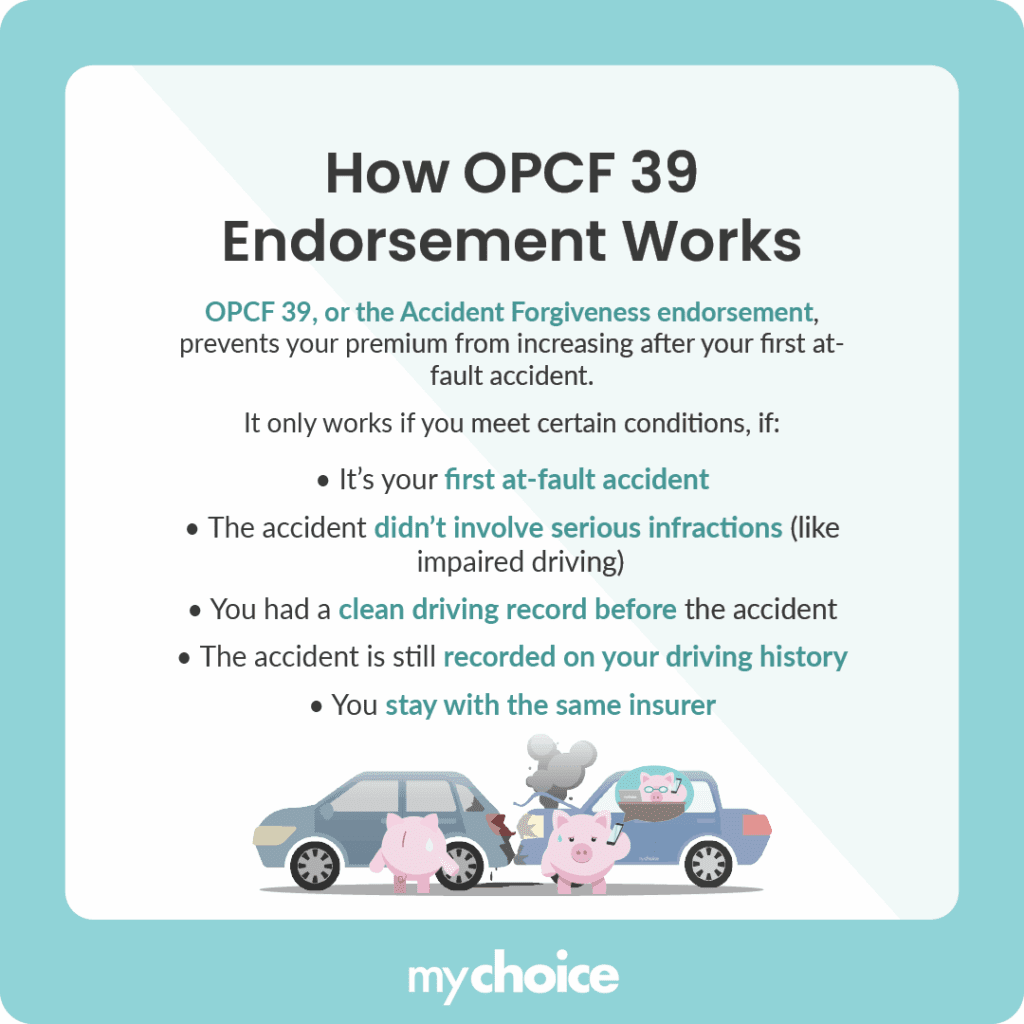
How OPCF 39 Works
Here are a few important points about accident forgiveness:
- Accident forgiveness may not protect drivers from premium increases after subsequent at-fault accidents.
- It can prevent an eligible accident from affecting your rate, but it doesn’t guarantee that your total premium will remain unchanged at renewal.
- Accident forgiveness is not transferable between insurers. It will not follow you if you change insurance companies.
- A forgiven accident is still reported as a claim. Another insurer may apply its own approved rules to the disclosed claim.
- Accident forgiveness does not remove demerit points or driving convictions.
- Not all drivers on your policy may be eligible. Check the certificate or endorsement to see which drivers and accidents qualify.
Accident Forgiveness And Ontario’s Minor-Accident Rule Are Separate
Accident forgiveness and Ontario’s statutory minor-accident rule are separate. Whether OPCF 39 applies depends on the endorsement wording, eligible driver and accident circumstances, not solely on the statutory minor-accident threshold.
Your Insurer May Not Have A Reset Period
Accident forgiveness may reset after a period of time. Some insurers allow the benefit to reset after a period of accident-free driving. Others don’t.
Check the actual certificate or endorsement for the eligible driver, qualifying accident, effective date and any reset rule.
Do I Need Accident Forgiveness In Ontario?
You’re never legally required to get accident forgiveness in Ontario. However, the endorsement can help protect your car insurance rate.
It may be useful for:
- Drivers with a clean driving record who want protection against the rating effect of their first eligible at-fault accident.
- Drivers who expect to stay with the same insurer for several years. Accident forgiveness is usually insurer-specific and doesn’t automatically transfer to a new company.
Read More: When to File a Claim and When to Pay Out of Pocket
How Does Accident Forgiveness Affect Future Insurance Applications?
Accident forgiveness may remove a specified accident-related rating effect with the issuing insurer. It doesn’t mean another insurer can’t apply its own approved rules to the disclosed claims history.
Read More: How Long an Accident Stays on Your Driving Record