









Will right-to-repair legislation lower your car insurance? Not as a guaranteed discount. Canada has removed some legal barriers that can affect access to repair tools and information, but the federal changes do not create universal access to every vehicle’s data. More repair competition could reduce some claim costs. No government or industry source we reviewed establishes a premium reduction, amount or timeline.
For this article, our team reviewed the federal Copyright Act repair exception, the interoperability amendment, the Competition Bureau’s current refusal-to-deal guidance and AIA Canada’s MNP repair-cost study.
Keep reading to see what the laws actually changed, where the limits remain and what to check before an independent shop repairs a vehicle involved in an insurance claim.
What Does Right to Repair Mean for Canadian Drivers?
Right to repair generally means giving you more choice over who can diagnose, maintain or repair a product. For a modern vehicle, that can involve access to service information, software, tools, parts and calibration procedures. Access matters because a shop may need more than mechanical skill to complete a safe repair.
The legal position is narrower than the phrase suggests. The Competition Bureau says the amended refusal-to-deal rule concerns businesses and applies only when a five-part legal test is met. It does not give every vehicle owner a general right to demand repair material from a manufacturer.
Read More: See What Is Driving Up Vehicle Repair Costs in Canada
What Changed at the Federal Level?
| Change | What it does | What it does not do |
|---|---|---|
| Copyright Act repair exception, in force since November 7, 2024 | Allows a technological protection measure to be bypassed solely to diagnose, maintain or repair a product, subject to the Act. | It does not require a manufacturer to supply every tool, part or data feed. |
| Copyright Act interoperability amendment, in force since November 7, 2024 | Expands the exception for bypassing a technological protection measure to make computer programs interoperable. | It does not guarantee that every independent shop can access every vehicle system. |
| Competition Act refusal-to-deal amendment | Can apply when a business refuses to supply a means of diagnosis or repair and the statutory competition test is met. | It is case-specific and is not a general consumer right to repair. |
These changes remove important barriers. They do not settle every issue involving connected-vehicle data, cybersecurity, trade secrets, safety procedures or the cost of manufacturer subscriptions.
Could Greater Repair Choice Affect Insurance Costs?
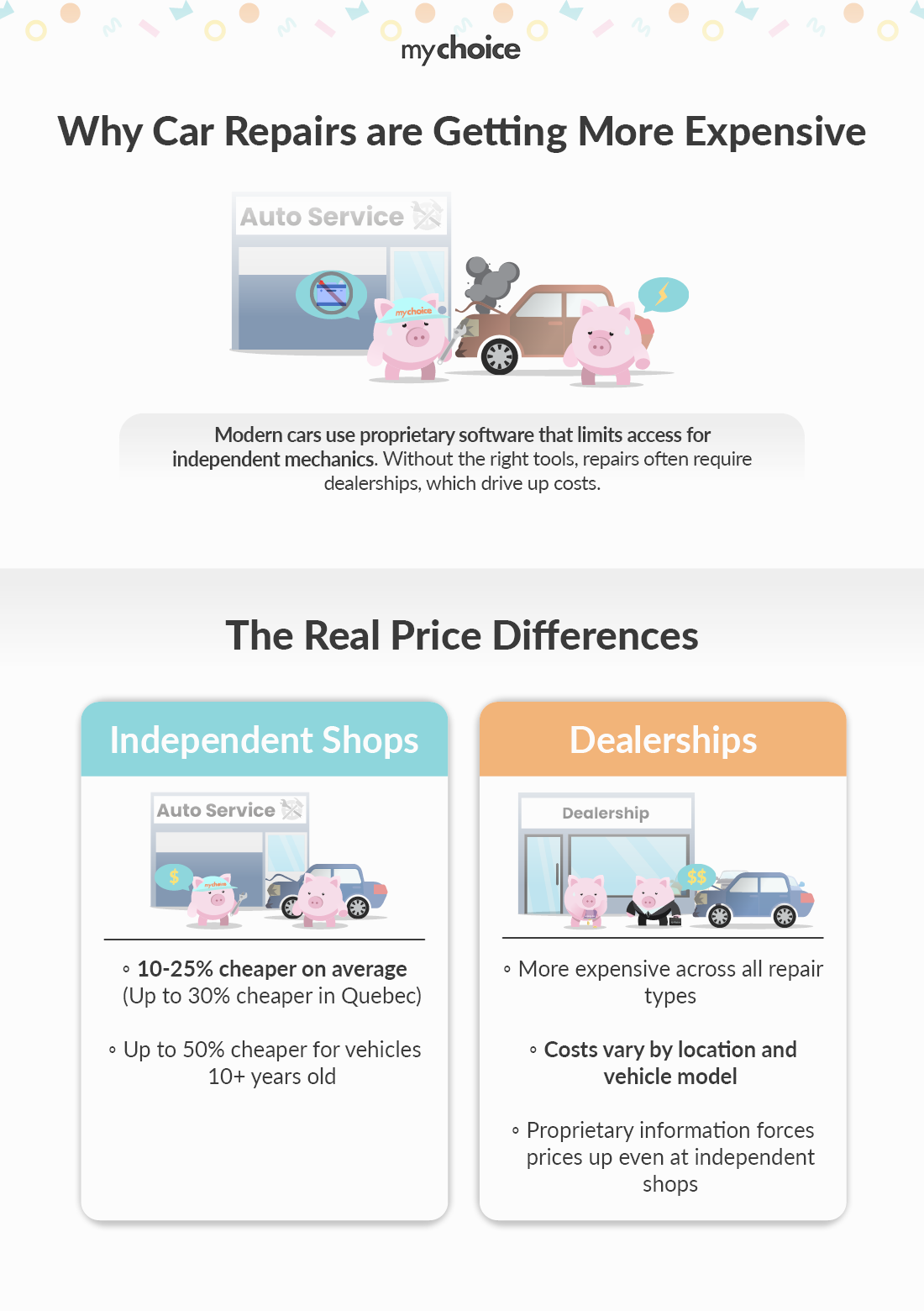
Potentially, but the link is indirect. Repair bills form part of an insurer’s claim costs. If qualified repairers can compete for more work and obtain the information needed to complete it correctly, some repairs may cost less. Insurers still price policies using many other inputs, including collision frequency, theft, parts prices, labour, weather losses and approved rating factors.
A 2026 MNP study commissioned by AIA Canada compared selected maintenance and repair jobs for four vehicles through mystery shopping. It reported that independent options were often less expensive, with estimated regional differences ranging from 5% to 30% depending on the region and repair. Treat those figures as examples from the study design, not as a national saving on every job and not as evidence of an insurance-premium decrease.
What Should You Check During an Insurance Repair?
| Question to ask | Why it matters |
|---|---|
| Can this shop access the manufacturer’s current repair procedure? | Structural, electrical and high-voltage work can depend on model-specific instructions. |
| Will sensors or driver-assistance systems need calibration? | A repaired bumper, windshield or suspension component can affect cameras, radar or alignment. |
| Which parts are included in the estimate? | Ask whether the estimate uses original, aftermarket, recycled or reconditioned parts and what your policy permits. |
| Who approves added damage found after teardown? | The shop may need insurer approval before completing work beyond the initial estimate. |
| What repair and calibration records will I receive? | Keep the final invoice, scan results, calibration reports and warranty information. |
Your right to select a repairer, the insurer’s payment obligation and the parts or procedures allowed can depend on your province, policy and claim. Confirm the process before authorizing work. A lower estimate is useful only if the shop can complete the repair safely and document it.
Read More: Learn Why ADAS Calibration Can Affect a Repair Claim