









Do Speeding Tickets Follow You Across Canada?
In most cases, yes. The Canadian Driver License Compact (CDLC) is an agreement between most Canadians provinces and territories to share driving records and demerit points.
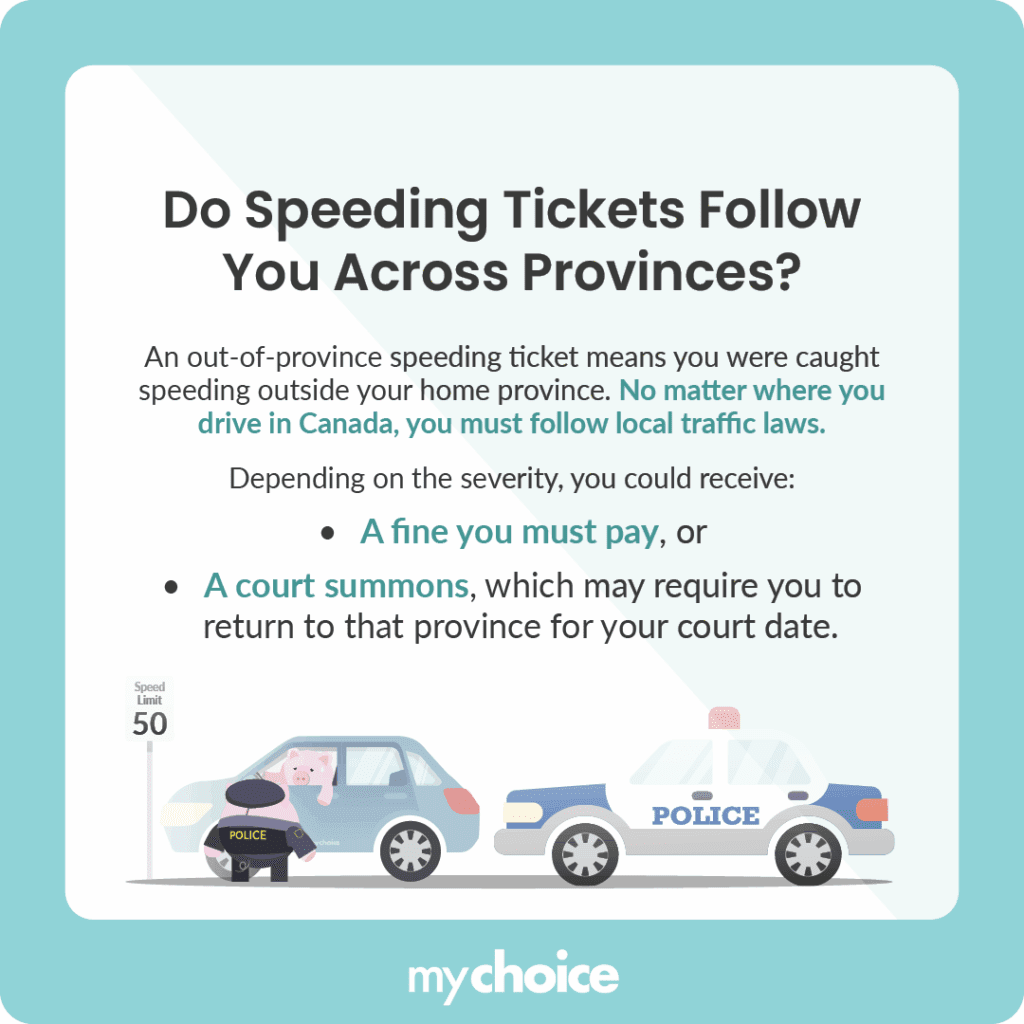
Provincial Differences in Ticket Reciprocity and Penalties
The Canadian Driver License Compact (CDLC) is an agreement between most Canadians provinces and territories to share driving records and demerit points.
| Jurisdiction | Member of Compact (CDLC)? | Standard Speeding Fine | Unique Repercussions |
|---|---|---|---|
| Ontario | Yes | Up to $1,000 | 30-day suspension for G1/G2 if 4+ points |
| Alberta | Yes | Varies by km/h | Mandatory court hearing for 50 km/h+ over |
| British Columbia | No (Limited) | $138 – $483+ | $252 annual “Point Premium” for 4+ points |
| Manitoba | Yes | Up to $2,000 | Impacts Driver Safety Rating (DSR) |
| Quebec | Yes (Specific ON deal) | $300 – $600 | Immediate 3–30 day suspension for repeats |
| Saskatchewan | Yes | $580+ | Immediate 7-day seizure for high speed |
| Atlantic (NS, NB, PE, NL) | Yes | $100 – $1,275 | PEI has the highest minimum fines ($575) |
| Yukon/NWT | Yes | $100 – $500 | Fines double in school/construction zones |
Do Out-of-Province Speeding Tickets Affect Insurance?
Yes, out-of-province speeding tickets can absolutely impact your insurance premiums just as much as a local ticket. According to MyChoice’s most recent study on this topic, a single police-issued speeding ticket can increase your insurance premiums by 16.5%.
Insurance companies rate you based on the conviction (the fact that you were speeding) rather than just the number of points. Even if a ticket carries 0 points in the issuing province, it can still raise your rates if your home province records the conviction.
Insurers pull your updated driver’s abstract at renewal. Any reported interprovincial or reciprocal U.S. conviction will be visible to them and treated as a domestic risk.
Do I Have to Pay a Ticket From a Different Province?
Yes, you remain responsible for paying the designated fine for your speeding ticket, even if you no longer plan to visit that province or territory. This not only applies if you committed the speeding offence in another Canadian province, but also in the United States.
Resolving the Ticket: Do You Need to Travel Back?
A common myth is that you must return to the province where the ticket was issued to fight it. While this was historically true, most Canadian courts now offer remote proceedings via Zoom or phone call.
You can contest your ticket or attend early resolution meetings from your home province.
If you do not dispute the ticket, you are legally responsible for paying the fine directly to the province where it occurred. You cannot pay out-of-province fines through your local home-province courthouse.
Key Advice from MyChoice
- Contest your tickets remotely. Since travel is no longer required for most hearings, always attempt to have an out-of-province ticket reduced to a non-moving violation or “0-point” offence before it hits your record.
- Mind the disclosure clause. Even if a ticket from a non-reciprocal area (like BC) doesn’t show up on your home record, your insurance contract may legally require you to self-disclose all tickets and accidents. Failing to do so can result in a voided policy for misrepresentation.
- Watch the “Stunt” threshold. “Stunt Driving” thresholds vary across Canada. In Ontario, going 40 km/h over the speed limit in a zone under 80 km/h triggers immediate roadside impoundment, even if your home province has a higher threshold.