









A renewal notice showing a rate increase may arrive before the policy expires. The increase may reflect newly approved rates rather than a change in your own driving record.
To prepare this guide, our MyChoice team reviewed FSRA’s automobile rate-approval regime and the non-renewal provisions of Ontario’s Insurance Act. Section 236 requires at least 30 days’ written notice when an insurer proposes to renew a policy on varied terms or does not intend to renew it. Section 238 bars an insurer from refusing to renew except on a ground filed with the regulator.
What Actually Happens Behind the Scenes at Renewal Time
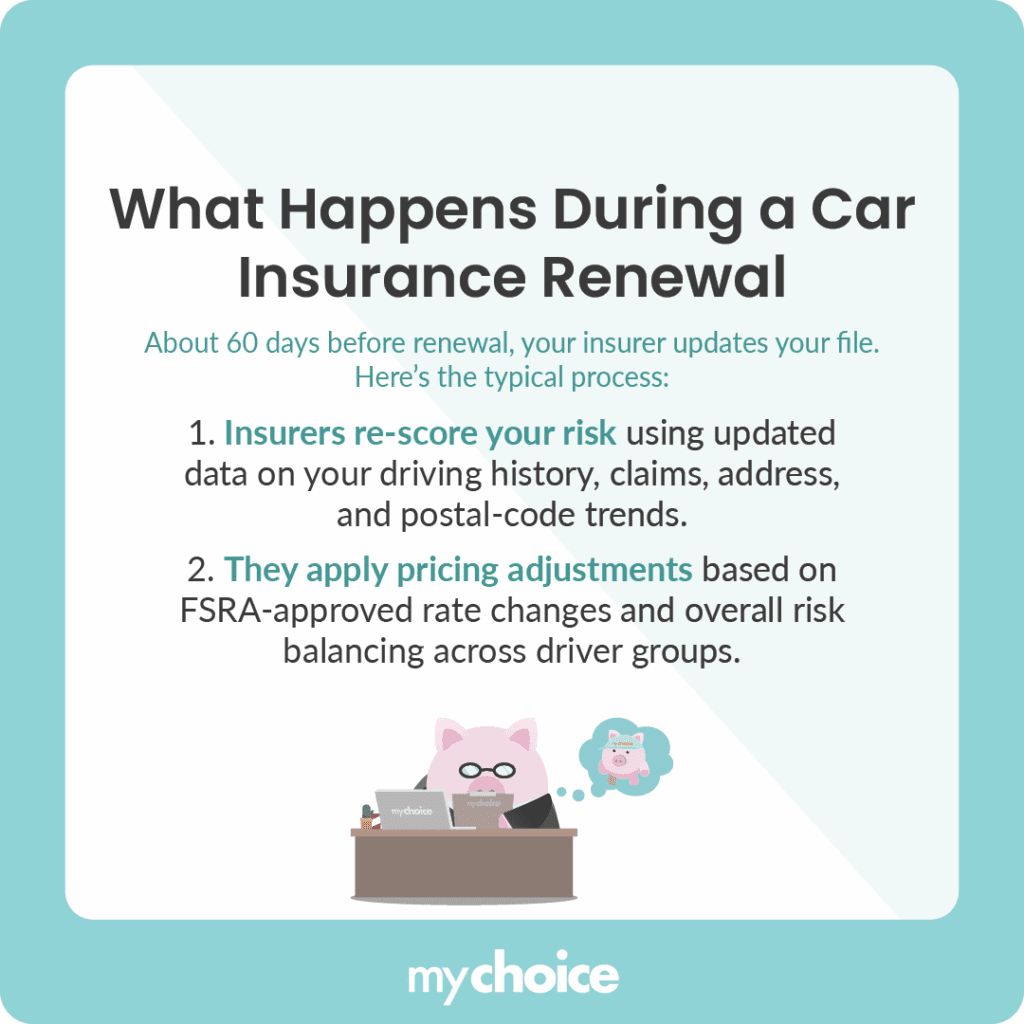
Your Risk Profile Is Re-Evaluated
At renewal, insurers may recalculate premiums using updated rate manuals approved by regulators such as FSRA. The calculation considers factors including the vehicle, driving history and coverage, so the premium may rise or fall even when the driver’s circumstances have not changed.
Approved Rate Changes May Take Effect at Renewal
Insurers don’t file changes on a regular schedule because each company’s filing dates vary. In Ontario, changes to insurance rates must be approved by FSRA before they can be used at renewal.
The Renewal Timeline To Keep Track Of
Review the following timeline so that you’ll be prepared for your upcoming renewal date. These are suggested review dates rather than legal deadlines.
| Step | What to do | Why it matters |
|---|---|---|
| 45–60 days before expiry | Begin comparing quotes either through MyChoice or with your insurer. | Before your renewal is processed, find out if your insurer is still competitive. |
| 30 days before expiry | Review your coverage and discounts. | A change in lifestyle or driving habits may qualify you for lower rates. |
| 15 days before expiry | Contact your insurer or broker with questions. | Correct any inaccurate information and confirm which discounts apply. |
| Renewal day | Confirm your final policy details. | Confirm that the drivers, annual mileage and coverage are correct. |
| Post-renewal | Review your paperwork and save your proof of insurance. | Double-check the payment schedule and renewal effective date. |
The Renewal “Audit” Checklist
Here’s a renewal checklist to make sure that you don’t leave any money on the table when it’s time to renew.
Compare Quotes
Other insurance companies may offer a better deal. Use sites such as MyChoice to compare insurance rates.
Check If Your Insurer Filed a Rate Change
All insurers in Ontario submit their intended rate changes to the Financial Services Regulatory Authority of Ontario.
Not all filings will affect your renewal. Each insurer files differently and may file more or less frequently. The approved filings are public, but they are not published with a plain-English explanation for consumers.
Review Optional Coverages
Review common endorsements such as OPCF 20, which provides transportation-replacement coverage; OPCF 27, which may extend specified coverage to eligible non-owned vehicles; and OPCF 43, which waives depreciation on an eligible damaged or lost vehicle.
Confirm Driver List Accuracy
Remove anyone who no longer drives the vehicle, and confirm that everyone who does drive it is listed correctly.
Verify Mileage and Vehicle Use
Insurance rates could drop if you drive fewer kilometres.
Why Your Renewal Price Can Change Even With a Clean Driving Record
Your insurer may apply new regulator-approved rates across its policies, regardless of whether your own driving record has changed.
According to Statistics Canada, the price index for passenger vehicle parts, maintenance and repair rose 22.3% between December 2019 and December 2024.
Auto insurance rates are determined using rate manuals. These manuals must be filed with FSRA and approved before they can be used. At renewal, an insurer can apply a new FSRA-approved version of its rate manual, meaning rates can increase even if nothing about you personally has changed.
An update can reflect the insurer’s expectation that its costs will increase across its book of business. Examples include vehicle repair inflation, loss experience in certain areas and changes in legislated benefit requirements.
You may be offered a higher renewal rate despite a clean driving record. This can happen if it has cost more to insure drivers similar to you in your area, even if your own risks have not increased.
Auto insurance rates increased by 8.64% in Kingston but just 2.12% in Welland. Our most recent car insurance market overview also found increases of 8.43% in Milton and 8.12% in Markham, compared with 2.45% in Oakville and 2.53% in London.
How To Review Your Renewal
1. Gather Quotes First
Compare quotes from other insurers.
2. Mention Life Changes
Some companies offer discounts for people who telecommute, drive fewer kilometres or have approved anti-theft devices in their vehicles.
3. Bundle Your Policies
You may qualify for a multi-policy discount by combining home and auto insurance.
When To Switch and When To Stay Put
After receiving your renewal and comparing other quotes, consider whether it makes sense to switch insurers.
- You find a better rate for similar coverage.
- You are unhappy with your current insurer’s customer service or claims service.
- Your price increased and the explanation does not justify staying.
- Another insurer offers a better combination of coverage and price.
- Other insurers may not offer the same benefits as your current policy. Don’t give up coverage such as accident forgiveness without considering its value.
Read More: Consequences of a Lapsed Insurance Policy