









Our team reviewed section 172 of the Highway Traffic Act and Ontario Regulation 455/07 to determine what penalties Ontario drivers face when charged with stunt driving.
Keep reading to learn about current speed thresholds, roadside penalties, penalties after conviction, reinstatement costs and the possible insurance consequences.
Stunt Driving Penalties in Ontario
Drivers charged with stunt driving face an immediate 30-day licence suspension and 14-day vehicle impoundment at the roadside, even before the case goes to court.
Here’s a closer look at the penalties:
| Penalty | First conviction | Second conviction | Third or subsequent conviction |
|---|---|---|---|
| Roadside licence suspension | 30 days | 30 days | 30 days |
| Roadside vehicle impoundment | 14 days | 14 days | 14 days |
| Fine on conviction | $2,000–$10,000 | $2,000–$10,000 | $2,000–$10,000 |
| Jail | Up to six months | Up to six months | Up to six months |
| Demerit points | Six | Six | Six |
| Licence suspension on conviction | One to three years | Three to 10 years | Lifetime for a third conviction, reducible after 10 years under certain conditions; non-reducible for a fourth or subsequent conviction |
| Driver-improvement course | Mandatory | Mandatory | Mandatory |
If you don’t pay a court-ordered fine, your driver’s licence may be suspended.
You may also have to pay for:
- Legal representation
- Towing
- Vehicle storage
- Licence reinstatement
- Lost income if your job requires you to drive
Getting back on the road may also require payment of Ontario’s $281 driver’s-licence reinstatement fee.
A stunt-driving conviction can substantially increase your insurance rates, affect your eligibility with your current insurer or place you in the high-risk insurance market.
Stunt driving is a separate offence under section 172 of the Highway Traffic Act and is different from careless driving.
What Is Classified as Stunt Driving?
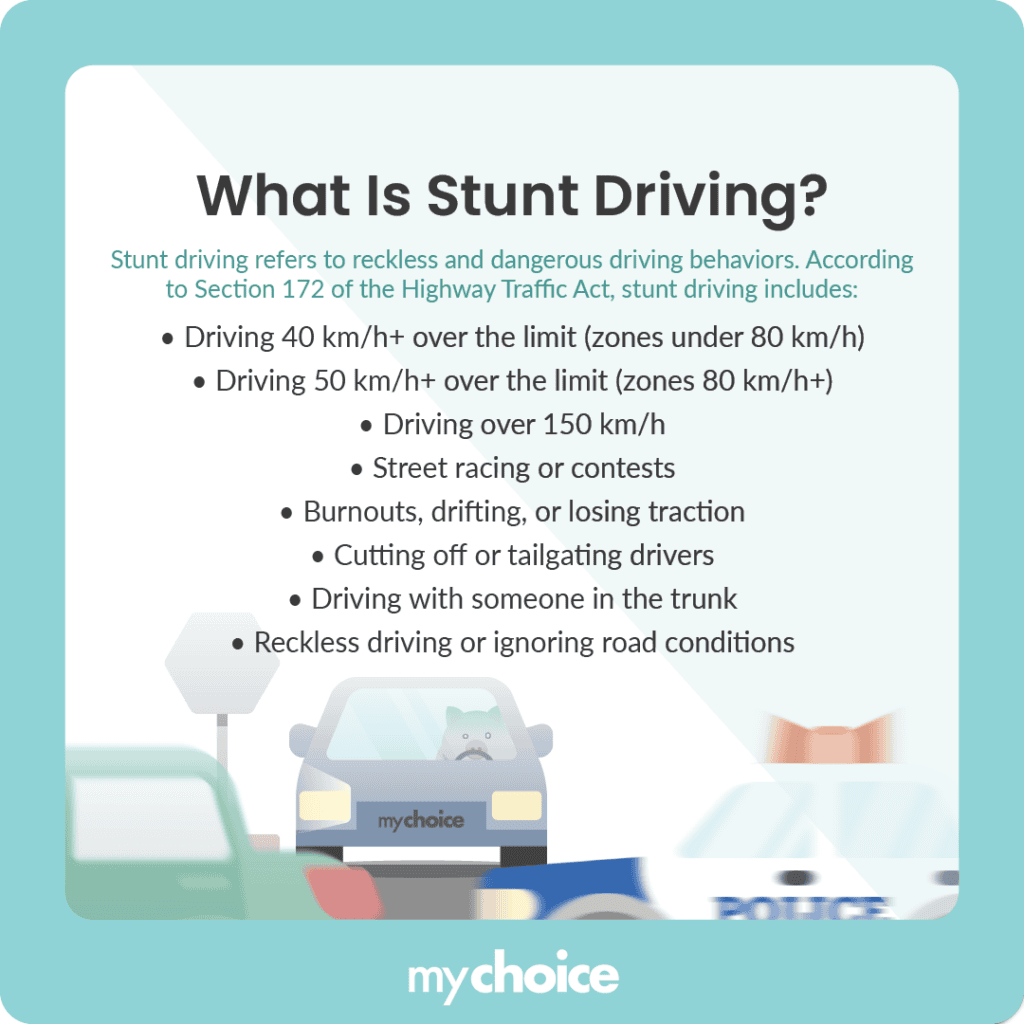
Ontario’s stunt-driving rules include:
- Driving 40 km/h or more over the speed limit where the posted limit is under 80 km/h
- Driving 50 km/h or more over the speed limit where the posted limit is 80 km/h or higher
- Driving at 150 km/h or more
- Intentionally causing the vehicle’s tires to lose traction while turning
- Driving in a way that indicates an intention to spin or circle the vehicle without maintaining control
- Driving with a person in the trunk
- Driving while not sitting in the driver’s seat
- Driving in a way that indicates an intention to lift one or more tires from the road
- Intentionally preventing another vehicle from passing
- Intentionally cutting off another vehicle
- Intentionally driving as close as possible to another vehicle, pedestrian or fixed object without justification
Updated Ontario Stunt-Driving Laws
The Moving Ontarians More Safely Act, 2021 introduced tougher measures against stunt driving.
| Measure | Current rule | Previous rule |
|---|---|---|
| Speed threshold on roads posted under 80 km/h | 40 km/h or more over the limit | 50 km/h or more over the limit |
| Roadside licence suspension | 30 days | Seven days |
| Roadside vehicle impoundment | 14 days | Seven days |
Stunt-driving rules can also apply in parking lots and other places covered by the regulation.
Read More: How Parking Lot Accidents Can Affect Insurance
What to Do if You Receive a Stunt-Driving Charge
Do not drive while your licence is suspended.
Read the charge and court documents carefully and follow every deadline. Keep copies of the documents relating to the charge, suspension, impoundment and court date.
Because the penalties are serious, you may want advice from a licensed lawyer or paralegal.
Can You Go to Jail for Stunt Driving?
Yes. A stunt-driving conviction can result in up to six months in jail.
Can a Stunt-Driving Charge Be Dropped or Reduced?
A charge may be defended, withdrawn or reduced depending on the evidence and legal process. The outcome cannot be guaranteed.