








Getting Car Insurance After Cancellation in Ontario

3 minutes can save you hundreds. Enter your postal code below and join thousands of Canadians saving on car insurance.

Secure. No Spam. No Fees.

Why Use MyChoice

MyChoice.ca is an independent platform that helps Canadians find their best insurance options and make informed financial decisions. Our service is free to use. We may earn a commission from some providers when you buy a policy, but it never affects the price you pay or how products are reviewed. To help ensure accuracy, our content is researched and reviewed by licensed insurance professionals before publication.

First published on January 10, 2024

5 minute read

Edited By Vitalii Starov on August 1, 2026

MyChoice follows a strict content review process designed to ensure reliable and unbiased information.

A car insurance cancellation doesn’t just mean finding a new insurer. The process can affect when you can legally drive, what you’ll pay for coverage in the near term, and whether you’ll qualify for a standard auto insurance policy. Read on to learn why insurers cancel policies, how Ontario’s cancellation notice process works, what your rights are, and how to find new coverage without leaving yourself uninsured.

To prepare this guide, our team reviewed Ontario’s Statutory Conditions for Automobile Insurance, the Compulsory Automobile Insurance Act, Ontario Regulation 664, FSRA’s guidance on declined, non-renewed and terminated policies, and the Facility Association’s description of Ontario’s residual market.

Applying for Car Insurance After Cancellation
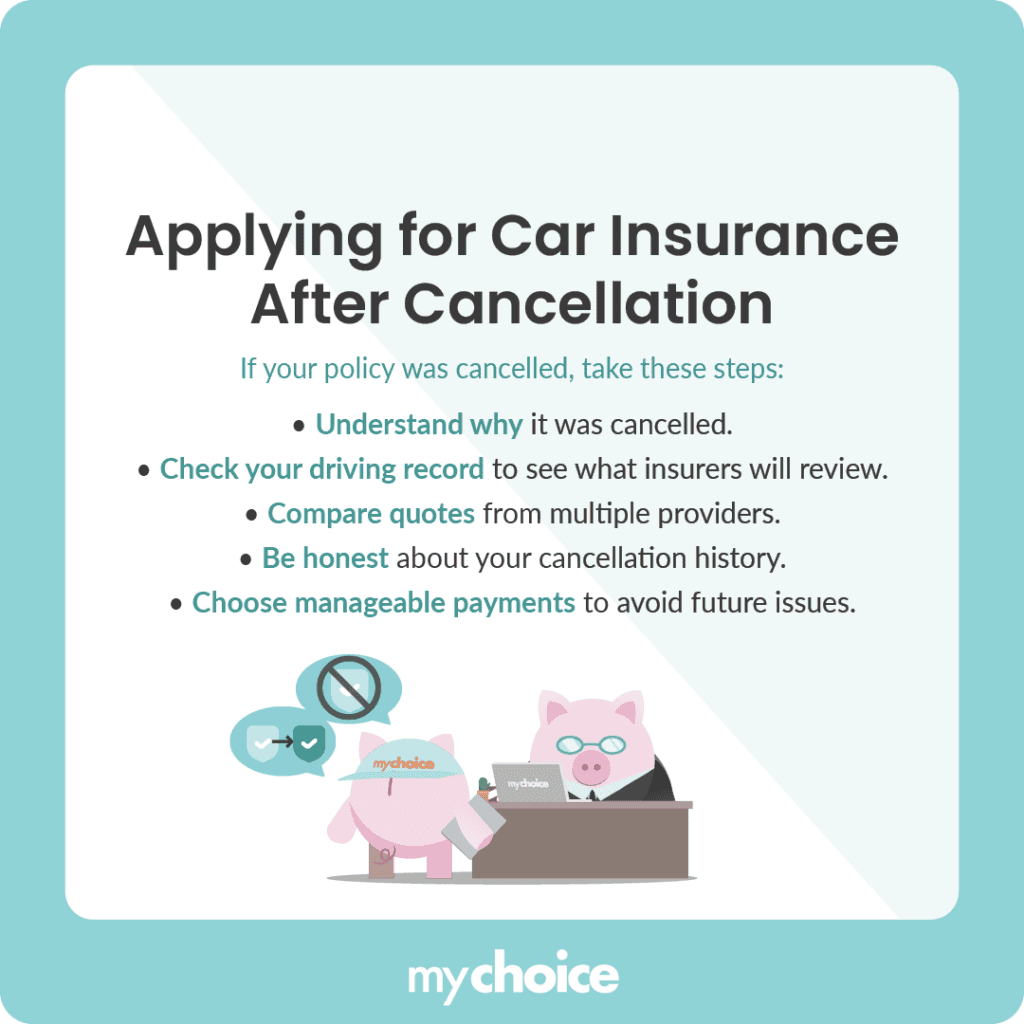
If you have no other option but to find a new insurance policy, follow these steps for smooth, worry-free policy-hunting:

  1. Evaluate your situation: Identify what caused your policy to be cancelled. This will help you understand what steps you have to take to contest your cancellation or apply for a new policy.
  2. Collect the relevant records: Ask the former insurer for the cancellation notice, payment history and a letter of experience. Order an MTO driving record only when you also need to verify licence status, convictions, suspensions or collisions.
  3. Compare quotes: Shop around to compare quotes across different insurance companies. Some providers have more generous rules than others regarding high-risk driving status.
  4. Be transparent about your situation: Be honest about your prior cancellation. This will help build trust with your new insurance provider and avoid any issues in the future.
  5. Find payment options you can handle: If you had trouble paying your premiums in the past, ask your insurer if they offer flexible payment terms to avoid future cancellations.
Applying for Car Insurance After Cancellation

Why Do Policies Get Cancelled? 

Insurance companies can generally cancel a new policy for almost any reason during an initial underwriting period. However, once a policy has been in force for more than 60 days, Ontario law limits when an insurer can cancel it. Under section 12(1) of the Compulsory Automobile Insurance Act, insurers may terminate a policy only for one or more of the following reasons:

  • Knowing misrepresentation or non-disclosure. For example, failing to disclose the real principal driver, hiding previous accidents, or not telling the insurer the vehicle will be used for commercial purposes.
  • Material change in risk. For example, moving to a new address, adding a regular driver, or changing how the vehicle is used without notifying your insurer.
  • False information about the insured vehicle β€” For example, providing incorrect information about the vehicle itself that affects the insurer’s assessment of risk.

Non-payment is also one of the most common reasons for policy termination. Insurance is rarely cancelled after the first missed payment. There is a grace period, and insurers generally send a notice to the policyholder with the overdue amount and the deadline to pay.

How Ontario Non-Payment Cancellation Notices Work

Under Statutory Condition 11 of Ontario Regulation 777/93, a first or second non-payment notice in the same policy term must set a termination date no earlier than 30 days after notice by registered mail, or 10 days after personal delivery, prepaid courier or consented electronic delivery. The policy stays in force if the full amount stated in the notice, plus the permitted administration fee, is received in the required form by noon on the business day before the termination date.

If the insurer has already issued two non-payment notices during the term and both were cured on time, a later non-payment notice can follow the shorter termination timetable that applies to other permitted termination reasons. Confirm if what you received is the first, second, or the last non-payment notice and obtain written confirmation of any payment or reinstatement.

Read More: Missed Car Insurance Payment in Canada: Here’s How to Resolve It

What Can You Do if You Receive a Car Insurance Cancellation Notice?

Read the notice immediately and keep the envelope or delivery record. It should identify the reason, the effective date and, for a curable non-payment notice, the amount, fee, accepted payment method and deadline. Do not drive after the effective date unless you have written confirmation that the policy remains in force or replacement coverage has begun.

If you receive a notice that your car insurance will be cancelled, normally you have three options:

Contest the Cancellation

Contact the insurer or broker promptly, explain the disputed facts and request the decision and applicable underwriting rule in writing. Keep the notice, proof of payment and a dated log of calls and emails. If the issue is non-payment and the notice is curable, follow the notice’s payment instructions exactly rather than relying only on an informal appeal.

If the policy has already terminated, payment does not automatically reinstate it. Ask whether reinstatement is available and request written confirmation of the effective date.

Know Your Rights as a Consumer

Start with the insurer’s Complaint Officer and request a final position letter. If the issue remains unresolved, FSRA’s complaint process points consumers to the General Insurance OmbudService for independent review and allows FSRA to assess possible regulatory non-compliance. FSRA does not award compensation or rewrite the insurance contract.

Find a New Insurance Policy

If coverage will end, begin shopping before the termination date and work with a licensed broker if standard-market options are limited. Disclose the prior termination accurately. Do not drive the vehicle until the replacement policy is effective and you have valid proof of insurance, as required by Ontario’s Compulsory Automobile Insurance Act.

What If You Can’t Afford a Car Insurance Payment?

If you’re worried about meeting the deadline for your premium payment, there are a few steps you can take to avoid immediate policy cancellation.

Contact the insurer or broker before the due date and ask what payment arrangements, if any, are available. An arrangement is effective only when the insurer confirms it, so keep that confirmation in writing and continue to follow the existing payment schedule unless told otherwise.

If a payment has been missed, call immediately and check whether a statutory termination notice has been issued. Use the amount, payment method and deadline written in that notice. A policy is either in force or terminated on the stated date; avoid describing termination as a temporary cancellation unless the insurer has provided a specific reinstatement agreement.

Where Is a Cancellation Recorded, and How Long Can It Affect Insurance?

A policy termination is insurance-history information, not an entry on the Ministry of Transportation driving record. Ontario describes driver records as containing licence status, convictions, suspensions and reinstatements (and, for a complete record, collisions) but not policy cancellations. S

A non-payment termination can still affect your car insurance rates in the future. The cancellation stays on industry database reports (i.e. Autoplus or CLEAR) for an average of 3 years.

According to MyChoice’s internal data, your premiums can go up on average 25-30% after an insurance cancellation for non-payment is present on your record.

Read More: Understanding the Consequences of Lapses in Your Car Insurance History

Navigating Policy Cancellation for High-Risk Drivers

Insurers may decline an applicant only under underwriting rules filed with and approved by FSRA. Those rules differ by insurer, so a prior cancellation does not produce one universal price or result. Ask for the specific rule in writing if coverage is declined.

If standard-market coverage is unavailable, ask a licensed broker about the residual market. The nonprofit Facility Association exists to ensure automobile insurance is available to eligible owners, lessees and licensed drivers.

Facility Association administers the Residual Market Mechanism. Servicing carriers issue and endorse policies, receive premiums and adjust claims on behalf of Facility Association members.

Residual-market rates and classifications require regulatory approval, but the premium depends on the individual risk. Continue to compare all eligible standard-market options before placement. Try to avoid relying on a fixed list of named insurers because underwriting rules and market participation can change.

Read More: A Guide to High Risk Insurance in Ontario

Eligibility Criteria for Facility Insurance

Facility Association describes its purpose as ensuring availability for eligible owners, lessees and licensed drivers. A broker should confirm the current Ontario eligibility and placement requirements for the specific vehicle and applicant.

  •  Provide accurate licence and driver information requested for the application.
  •  Provide the vehicle, registration and ownership or lease information required for placement.
  •  Facility Association operates in Ontario and the other jurisdictions listed on its official About page, but rules and mechanisms vary by jurisdiction.

With over a decade in Canada’s insurance sector, Aren is a leading voice in the industry, providing thought leadership on auto insurance, underwriting innovation, and how technology is reshaping insurance.

Congratulations! You made it to the end!

Now, here is the easy part: complete your quote in under 2 minutes

Discover More About

July 30, 2026
Learn what happens if you hit a deer or other wildlife in Ontario, which auto insurance coverage pays, and what to do after a collision.
July 23, 2026
What happens if your car is declared a total loss in Ontario? Learn how insurers calculate payouts, when vehicles are written off, and how OPCF 43 protects you.
July 8, 2026
Staged collisions, re-VINing, fake documents and repair fraud cost insurers millions each year. Learn how that affects your premiums in Ontario.

Even More Ways To Save on Insurance