









Alberta’s demerit point system affects more than just your licence. It can also influence your insurance premiums and your ability to stay on the road.
To prepare this guide, our team reviewed the Government of Alberta’s demerit point program and the province’s Traffic Safety Act. We also analyzed proprietary MyChoice auto insurance quote data to explain how traffic convictions and licence suspensions can affect insurance costs.
Keep reading to learn more about Alberta’s demerit point system, common traffic offences and their penalties, how to reduce demerit points, and what all of it does to your insurance.
How Demerit Points Work in Alberta
In Alberta, you get a certain number of driving demerit points every time you’re convicted of a traffic offence. More severe offences usually carry a higher point penalty. A common example would be speeding in the province, where you get:
- 2 demerit points for speeding up to 15 km/h above the speed limit
- 6 demerit points if you exceed the speed limit by 51 km/h.
Once you pass a certain threshold, the authorities will take action. These actions range from cautionary letters to licence suspension. But not all violations carry demerit point penalties. Some violations, like driving without insurance, get you fined instead of demerit point penalties.
How Many Demerit Points Before You Lose Your Licence?
How many demerit points you can accumulate before you lose your licence by suspension differs depending on your licence type. Here’s a breakdown of the maximum demerit points and suspension duration for each licence type:
Maximum Demerit Points for Class 5 Licence Holders
Fully licenced drivers with a Class 5 licence can get up to 15 points before their licence is suspended, which also applies to licence classes 1 through 6. The driver will receive a cautionary letter in the mail at 8 points.
Your suspension period also gets longer with every subsequent suspension. Here’s a summary of your first three suspension periods:
- First suspension: Once you accumulate 15 demerit points within two years, your licence is suspended for one month.
- Second suspension: If you receive another demerit suspension within one year, your licence is suspended for three months.
- Third suspension: Your third suspension within two years will last six months. This also applies to any subsequent suspensions.
After each suspension, your licence will be reinstated with 7 demerit points.
Maximum Demerit Points for Class 7 Licence Holders
Class 7 licence holders are learner drivers, so they have a lower demerit point threshold and longer suspension periods. You’ll get a cautionary letter at 4 demerit points and a suspension at 8 points. The lower bar isn’t about the class number, either. Class 5-GDL probationary drivers face the same 8-point suspension threshold, because it’s GDL status that sets the limit, not the licence class (Source: Alberta.ca).
Here’s a summary of a Class 7 licence holder’s suspension periods:
- First suspension: You’ll lose your licence for one month at 8 demerit points.
- Second suspension: A second suspension in one year extends your suspension period to three months.
- Third suspension: Getting suspended three times within one year means losing your licence for six months.
You’ll get your licence reinstated with 3 demerit points after each suspension.
Getting Your Licence Back, and Appealing a Suspension
A demerit suspension doesn’t end on its own. Once the suspension period has fully run, you reapply for your licence through an Alberta registry agent. You have to bring identification and be ready to pay the reinstatement and licensing fees the registry charges. Your record then restarts at 7 demerit points on a full licence, or 3 for GDL drivers, so you’re already closer to the threshold than a driver with a clean slate (Source: Alberta.ca).
If you believe your demerit points were assigned in error, you can request a review through Alberta’s Monitoring and Compliance unit. However, you cannot appeal a demerit driving suspension itself. If you want to challenge the conviction that led to the suspension, you must appeal that conviction through the Court of Justice of Alberta.
How Long Do Demerit Points Last?
Demerit points last two years from your date of conviction. You’re considered convicted when you pay a fine or are found guilty in court. Demerit points are removed two years after the conviction date, not the ticket date.
Are Demerit Points Written on Your Ticket?
Demerit points aren’t written on your ticket because they’re issued on conviction. That means your demerit points will be issued after you pay a fine or are found guilty in court.
Can You Reduce Demerit Points?
Yes. Alberta lets you reduce your points by completing an approved defensive driving course. Finish one and up to 3 demerit points come off your record, but there are several eligibility requirements. The credit is available only once every two years, the course has to be completed while your licence is still active (once you’ve hit the suspension threshold, it’s too late), and it must be a course from the Government of Alberta’s approved list, delivered through licensed providers (Source: Alberta.ca). If you’re a driver with 12 or more points, booking one is among the few moves that can keep you on the road.
How to Check Your Demerit Points in Alberta
You can check how many demerit points you have by requesting a driver’s abstract. A driver’s abstract contains essential information about your driving record, which includes:
- Basic personal information
- Licence status
- Demerit points
- Past suspensions
- Traffic convictions
- Conditions for licence reinstatement, if applicable
You can request abstracts for the past three, five, or 10 years. Insurers usually look at your abstract to determine your accident risk when setting your Alberta car insurance rates.
Your driver’s abstract is available at the nearest Alberta Registry Private Service Center. You can also get it online through the Government of Alberta’s website. Obtaining a copy costs about $20.
Do Demerit Points Transfer to Other Provinces?
Your Alberta driving record does follow you. However, provinces exchange conviction information under the Canadian Driver Licence Agreement, administered by the Canadian Council of Motor Transport Administrators — so it’s the convictions that travel, not your point total. If you move to Ontario, Ontario applies its own demerit scale to the Alberta convictions it receives, and serious offences are treated as though they happened there.
Read More: How Out of Province Speeding Tickets Work
How Demerit Points Affect Insurance
Contrary to popular belief, demerit points themselves don’t affect insurance premiums, but the traffic convictions associated with them do. According to MyChoice’s internal data collected since the beginning of the year, drivers can see anywhere from a 30% to 300% increase in their premiums after a license suspension in Alberta, depending on the reason for suspension.
Read More: How Car Insurance Works in Alberta
Being convicted of multiple traffic violations shows that you’re a dangerous driver. When insurers think you’re a dangerous driver, your premiums will increase.
But that doesn’t mean demerit points don’t matter to your insurance premiums. Accumulating demerit points leads to suspensions, which raises your insurance premiums. Some insurers may even turn you down if you have too many recorded suspensions.
Traffic violation convictions affect insurance premiums differently depending on how severe they are. If we break it down, you have three main categories:
- Minor violations, like speeding and not wearing seatbelts
- Major violations, like driving without insurance and escaping an accident
- Criminal violations, like street racing
Driving offences stay on your record for three years from your conviction date. But your rates may stay higher for longer – some companies even examine your driving record as far back as 10 years.
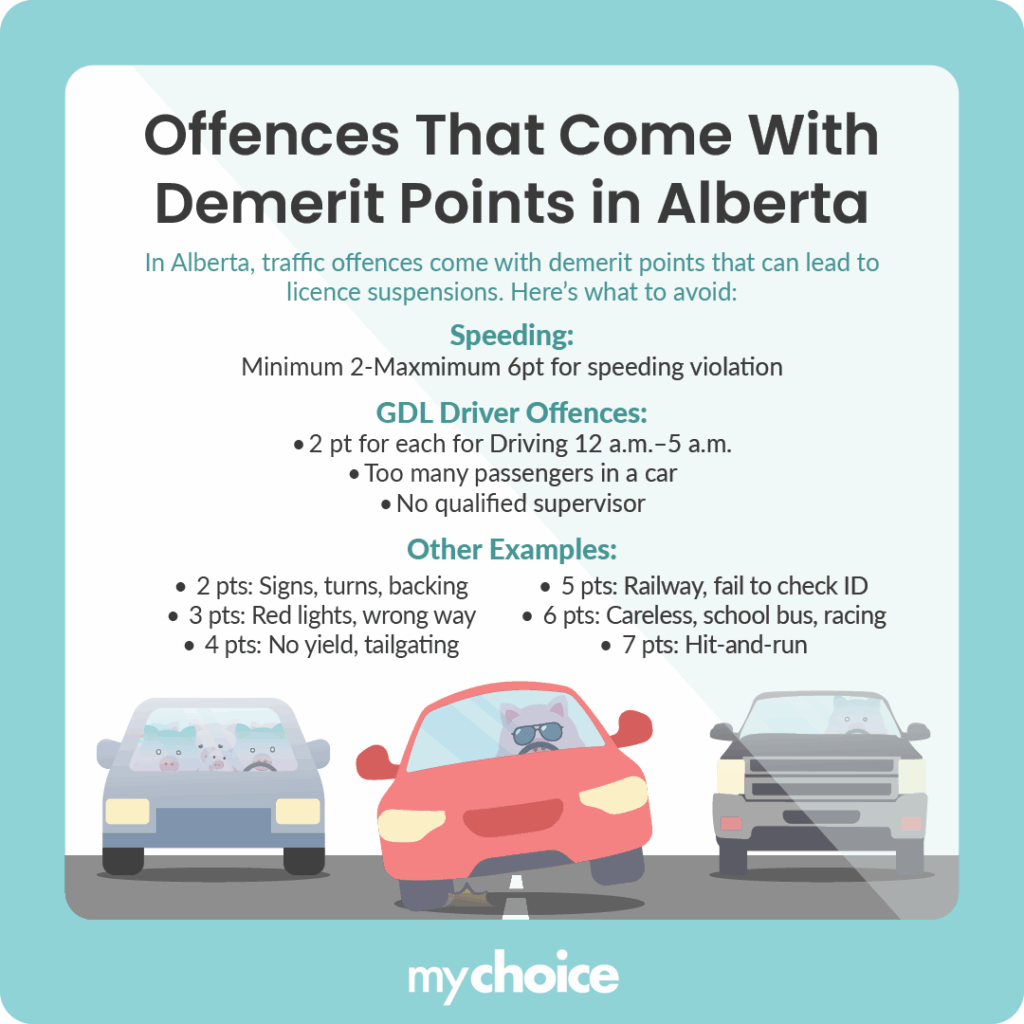
Offences That Come With Demerit Points
Different types of offences have varying demerit point penalties. Here’s an Alberta demerit points list to help you avoid committing these offences.