









Speeding tickets issued out of province don’t disappear when you get home. If you’re an Ontario-licensed driver, you’ll have to respond to the ticket in the jurisdiction where it was issued. Speeding convictions in other Canadian provinces and territories, as well as New York or Michigan, will be added to your Ontario driver’s record and attract demerit points as if you’d been convicted of an equivalent speeding offence in Ontario.
For this guide, our team checked Ontario’s current out-of-province demerit rules and FSRA’s auto-rating factors.
Do Out-of-Province Speeding Tickets Follow Ontario Drivers?
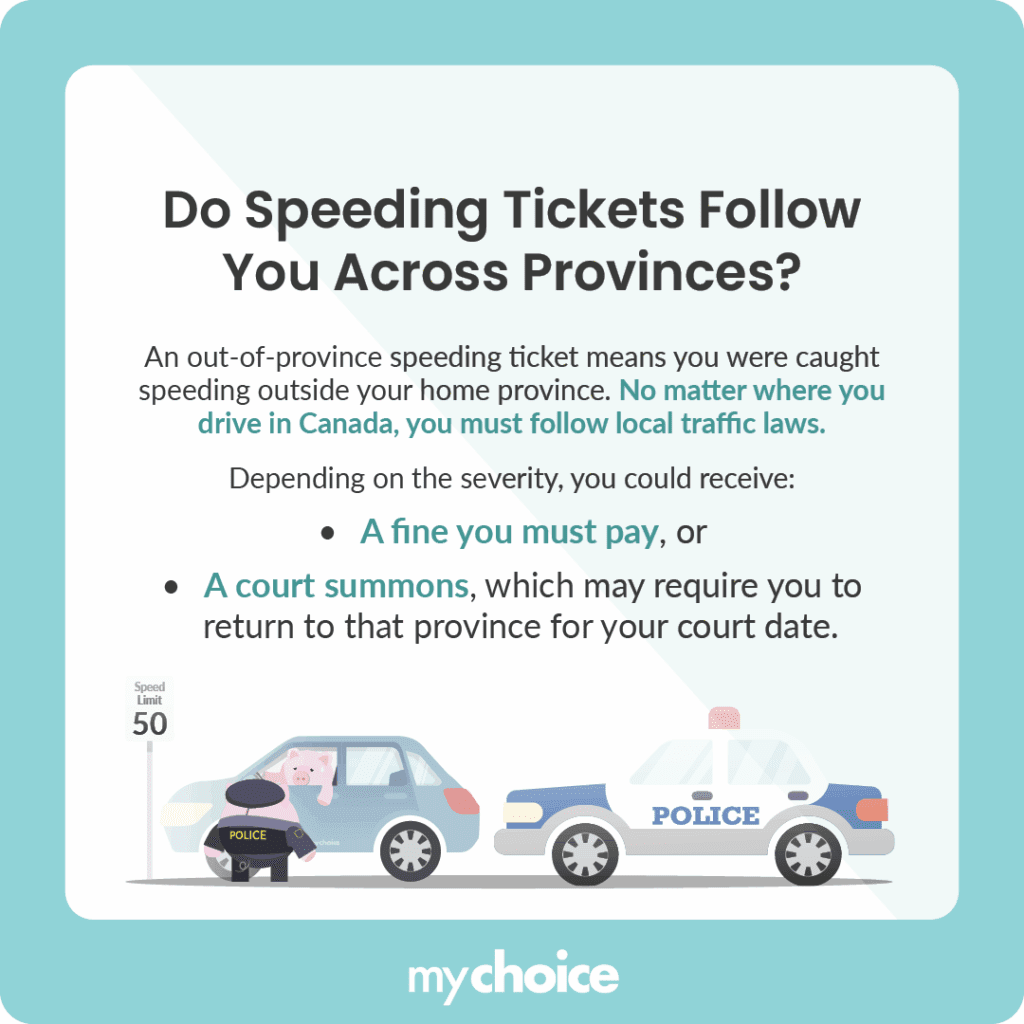
Ontario will add demerit points for convictions for certain offences committed in other provinces and territories and certain offences committed in Michigan and New York. Demerit points are assigned as though the offence occurred in Ontario.
Interestingly, you can even get your licence suspended for certain criminal convictions received outside Ontario. It’s not just for speeding either. It covers a range of offences, including not obeying a stop sign or signal, not stopping for a school bus, racing, not remaining at the scene and careless driving.
How Are the Points Calculated?
| Speed over the limit | Ontario demerit points after a qualifying conviction |
|---|---|
| 15 km/h or less | 0 |
| 16 to 29 km/h | 3 |
| 30 to 49 km/h | 4 |
| 50 km/h or more | 6 |
A qualifying out-of-province conviction does not prevent the jurisdiction where the infraction occurred from fining or prosecuting you through its own court system.
Read More: Understand Ontario Demerit Points
Can the Ticket Affect Ontario Car Insurance?
Demerit points do not cost a set amount when determining insurance rates. However, insurers will consider convictions like speeding when setting premiums. According to FSRA, speeding tickets fall under the driving convictions and driving record considered when calculating Ontario auto insurance premiums.
What MyChoice Quote Data Shows
Data from MyChoice, collected from 50,000 insurance quotes since the beginning of 2026, shows an average rate of $2,345 for an Ontario driver with a clean driving record and $3,244 with a minor speeding ticket. That is an increase of $899, or about 38%.
Rates vary by conviction, insurer, vehicle, location, coverage level and other factors. The difference shown is not necessarily what you would pay.
Source: MyChoice quote data, 2026.
Do You Have to Pay an Out-of-Province Ticket?
If you get a speeding ticket in another province, territory or state, don’t ignore it because you’ll be leaving that jurisdiction. You have to pay it or contest it through the agency that issued it. Follow the payment instructions on the ticket, pay by the deadline and save the confirmation.
Penalties for non-payment vary depending on the court or transportation authority that issued the ticket. Contact that court or authority for more information.
Can You Dispute the Ticket Without Travelling Back?
Sometimes, but never assume that’s an option without contacting the court. Read your ticket, then visit the issuing court’s website or call the clerk to find out whether a written, remote or video appearance is available. Appearance options vary widely among courts.
If you face a more serious allegation, a licence suspension, penalties affecting novice drivers or a U.S. proceeding, seek advice from a licensed professional in that jurisdiction. An early-resolution option may let you speak with the prosecutor, but it does not guarantee a reduced charge or a zero-point outcome.
A Practical Response Checklist
Note the name of the issuing authority, offence, recorded speed, deadline to pay or fight the ticket and the court’s contact information. Check with the court for more information about paying or fighting your ticket by mail or online. Save the receipt or confirmation showing how you dealt with the ticket. You can request your Ontario driver’s record later to make sure the offence has been properly noted.
Read More: See How Red-Light Camera Tickets Differ