









Review your car's market value. Decide if physical-damage coverage makes sense. Many people drive less in retirement. If you're not commuting daily, tell your insurer how you use the car, ask about retiree discounts and confirm the qualifications. Shop around for comparable coverage.
For this guide, our team reviewed Ontario’s current licence-renewal process for drivers 80 and older, FSRA’s Ontario auto application and its premium-saving guidance.
Read More: Learn About Car Insurance for Senior Drivers
What Do Older Ontario Drivers Pay?
Age is just one rating factor. Your licensing and insurance history, claims or convictions, vehicle details, postal code, coverage choices, annual kilometres driven and insurer can have a greater effect on your individual rate.
What MyChoice Quote Data Show
Based on our internal data on Ontario’s typical driver profiles since the beginning of 2026, the median quote for those aged 35–44 is $2,345. It decreases to $2,093 for those aged 55–64 and $1,714 for those aged 65 and older.
Location, car, coverage, driving history and other individual circumstances mean a senior’s rate may not match provincial trends. These comparisons are not quotes for every senior but reflect age bands applied to a standard profile.
1. Check Whether You Qualify for Ontario’s Retiree Discount
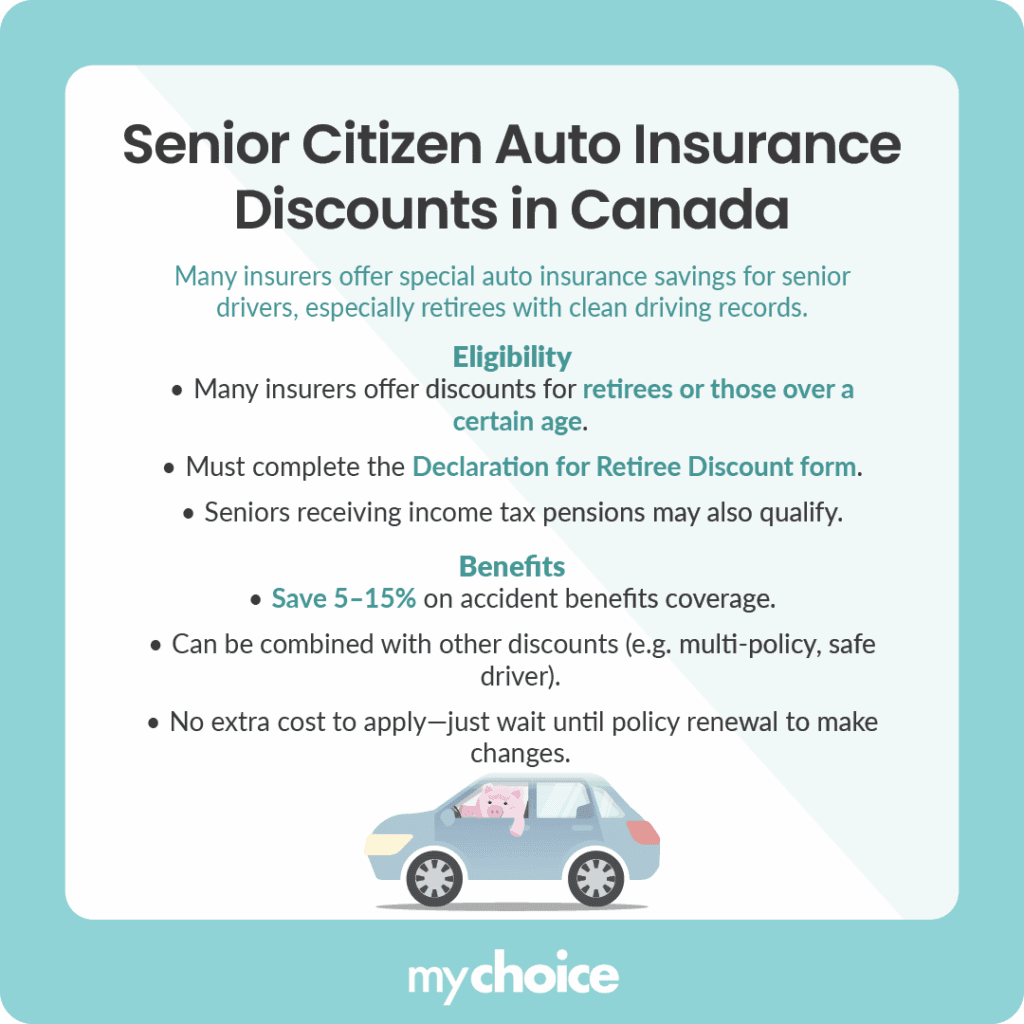
FSRA's Ontario application says you may qualify if you are the vehicle’s principal operator, are retired, have not been employed for 26 weeks or more in the previous 52 weeks, do not receive employment income and are not engaged in a profession or business.
You must also be at least 65 or receive a pension under the Canada Pension Plan, Quebec Pension Plan or a pension registered under the Income Tax Act. Your agent or broker may ask you to sign a declaration.
Ask if you can get the discount, which part of the premium it affects, and how many dollars that means in your quote.
2. Update Your Annual Kilometres and Vehicle Use
Ask about low-mileage pricing plans. Tell your insurer if your situation changes. If you drive fewer kilometres or store the car elsewhere, you might be eligible for a rate reduction. Give accurate distance estimates and ask about pay-per-kilometre and other plans for occasional drivers.
Read More: See Car Insurance Options for Low-Mileage Drivers
3. Review Collision and Comprehensive Coverage
If the car is older and the lender or lessor doesn't require physical-damage coverage, consider whether it’s worth it. Can you afford to lose the car or have it stolen?
If so, compare its cash value with what you’re paying for Collision and Comprehensive coverage, including the deductibles. If the maximum potential payout is relatively small, you may want to drop the coverage.
Read More: See When Collision Coverage May Still Be Worth It
4. Compare the Whole Household Price
Bundle discounts for multiple policies, vehicles or home and auto may save money, but don’t focus only on the discount.
This might unlock some savings opportunities.
5. Ask About a Rate Increase
If your premium changes at renewal, ask your broker or insurer why this happened. Double-check your policy details, specifically your listed drivers, address, discounts, coverages and deductibles.
What Are Ontario’s Licence-Renewal Rules at Age 80?
In Ontario, you must renew a G licence every two years once you become 80 years old. The province sends a renewal notice with instructions. Before the appointment, watch the senior-driver video and consult the Driver’s Handbook.
At the appointment, staff will check your vision, and you will complete a five-minute screening exercise without a computer.
A road test does not automatically follow the screening. Ontario may require a road test, further medical information or an additional vision test.
Read More: See What Age Can Mean for Car Insurance Rates
Questions to Ask at Renewal
When changing your policy, ask whether a retiree declaration is on file, what annual kilometres and vehicle use are recorded, which discounts apply, what each optional coverage costs, which deductibles apply and whether joining a usage-based insurance program will affect the price. Get the answers in writing.