









If you’re trying to figure out where the line actually sits before you drive after a drink or you’ve just been stopped and want to know what kind of fine you’re facing, our article lays out Ontario’s limits and the penalties in plain terms. We have carefully reviewed the province’s impaired-driving rules to compile this guide.
Read on to learn about the legal limit, the warn range, the zero-tolerance rules, and what will happen after a conviction, including court penalties and your insurance premium.
What Is the Legal Blood Alcohol Limit in Ontario?
In Ontario, the criminal blood-alcohol limit for a fully licensed driver is 0.08% (80 mg of alcohol per 100 mL of blood), and hitting it can bring a criminal charge.
Below that, a BAC in the 0.05–0.079 “warn range” still triggers immediate administrative penalties — a 7-day licence suspension and a $250 penalty on a first occurrence.
Does an Impaired Driving Violation Affect My Insurance?
Yes, being charged with an impaired driving offence can impact your current policy and your ability to get auto insurance in the future. Your insurance provider could either cancel your policy or raise your premium rate significantly.
A DUI offence can increase your car insurance rates by 100-300% depending on the insurer and the type of policy you have.
When applying for insurance coverage with an impaired driving charge or conviction on your record, you’re likely to be classified as a high-risk driver by insurance providers.
Read More: Navigating Car Insurance After a DUI Conviction in Canada
What Is the Ontario BAC Limit for Young and New Drivers?
The BAC limit for young and new drivers in Ontario is anything above zero. Ontario has a zero-tolerance policy for drivers aged 21 or under, as well as drivers of any age who hold a G1, G2, M1, or M2 license. In short, young and novice drivers cannot drive with any alcohol in their systems.
Why Are Rules for Young Drivers so Strict?
According to Statistics Canada’s 2015 police-reported data, drivers between the ages of 20 and 24 years old recorded the highest rates of impaired driving at 480 incidents for every 100,000 drivers.
What Is the Ontario BAC Limit for Commercial Drivers?
The BAC limit for commercial drivers in Ontario is also zero or above. This means that anyone operating a commercial vehicle with licence classes such as A, B, C, D, E, or F or Commercial Vehicle Operator’s Registration (CVOR) cannot have any trace of alcohol (or drugs) in the system when operating a commercial vehicle.
Commercial vehicle drivers caught with any drugs or alcohol in their systems could face a three-day immediate roadside license suspension and up to $450 in fines. They must complete an education or treatment program. Drivers whose licenses are suspended will also have to shell out money to have them reinstated.
What is the Definition of Impaired Driving in Ontario?
According to the Ontario Ministry of Transportation, impaired driving means “operating a vehicle while your ability to do so has been compromised by the consumption of alcohol, drugs, or a combination of the two”. Impaired driving laws don’t just cover driving cars and trucks, but also off-road vehicles, boats, and snowmobiles. (Government of Ontario).
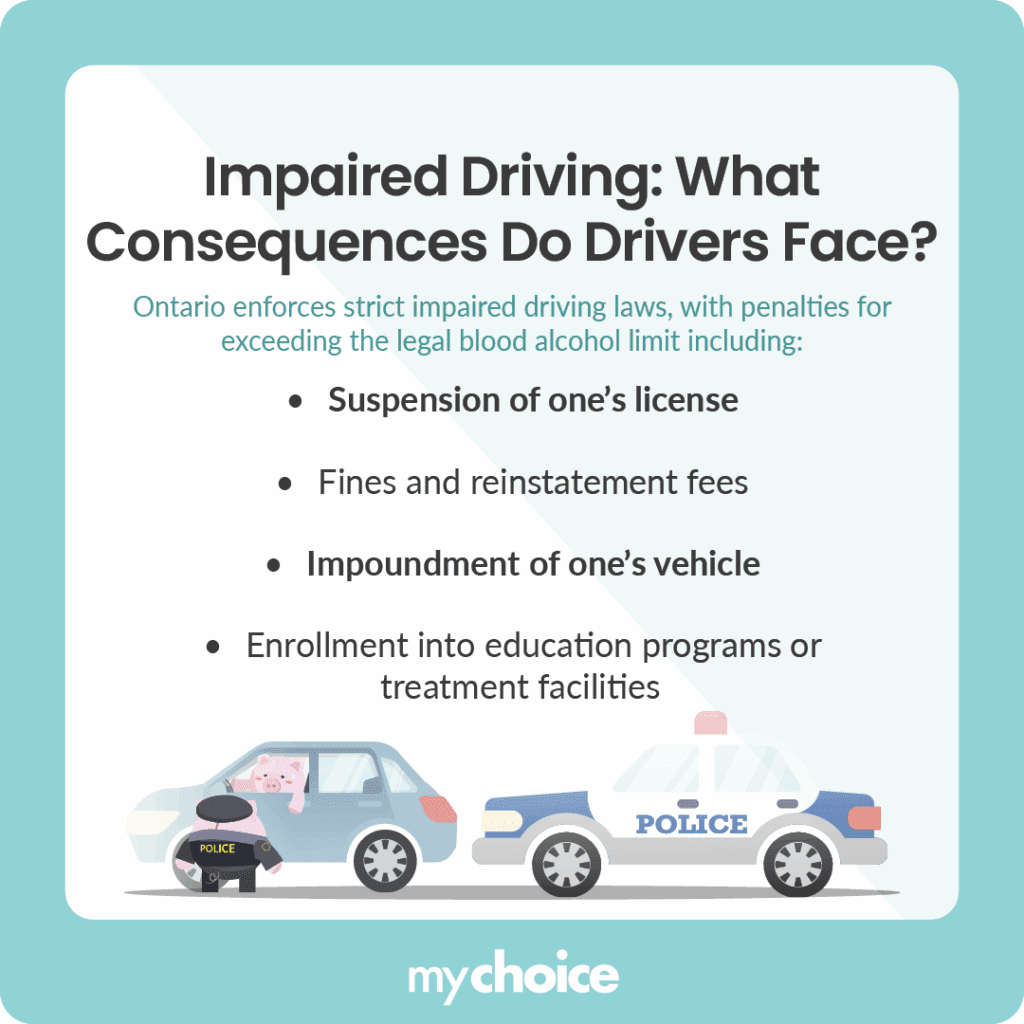
What Are the Penalties for Impaired Driving in Ontario?
Here is a list of the penalties that drivers who are caught drinking and driving in Ontario could face:
| Offence Type | First Offence | Second Offence | Third Offence |
|---|---|---|---|
| Warn range (BAC 0.05–0.079) or failed sobriety test | 7-day immediate licence suspension; $250 penalty; 8-hour education course | 14-day immediate licence suspension; $350 penalty; 16-hour education course | 30-day immediate licence suspension; $450 penalty; 16-hour treatment program; Ignition interlock condition for 6 months |
| BAC ≥0.08 or refusing alcohol/drug test | Immediate roadside 90-day licence suspension; 7-day vehicle impoundment; $550 penalty; 8-hour education course | Immediate roadside 90-day licence suspension; 7-day vehicle impoundment; $550 penalty; 16-hour treatment program | Immediate roadside 90-day licence suspension; 7-day vehicle impoundment; $550 penalty; 16-hour treatment program; Ignition interlock condition for 6 months |
| Drivers under 21 or with G1, G2, M1, M2 licence (zero tolerance) | 7-day immediate roadside suspension; $60–$1000 fine if convicted; $250 penalty; 8-hour education course | 14-day immediate roadside suspension; $60–$1000 fine if convicted; $350 penalty; 16-hour treatment program | 30-day immediate roadside suspension; $60–$1000 fine if convicted; $450 penalty; 16-hour treatment program; Ignition interlock condition for 6 months |
| Commercial vehicle drivers (zero tolerance) | 3-day immediate roadside suspension; $250 penalty; 8-hour education course | 3-day immediate roadside suspension; $350 penalty; 16-hour treatment program | 3-day immediate roadside suspension; $450 penalty; 16-hour treatment program; Ignition interlock condition for 6 months |
How Long Does Impaired Driving Stay on Your Driving Record?
A conviction for impaired driving remains on your driving record for:
- 3 years (if your license wasn’t suspended)
- 6 years (if your license was suspended)
When it comes to insurance companies, they will typically factor a DUI into your rates for 6 years.
How Many Beers Can You Drink and Drive in Ontario?
The number of beers you can drink without going over the legal limit in Ontario depends on several factors, including how far apart you drink those beers, how much time passes between your last drink and the moment you get in your car, your weight, metabolism, and even your gender.
In general, smaller people have a slower metabolic rate, or the rate at which alcohol is removed from the blood. Women also tend to metabolize alcohol more slowly than men.
In practice, there is no dependable formula: the same drinks produce different BAC readings in different people depending on weight, body composition, food, and how fast they drink. Because the only BAC guaranteed to keep you under every Ontario threshold is zero, the safe planning assumption is that if you’ve been drinking at all, you shouldn’t drive.