









You cannot drive while suspended. Once your licence is valid again, you must have auto insurance before driving. An impaired-driving conviction significantly affects your insurance. Your rates may be higher, and insurance companies may even refuse to insure you. In this situation, you may need a broker to find coverage from a non-standard insurance company or the Facility Association.
For this article, our team reviewed the federal Criminal Code, Ontario’s updated impaired-driving rules, FSRA’s high-risk and declined-policy guidance, and the Facility Association.
How Does a DUI Conviction Affect Car Insurance?
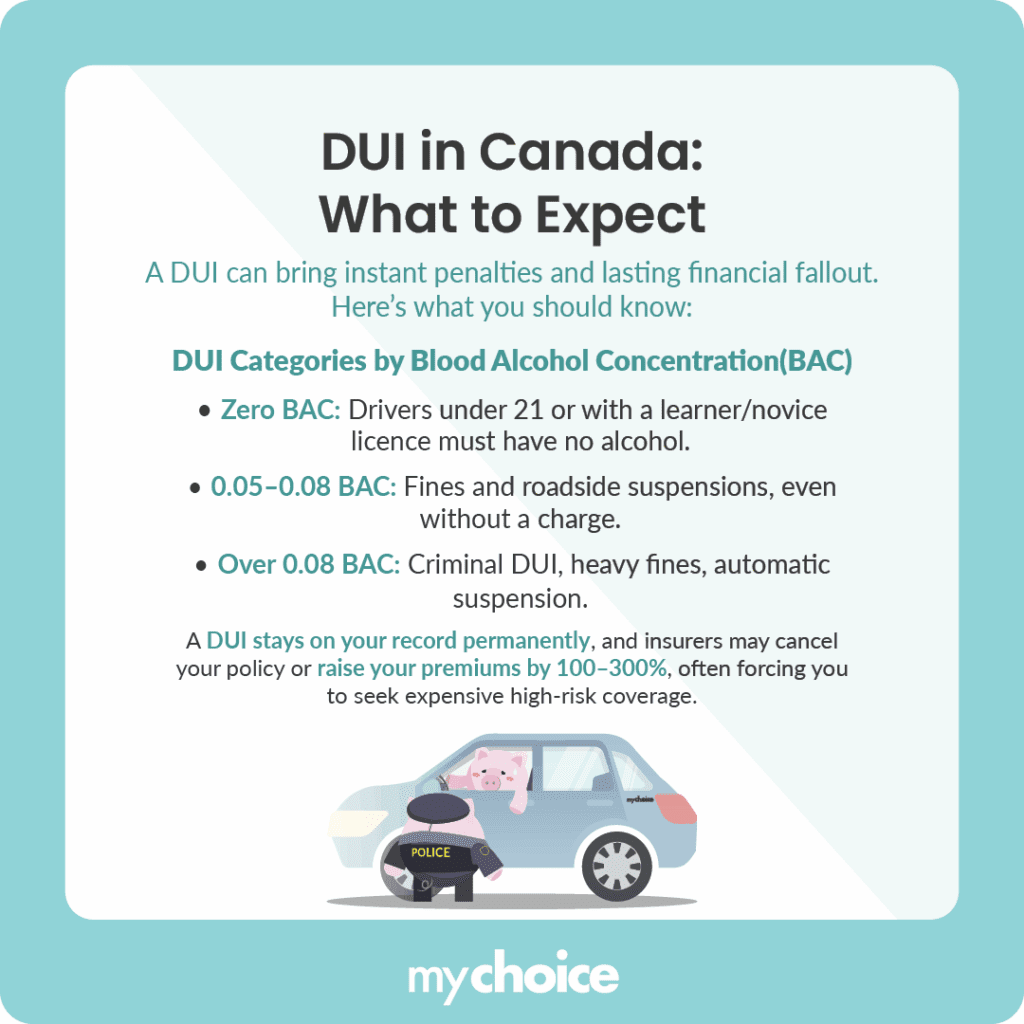
A conviction is an important part of the driver’s profile. The insurer may apply a higher approved rate because of the conviction. Also, under an approved underwriting rule, an Ontario insurer can reject your application or decide not to renew your insurance. If it declines or does not renew, FSRA requires the insurer to put in writing which underwriting rule applied.
You may not drive until your licence is valid, you’ve completed any mandatory programs or other reinstatement requirements, including installing an ignition-interlock device if applicable, and an insurance representative has confirmed that you and your vehicle are insured. Remember that roadside suspensions, criminal prohibitions and provincial licence suspensions are all different. Insurance coverage decisions are different. Follow the conditions and dates outlined by the licensing authority.
Read More: See How High-Risk Auto Insurance Works in Ontario
What MyChoice Quote Data Shows in Ontario
Using 50,000 car insurance quotes collected on the MyChoice platform since the beginning of 2026, we looked at how car insurance rates change after an impaired-driving conviction. For a hypothetical, standardized driver in Ontario, quotes averaged $2,345 per year without any offences and $5,661 with an impaired-driving conviction.
Keep in mind that this cost difference won’t apply to everyone. In this comparison, the difference was $3,316, or about 141%.
Read More: Learn More About Car Insurance in Ontario
Where Can You Get Insurance After a DUI?
Always ask for quotes with the same limits of liability, accident benefits, physical-damage coverage, deductibles and endorsements. Tell the broker or agent all details of any conviction, any licence suspensions and the date your licence was or will be reinstated. Be sure to let them know if you’re required to have an ignition-interlock device.
| Market | When it may apply | What to ask |
|---|---|---|
| Standard insurer | The conviction fits the insurer’s approved rules | Is the quote final after the driving record is checked? |
| Non-standard insurer | A standard insurer will not accept the recent record | Which conviction, cancellation and payment rules apply? |
| Facility Association | You cannot obtain required coverage in the regular market in a participating jurisdiction | Which broker will place it, what coverage is included and when should you shop again? |
Drivers in Ontario, Alberta, the Atlantic provinces and the territories may be able to obtain coverage through Facility Association. The systems in British Columbia, Manitoba, Saskatchewan and Quebec combine public and private insurance differently. Follow local licensing and insurance guidance rather than Ontario’s penalty schedule.
Costs Beyond the Base Premium
Ask for a breakdown of each insurance quote and compare the annual price.
Keep in mind that requirements vary by jurisdiction. Budget for licence reinstatement fees, ignition-interlock installation and monitoring, alternate transportation if you have a suspension, any required programs and legal obligations. Budget separately for costs that may be required of you but won’t be considered insurance costs.
How to Work Back Toward Standard Rates
Shop around before renewing your insurance, and make sure the quotes you’re getting include the same coverage. Follow all conditions and court orders. Keep documents proving your licence has been reinstated and programs have been completed. Make all insurance payments on time. Avoid any further convictions or claims.
No course guarantees a discount. There is no single Canada-wide time frame. Insurers follow their own rules about how convictions affect your eligibility and insurance rates. If you’ve been convicted, ask each insurer about its current policies regarding convictions. Time and full disclosure can help.
Read More: Review Ontario’s Rules for Driving Without a Licence