









To better understand whether winter tire discounts actually influence driver behaviour, our team analyzed long-term winter tire adoption trends, Canadian collision data and consumer survey research. We compared data from the Tire and Rubber Association of Canada (TRAC), Quebec’s winter tire legislation research and more than 200,000 insurance quotes collected through the MyChoice platform since 2020 to see whether increasing winter tire use has coincided with improvements in winter road safety.
Read on to learn how winter tire discounts work, whether they reduce insurance costs and what the research says about their impact on road safety.
Winter Tire Usage and Collision Rates in Canada
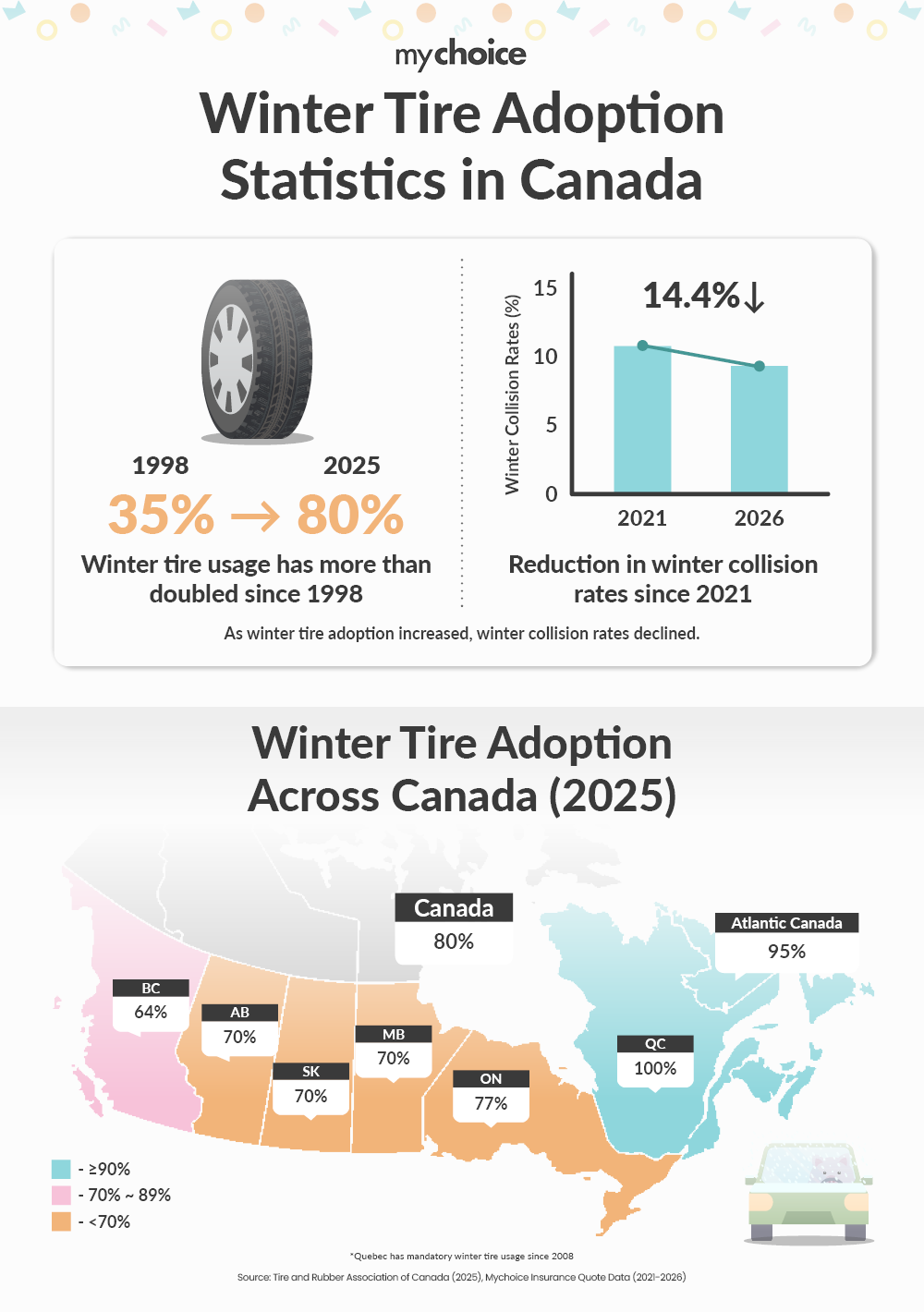
- According to the Tire and Rubber Association of Canada, the use of winter tires in Canada grew from 35% in 1998 to 80% in 2025.
- Data from MyChoice, based on over 200,000 insurance quotes, shows that the percentage of drivers reporting winter collisions dropped from 10.78% in 2021 to 9.23% in 2026.
- About 24% of Canadian drivers say they install winter tires partly to get lower insurance premiums.
- About 84% of people who use winter tires say the tires have helped them avoid a dangerous driving situation.
- After Quebec introduced its mandatory winter tire law, winter collisions dropped by 5%, while deaths and serious injuries fell by 3%.
How Insurance Incentives May Help Reduce Winter Collision Rates in Canada
In 1998, just 35% of Canadians used winter tires, which at the time were widely viewed as optional. Today, Canadians clearly understand the importance of the right rubber: 80% of Canadians reported using winter tires in 2025, up from 72% in 2020, according to the Tire and Rubber Association of Canada.
The increase in winter tire adoption has coincided with a decline in winter collisions reported through MyChoice. Data collected on our platform, based on more than 200,000 insurance quotes since 2020, shows the percentage of quoted drivers reporting winter collisions fell from 10.78% in 2021 to 9.23% in 2026. That represents a roughly 14% decline over the period.
Several factors have compelled Canadians to make the seasonal switch, and insurance incentives appear to be one of them.
“Insurance is often viewed as something that responds after an accident, but some of the industry’s biggest successes happen before a claim ever occurs,” says Aren Mirzaian, CEO of MyChoice. “Winter tire discounts are a good example of how relatively small incentives can encourage safer driving behaviour at scale. When more drivers adopt proven safety measures, everyone benefits through fewer collisions, lower claims costs, and ultimately more stable insurance premiums.”
Why Have Canadians Become More Likely to Use Winter Tires?
Consumer education around winter tires has come from many sources over the past few decades, including automakers, tire manufacturers, insurance stakeholders and automotive media.
According to TRAC’s 2025 Winter Tire Report:
- 76% of Canadians believe extreme weather linked to climate change has made winter tires more important than ever.
- 70% believe winter tires provide a safety advantage in cold weather.
- 81% feel winter tires are an important investment despite rising cost-of-living pressures.
- 84% of those who use winter tires report that they’ve helped them avoid potentially hazardous driving situations, such as loss of control or a collision.
The Insurance Industry’s Influence on Driver Behaviour
Quebec is an obvious example: winter tires have been mandatory in the province since 2008. A 2011 survey by the Ministère des Transports et de la Mobilité durable showed a 5% reduction in winter collisions and a 3% reduction in deaths and serious injuries in the first two seasons of enforcement.
British Columbia makes winter tires mandatory on designated highways during the winter. Otherwise, there are no Canadian provinces or territories that require winter tire use.
Ontario and Newfoundland and Labrador have legislation requiring insurers to offer a discount for drivers who install qualifying winter tires on their vehicles. In other provinces and territories, insurers may offer voluntary discounts for winter tire use, but consumers need to shop around to find them.
According to TRAC data, insurance discounts affect consumer decision-making around winter tires. Lower insurance rates are cited by 24% of Canadian drivers as a reason to install winter tires.
The Takeaway
Survey data from TRAC and MyChoice suggests that insurance discounts play a role in encouraging winter tire adoption and may contribute to broader road-safety improvements.
Winter tires are only one part of the equation. Following good winter driving safety practices can further reduce the risk of collisions during Canada’s most challenging driving months.
Read More: Top 10 Winter Tires for Canadian Winters