








Do School Buses Have Cameras in Ontario?

3 minutes can save you hundreds. Enter your postal code below and join thousands of Canadians saving on car insurance.

Secure. No Spam. No Fees.

Why You Can Trust MyChoice

MyChoice serves as an independent intermediary between you, financial institutions and licensed professionals without any additional charge to our users. In the interest of transparency, we disclose that we partner with some of the providers we write about – we also list many financial services without any financial gain. MyChoice does not operate a financial institution or brokerage and to ensure accuracy, our content is reviewed by licensed professionals. Our unique position means that we hold no recurring stake in your policy, ensuring our mission to help Canadians make better financial decisions is free of bias or discrimination. 

Updated on February 15, 2026

3 minute read

MyChoice follows a strict content review process designed to ensure reliable and unbiased information.

School Bus Cameras in Ontario At a Glance

  • Roughly 20,000 school buses operate in Ontario daily, and cameras help keep the passengers safe. 
  • While not mandated by law, most school buses in Ontario are equipped with cameras to monitor student behaviour and ensure safety. 
  • School bus cameras can be located on the vehicle’s dash, side, or stop arm.
  • Stop-arm camera photos are now legally admissible in court as proof of an offence without a police officer present.
  • A conviction for passing a school bus results in six demerit points, which remain on your record for two years.
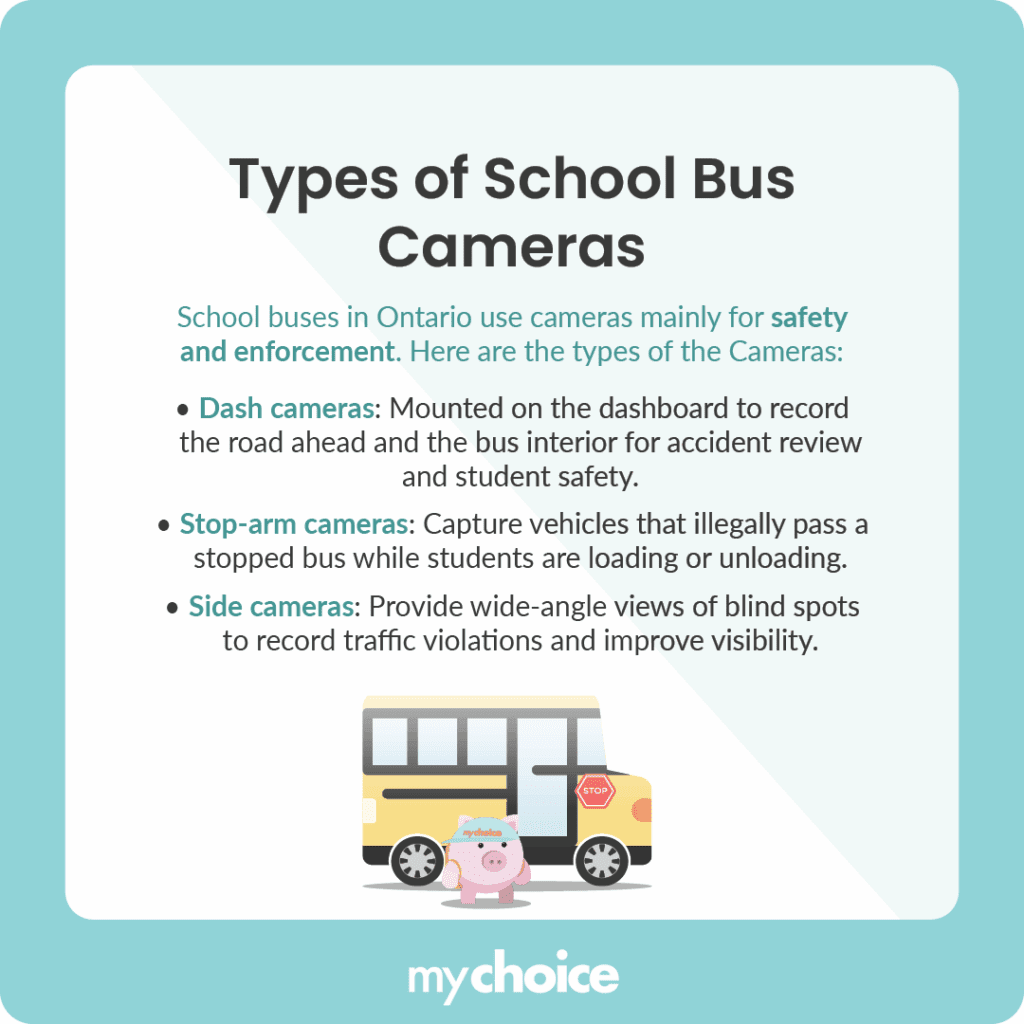
Types of School Bus Cameras

Why Do School Buses Have Cameras?

School buses in Ontario have cameras for the following purposes: 

  • Student safety: Interior school bus cameras help monitor student behaviour and identify safety hazards on board. They help ensure a safe environment free of bullying, vandalism, or other inappropriate behaviour by students or drivers. School bus cameras can also provide parents with peace of mind.
  • Traffic enforcement: Cameras attached to a school bus’s stop-arm can capture footage of vehicles that illegally pass the bus while it’s stopped to load or unload students. Evidence captured on these cameras can be used to fine or charge drivers who violate road safety laws.

In 2023, the Municipality of North Perth invested up to $16,500 in camera installations, equipping ten buses from Elliot Bus Lines and Newry Coach Lines. They mounted each camera under the stop arm and continuously uploaded the footage to a secure online portal for Perth County OPP access. 

When Can You Legally Pass a School Bus?

You are only permitted to pass a stopped school bus from the opposite direction if the road is divided by a median strip (a physical barrier). On any other undivided road, traffic in both directions must stop when red lights are flashing or the stop arm is out. You should always halt your vehicle when a school bus’s stop arm is out while you are in the same lane.

Failing to stop for a school bus carries a mandatory range of fines. For a first offence, the fine is between $400 and $2,000, plus six demerit points. For subsequent offences within five years, fines increase to between $1,000 and $4,000, and you may face up to six months in jail.

Types of School Bus Cameras

School bus cameras are available in various options, each designed to perform specific tasks. Below are a few standard options for school bus cameras:

These cameras are mounted on the dash of a school bus and capture the road ahead and the bus’s interior. They’re ideal for investigating accidents, observing the driver, and helping to ensure student safety.

These cameras record vehicles and individuals that pass a parked bus as they let passengers on and off. 

Unlike stop-arm cameras, side cameras have wider-angle views of areas with limited visibility, providing additional evidence of traffic violations.

What Features Should a School Bus Camera Have?

For a school bus camera to improve operations and enhance safety, it should have the following features: 

High-quality video resolution:

The camera should provide clear and detailed footage that can help identify individuals or vehicles. It should ideally have a wide-angle lens that can capture a more extensive area of the bus and night vision to get clear footage in low-light conditions.

GPS data:

Timestamps and location information can optimize bus routing and provide critical incident details. GPS tracking can also enhance a driver’s response time in an emergency.

Secure storage and remote access:

Footage should be kept securely to ensure privacy, while remote access should be limited to trusted school officials and transportation departments. 

Tamper-proofing:

Cameras should be tamper-proof to preserve evidence and integrity.

Specific Policies and Practices

Specific school bus camera policies and practices may vary depending on your location within Ontario. Factors that may influence these policies include the following: 

School board regulations:

Your school board’s policy regarding where it places school bus cameras and who can access the footage may differ from others. 

Municipal bylaws:

Some municipalities may enforce bylaws regarding camera placement, privacy concerns, and data retention. 

Provincial legislation:

Schools must adhere to minimum surveillance standards and guidelines set by Ontario’s provincial government.

You can gather more information about these policies and practices by contacting your school board, visiting your municipality’s official website, reading the news, or speaking to someone in your local government.

Does Car Insurance in Canada Cover School Bus Accidents?

In Ontario, school bus accidents are covered under the standard Statutory Accident Benefits (SABS) framework.

Regardless of who is at fault, anyone injured, including the driver, passengers, or even pedestrians struck by the bus, can claim medical, rehabilitation, and attendant care benefits through their own auto insurance or the bus company’s policy. 

Whatever the case, knowing what to do after a car accident is imperative to ensure the best outcome for your personal safety.

Key Advice from MyChoice

  • Generally, it’s best to slow down when driving in a school zone. Never pass a school bus if the stop arm is out.  
  • You can tell a school bus camera is recording by noticing the status LED, which typically blinks red. 
  • Know how to drive safely, especially at night. Be aware of blind spots when driving around a school bus.

Congratulations! You made it to the end!

Now, here is the easy part: complete your quote in under 2 minutes

Discover More About

February 27, 2026
Chinese EVs are coming to Canada. Here’s how much BYD, MG and other models could cost to insure, with provincial breakdowns and projections.
February 10, 2026
Car repair costs rose 4.1% in Canada in 2025. View our breakdown of provincial repair trends, labour shortages, and what they mean for auto insurance rates.
January 26, 2026
In this MyChoice study, we analyzed data collected on our platform to compare insurance costs of popular electric cars with similar gas vehicles.

Even More Ways To Save on Insurance