









Window tint can make a car look cooler, but it can also create a visibility problem, fail a safety inspection or lead to a traffic ticket. Ontario drivers also need to know that the roadside law and the safety-certificate inspection standard do not use exactly the same test.
To prepare this guide, the MyChoice editorial team reviewed sections 73 and 74 of Ontario’s Highway Traffic Act, the province’s Passenger/Light-Duty Vehicle Inspection Standard, the current Ontario Court of Justice set-fine schedule, Ontario’s standard OAP 1 auto policy and FSRA’s guidance on approved rating and underwriting rules. We used those sources to separate what the law says, what an inspection station checks, what a tint ticket currently costs and when a modification or conviction can matter to an insurer.
Keep reading to learn whether tinting can affect your insurance, which windows are restricted, what the 70% rule actually means and what to check before an installer applies the film.
Will Tinting My Car Windows Affect My Auto Insurance?
Usually, legal window tint does not trigger an automatic insurance surcharge. Ontario insurers use rates and underwriting rules filed with FSRA, so there is no province-wide rule that adds a fixed amount simply because a car has tinted windows.
There are still two insurance issues to consider. First, the standard OAP 1 policy requires you to report a change that may increase the risk or affect the insurer’s willingness to cover you or the rate it charges. Ask your broker or insurer before installation if your application asks about vehicle modifications, the film is unusually expensive, or you are unsure whether the change needs to be disclosed. Keep the installer’s invoice and product specifications.
Second, a conviction for illegal tint can appear on Ontario’s three-year driver record. A conviction does not produce the same increase for every driver. The effect at renewal depends on the offence and the insurer’s approved rating and underwriting rules. FSRA notes that convictions are one of the circumstances that can affect a driver’s premium or eligibility.
Tint also does not automatically void a claim. However, an insurer can examine whether an illegal or unsafe modification contributed to a collision and whether the policyholder met the duties in the policy. If you want certainty before paying for tint, describe the planned film and windows to your broker or insurer and ask for the answer in writing.
Read More: Do Parking Tickets Affect Your Car Insurance Rates?
Is Tinting Car Windows Legal in Ontario?
Yes, but Ontario’s Highway Traffic Act uses visibility tests rather than one universal tint percentage for every window. Section 73 prohibits a windshield or window coating that obstructs the driver’s view. It also prohibits coloured or reflective material on the windshield or the windows directly beside the driver when it substantially obscures the vehicle’s interior from outside.
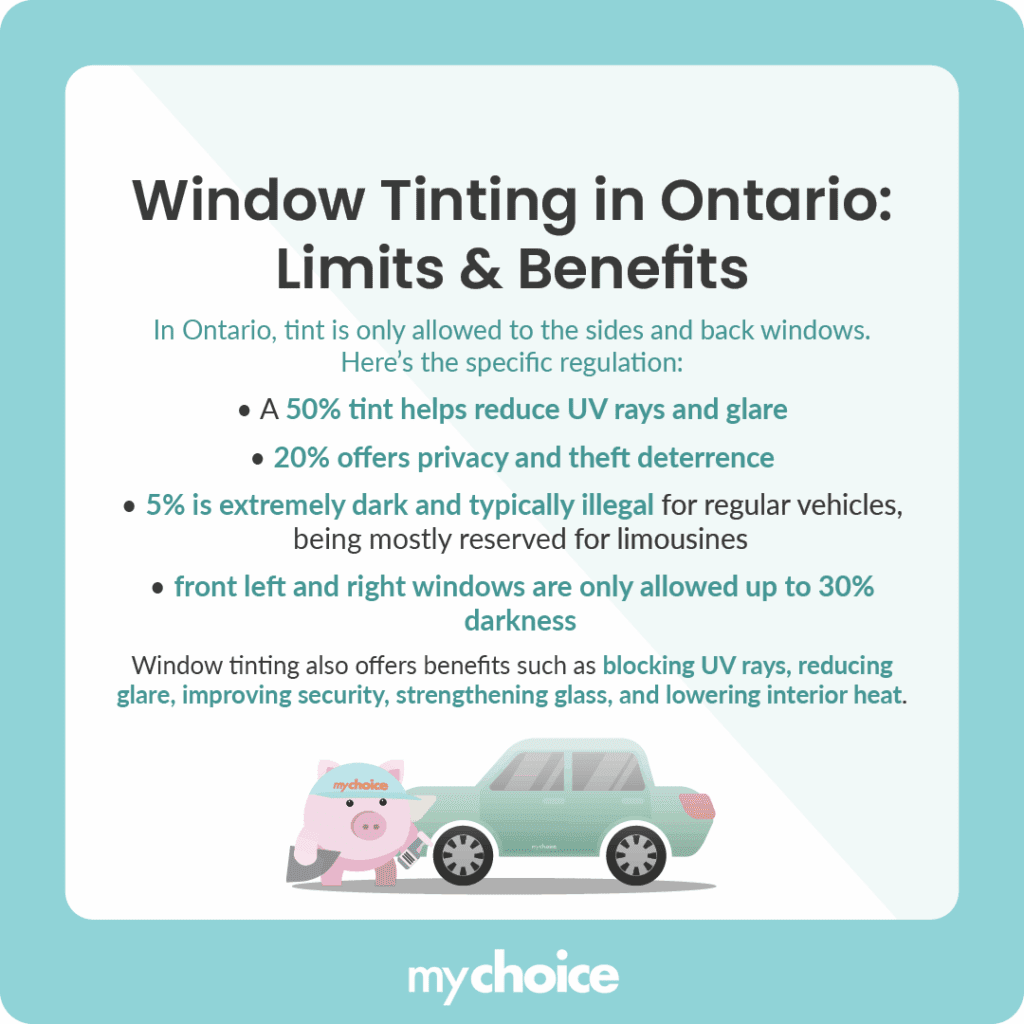
What are the legal Tint Percentages in Ontario?
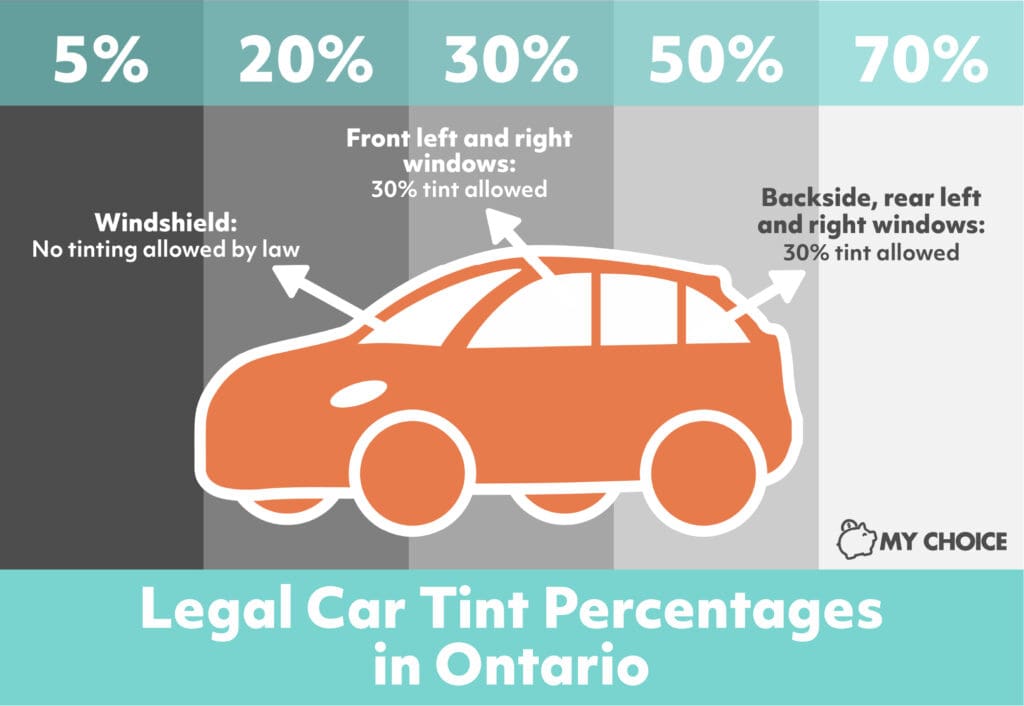
Remember: the lower the visible light transmission (VLT) percentage, the darker the window. VLT measures how much visible light passes through the factory glass and tint film together.
- 50% tint lets through about half the visible light. This is not an official legal category in Ontario. On a vehicle built on or after January 1, 2017, it would be too dark for the windows beside the driver — those must have at least 70% combined VLT to pass a safety inspection.
- 20% tint is much darker and can make it hard to see inside the vehicle. It does not meet the 70% front-side-window requirement for 2017 or newer vehicles. It may be used on rear side windows if it does not block the driver’s required view.
- 5% tint (sometimes called “limo tint”) lets very little light through. It also fails the front-side-window inspection standard for 2017-or-newer vehicles. It can be installed on rear windows, but a very dark tint reduces visibility at night. If the rear window no longer gives a clear view, the vehicle must have mirrors that do.
Ontario’s Highway Traffic Act does not list 50%, 20%, or 5% as legal tint levels. It requires that the tint not obstruct the driver’s view and that the front windows not substantially hide the interior from outside. Separately, the safety-inspection standard requires at least 70% combined VLT on the front side windows of vehicles manufactured on or after January 1, 2017. Those vehicles also cannot have aftermarket windshield tint if manufactured on or after January 1, 2017. These vehicles also cannot have aftermarket tint on the windshield.
How to Check the Tint Levels of Your Car?
Visible light transmission (VLT) is the percentage of visible light that passes through the glass and film together. A lower number means a darker tint. Do not rely on a phone app to decide if a tint is legal. Camera settings, screen brightness, and surrounding light can throw off the reading. Ask the installer to measure the existing glass with a calibrated meter before choosing the film, then measure again once the film is installed. Get the final combined VLT reading in writing. Keep the invoice, film specs, and warranty. If a police officer or inspection station questions the tint, their official assessment is what counts — not an app reading or the product label.
Why Is There a Tinting Windows Law in Ontario?
The rules are there to protect visibility. A driver needs to see pedestrians, cyclists, other vehicles, and road hazards in changing light and weather. Police also need to be able to see into the vehicle through the front area. A tint that works for one purpose can still be too dark or too reflective for safe driving.
What is the Fine for Illegal Tint in Ontario?
The current Ontario Court of Justice schedule sets an $85 fine for a section 73 offence involving an obstructed or coated windshield or window, or a coloured coating that obscures the interior. The total amount on a ticket can be higher once the victim fine surcharge and court costs are added. Check the current set-fine schedule rather than relying on older figures, as the amounts can change.
What Should You Ask Before Booking an Installer?
- What year was the vehicle manufactured, and which inspection rules apply?
- What is the existing VLT of the factory glass?
- What will the combined glass-and-film VLT be on each front side window?
- Will any aftermarket film be placed on the windshield of a 2017-or-newer vehicle?
- Can the installer provide the product specifications, final measurements, invoice and warranty in writing?
- Has your broker or insurer confirmed whether the modification must be disclosed?