








How to Boost a Car Battery

3 minutes can save you hundreds. Enter your postal code below and join thousands of Canadians saving on car insurance.

Secure. No Spam. No Fees.

Why You Can Trust MyChoice

MyChoice serves as an independent intermediary between you, financial institutions and licensed professionals without any additional charge to our users. In the interest of transparency, we disclose that we partner with some of the providers we write about – we also list many financial services without any financial gain. MyChoice does not operate a financial institution or brokerage and to ensure accuracy, our content is reviewed by licensed professionals. Our unique position means that we hold no recurring stake in your policy, ensuring our mission to help Canadians make better financial decisions is free of bias or discrimination. 

Last updated on March 04, 2026

3 minute read

MyChoice follows a strict content review process designed to ensure reliable and unbiased information.

Boosting a Car Battery at a Glance

  • Dead car batteries are a common issue, especially during cold Canadian winters, when low temperatures reduce battery performance.
  • Jump-starting a car requires jumper cables and a donor vehicle with a working battery.
  • The red cable connects to the positive (+) terminals on both batteries, while the black cable connects to the donor battery’s negative (–) terminal and a metal surface on the dead car.
  • If the car does not start after a jump attempt, the battery may be too old or deeply discharged and may need replacement.
  • A cracked, leaking, or severely corroded battery should not be boosted, as it could create a safety hazard.
  • Jumper cables should be clean, well-insulated, and securely connected to avoid sparks or damage to the vehicles.
How to Jump Start a Car Battery

What You Will Need to Boost Your Car

You’ll need the following

  • Jumper cables
  • A friendly stranger
  • A donor car to successfully boost your car

In an emergency, finding a kind individual to help you boost your car is much easier than finding jumper cables, so always keep these in your trunk as you never know when you’re going to need them. The most important item is the booster cables, which allow the battery power to be transferred from one vehicle to another.

How to Jump Start a Car Battery (Step-by-Step)

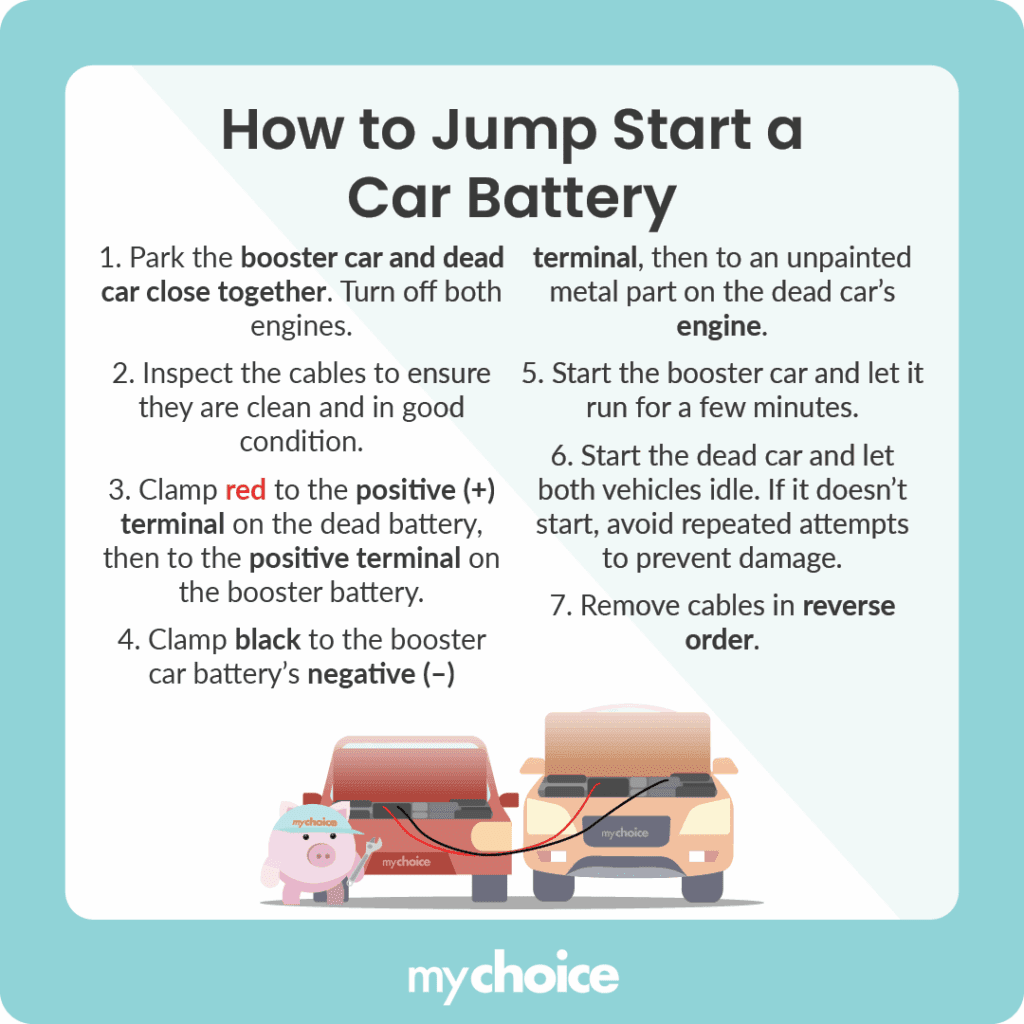
1. Bring the booster vehicle close to the car with the dead battery.

You want them close enough to reach the jumper cables, but not so close that they touch.

2. Turn off the ignition of both cars.

Check that both cars are in park (or neutral if they have manual transmissions), that the parking brakes are engaged, and that all car accessories are turned off. Unplug anything connected to the cigarette lighter that may be plugged into your car, such as a USB charger.

3. Check that the jumper cables you’re using are properly insulated and clean.

As you prepare to connect the cables, you should consider wearing protective eyewear and safety gloves.

4. Connect the red positive end of the jumper cable to the positive terminal on the dead battery, labelled with a “+” sign.

The positive terminal of a battery is usually larger than the negative terminal and may have a cover. Connect the other car’s positive terminal with the other red clip.

5. Connect the cable’s negative end (typically black) to the negative terminal of the donor (working) battery.

This is normally marked with a “–“ sign on the booster car.

6. Connect the other end of the negative cable to an unpainted metal surface on the engine block or chassis of the vehicle with the dead battery.

This could be a bare bolt or bracket placed as far away from the dead battery as possible.

7. Visually check that jumper cables are connected securely to the battery.

Also, double-check that the cables aren’t dangling near any moving engine parts in either vehicle.

8. Start the booster car and let it idle for a few minutes.

The length of idle time is determined by the state of the battery. If the battery has been deeply discharged for a long time, jump-starting may not work, and the battery may need replacement. If the battery is new and has been drained by leaving lights or accessories on, it will not require a lot of idling time.

9. Start the dead car and let both vehicles idle.

If the dead vehicle doesn’t start, don’t persist, or you could damage the starter. At this point, you might want to consider other factors that could be causing the vehicle not to start.

10. Remove the jumper cables in the reverse order after the dead vehicle has been boosted.

Again, make sure the cables do not fall into the engine or meet each other.

Safety Tips When Boosting a Car Battery

  • If the battery in the dead car is cracked or leaking, do not attempt to jump it as this could result in an explosion, if the battery is in this condition, it’s definitely time to replace it.
  • If any battery’s terminals are corroded, wipe them clean (while wearing gloves to protect your hands) to ensure that the clamps can make a secure connection.
  • If you’re looking to buy jumper cables, go with the best quality you can afford. Cables with well-insulated clamps and thicker wire (often 6- to 8-gauge) are generally recommended.
  • If the cable clamps touch each other or metal surfaces incorrectly, they can create sparks or electrical damage to the vehicles.
  • When working near a battery, exercise extreme caution because it has the potential to emit explosive gases. Use corrosion-resistant cables that can connect securely to the battery.
  • Wear safety equipment and avoid smoking or lighting a match near the battery.

Key Advice from MyChoice

  • Keep jumper cables in your car at all times. Dead batteries can happen unexpectedly, especially in winter.
  • Follow the correct cable order when boosting a battery. Incorrect connections can damage your vehicle’s electrical system.
  • Check your battery before winter. Cold temperatures can quickly expose a weak battery that worked fine during warmer months.
  • Consider roadside assistance coverage. Many insurance policies offer battery boost services, which can save time and stress if you get stranded.

Congratulations! You made it to the end!

Now, here is the easy part: complete your quote in under 2 minutes

Discover More About

February 27, 2026
Chinese EVs are coming to Canada. Here’s how much BYD, MG and other models could cost to insure, with provincial breakdowns and projections.
February 10, 2026
Car repair costs rose 4.1% in Canada in 2025. View our breakdown of provincial repair trends, labour shortages, and what they mean for auto insurance rates.
January 26, 2026
In this MyChoice study, we analyzed data collected on our platform to compare insurance costs of popular electric cars with similar gas vehicles.

Even More Ways To Save on Insurance