









To write this article, our team has reviewed section 233(1) of the province’s Insurance Act to learn what happens when you bend the truth on your insurance application. Keep reading to learn what examples of misrepresentation you should avoid, how insurers investigate, how long the cancellation affects you, and how to correct an application after you file a claim.
What Happens When You Lie on Your Insurance Application?
In an honest answer, lying on a car insurance application in Ontario can cost you your coverage. Under section 233(1) of the province’s Insurance Act, a claim is invalid or forfeited if you knowingly misrepresented or failed to disclose a fact the application asked for. You keep paying premiums; the policy stops owing you anything back.
An Honest Mistake Is Not Fraud: What the Law Actually Says
Not every wrong answer on an application is treated the same way, and the difference matters enormously. Section 233(1) of Ontario’s Insurance Act invalidates a claim where the applicant knowingly misrepresents or fails to disclose a fact required in the application. “Knowingly” is doing real work in that sentence. Misremembering your first licence date by a year is not the same thing as signing a parent up as the principal driver of a car their teenager actually drives to school every morning.
In practice, there are three tiers:
- An innocent error – a wrong date or a conviction you genuinely forgot is normally fixed with an amended application and an adjusted premium.
- A material misrepresentation — a fact that would have changed the premium or the insurer’s willingness to offer coverage at all, stated wrongly on purpose — is what triggers claim forfeiture under s. 233 and cancellation.
- And outright fraud — staged collisions, forged documents, invented injuries — moves the file from the underwriting department to the police under section 380 of the Criminal Code.
How Misrepresentation Will Cost You More in the Long Run
Misrepresentation, such as presenting yourself as a low-risk policyholder, seems to reduce premiums, saving you money at first. However, it usually ends up costing you more. The discount is borrowed, not earned — and it comes due at the worst possible moment, when you file a claim. Here is what that looks like in practice:
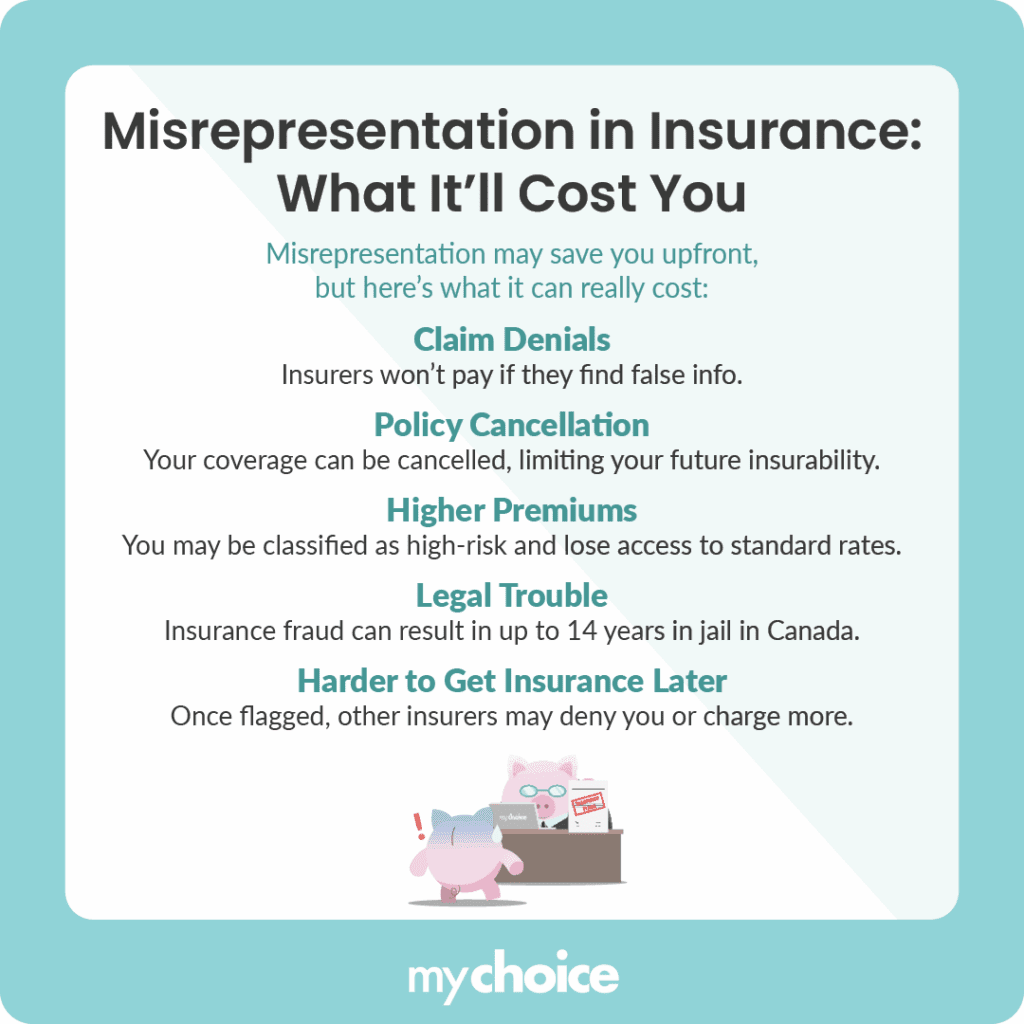
Most Common Misrepresentations on Insurance Applications
There are many things that irresponsible applicant can lie about or misrepresent on their application. Here are some common cases: Each one affects your premium and amount of coverage you might get, which is why insurers try their best to verify it:
- Annual kilometres driven, and how the car is used (commuting, business, or pleasure) — Canadian insurers rate in kilometres, not miles
- Who drives their vehicle
- Past accidents and driving infractions
- Home address
- Who the principal driver really is — listing a parent when a child drives the car daily is called “fronting,” and it is one of the misrepresentations insurers look for hardest
| What people may misrepresent | Difference in average annual premium | Spread |
|---|---|---|
| Principal driver’s age | Age 18–20: $6,118 vs. age 55–64: $1,684 | $4,434 |
| Garaging address | Brampton: $3,471 vs. Cornwall: $1,528 | $1,943 |
| Driving record | One at-fault accident: $4,178 vs. clean record: $2,132 | $2,046 |
How Insurers Actually Find Out
Verification starts before you’re approved. When you apply, the insurer pulls your driving record from the Ministry of Transportation and your claims history from industry databases such as Autoplus, which logs past claims, cancellations, and policies across companies — so an at-fault accident with a previous insurer three years ago is already on the underwriter’s screen. Your stated garaging address gets checked against your postal code, your licence, and sometimes the vehicle registration.
The second stage occurs during a claim investigation, when the stakes warrant a thorough investigation. An adjuster can pull collision-reporting-centre records, interview witnesses, establish who was actually behind the wheel and where the car actually lived, and require you to answer questions under oath. Insurers also refer suspicious files to Équité Association, the industry’s national anti-fraud organization, which runs its own investigators and analytics. Misrepresentation that slips through the application stage often surfaces exactly here, which is why the “discount you achieved” fails when you need coverage most.
How to Avoid Unintentional Misrepresentation
Mistakes usually happen because you can accidentally misrepresent yourself on your insurance application. Unintentional misrepresentation can happen by forgetting your first licence date, unintentionally neglecting to mention traffic tickets or accidents, or not realizing a past policy was cancelled for non-payment — a cancellation you must still disclose, whatever the reason for it.
Most of the time, unintentional misrepresentation can be avoided by double-checking your information and making sure everything is in order before submitting your application.
A concrete pre-submission check beats good intentions: order your uncertified driver’s record online through ServiceOntario for a small fee to confirm your conviction dates and licence history, ask your current broker for your claims history, and look up the exact date you were first licensed instead of guessing.
Already Submitted an Application With Something Wrong on It? Fix It Now
This is the part most articles skip, so let’s be practical. If you realize an application you already submitted was wrong, whether you fudged it or genuinely made a mistake — the fix is boring but fast: call your broker or insurer and ask to amend the policy. Mid-term corrections are routine for insurers, who recalculate the premium as of the change date and issue an amended declaration page. Get the confirmation in writing.
- Do it before a claim, not after. A correction volunteered proactively is an underwriting adjustment; the same fact discovered during a claim investigation is misrepresentation.
- You’re required to report changes anyway. Statutory Condition 1 in O. Reg. 777/93 obliges you to promptly notify your insurer of material changes in risk — a new regular driver, a move, or using the car for work.
- Expect the premium to move. If the corrected fact is one of the big rating factors, the increase can sting, but it buys a policy that will actually respond.
- If a policy has already been voided or cancelled, disclose it honestly on the next application. Hiding a cancellation is a fresh misrepresentation, and it is one of the specific things application forms and industry databases are built to check.
How Lies Affect the System and Honest Drivers
Lying on your insurance application doesn’t just affect you. It affects other drivers, including honest ones. Every invalid car insurance claim drives up the insurance company’s loss ratio. The loss ratio measures the amount of money the insurance company spends on paying out car accident claims compared to the money it earns from premiums.
When the insurance company spends more on claims payouts than what it earns from premiums, then the company is operating at a loss. To stay profitable, the insurance company recovers those losses by increasing its earnings, namely by increasing the premiums it charges. The financial impact is real, not rhetorical: Ontario’s Auto Insurance Anti-Fraud Task Force estimated that fraud adds roughly $770 million to $1.6 billion a year to what Ontario drivers pay in premiums. It’s an older figure, but it remains the most rigorous public estimate available.