









Most Ontario drivers know they don’t pay HST on their auto insurance, but many are surprised to see an 8% tax appear on related insurance products or when buying a vehicle privately.
To explain which taxes apply and which don’t, our team reviewed the Ontario Ministry of Finance’s guidance on Retail Sales Tax (RST), the Canada Revenue Agency’s GST/HST rules for financial services, and Ontario’s rules for privately purchased vehicles.
Learn when HST, GST or RST applies to vehicles and insurance in Ontario, which products are still taxed, and why your auto insurance premium itself remains tax-exempt.
The Short Answer: No HST, GST, or RST on Your Premium
You don’t have to pay HST or GST on auto insurance in Ontario, but other provincial insurance taxes may still apply in certain cases. While you do have to pay taxes for vehicle purchases, leases, and repairs, you don’t have to pay taxes to insure your vehicle.
In Ontario, taxpayers are charged something called Harmonized Sales Tax (HST) for certain goods and services. It combines the province’s previous provincial sales tax (PST), also known as Retail Sales Tax (RST), with the federal Goods and Services Tax (GST). Since July 1, 2010, HST has applied at 13%, the 5% federal GST plus an 8% provincial portion, to most goods and services in Ontario, with carve-outs for things like basic groceries and most financial services.
HST is not charged on auto insurance because insurance is classified as a financial service, and most financial services are exempt from GST/HST in Canada. Financial services, including the supply of auto insurance, are exempt from sales taxes in Ontario.
Read More: How Car Insurance Works in Ontario
What About RST? Is It Charged on Auto Insurance?
RST is still applied in select circumstances, such as specified privately purchased vehicles (motor vehicles that require a permit to drive on a highway, off-road vehicles, boats, and aircraft) from someone not registered for GST/HST, such as a non-resident. For those vehicles, the RST rate is 13%, generally calculated on the greater of the purchase price and the vehicle’s wholesale value, and ServiceOntario collects it when you register the transfer.
As per the Ontario Ministry of Finance’s guidance on RST on insurance premiums and benefits plans, RST at a rate of 8% is charged on:
- Premiums paid under taxable insurance contracts
- Group insurance
- Contributions paid into funded plans
- Benefits and certain payments made in respect of unfunded plans and qualifying trusts
- Payments made into insurance schemes or compensation funds established by statute
This is where the most Ontarians found out 8% in real life. If your employer deducts group insurance premiums from your pay, or you bought creditor insurance (sometimes called loan or payment protection) along with your car financing, an 8% RST line on those charges is correct — a $500 annual group premium carries $40 of RST, for example.
Retail Sales Tax (RST) is not applied to standard automobile insurance premiums, but it does apply to some other types of insurance products and benefit plans.
The table below shows how tax treats each part of owning and insuring a car in Ontario:
| What you’re paying for | Which tax applies | Rate |
|---|---|---|
| Standard auto insurance premium | None — exempt from HST/GST and RST | 0% |
| Group insurance or creditor/ loan-protection insurance | Ontario RST | 8% |
| Used vehicle bought privately (specified vehicle) | Ontario RST, collected at ServiceOntario | 13% |
| Vehicle bought or leased from a dealer; repairs and parts | HST | 13% |
| Auto insurance claim settlement | Not treated as income by the CRA | 0% |
When it comes to your car policy specifically, no sales tax should appear anywhere. Taxes are charged on top of premiums, never “deducted” from them. If a line on your statement looks like HST or RST, ask your insurer what product it’s attached to. If it’s tied to the auto policy itself, that’s an error worth escalating. Ontario’s insurance regulator, FSRA, takes complaints about insurer conduct if you can’t get a straight answer.
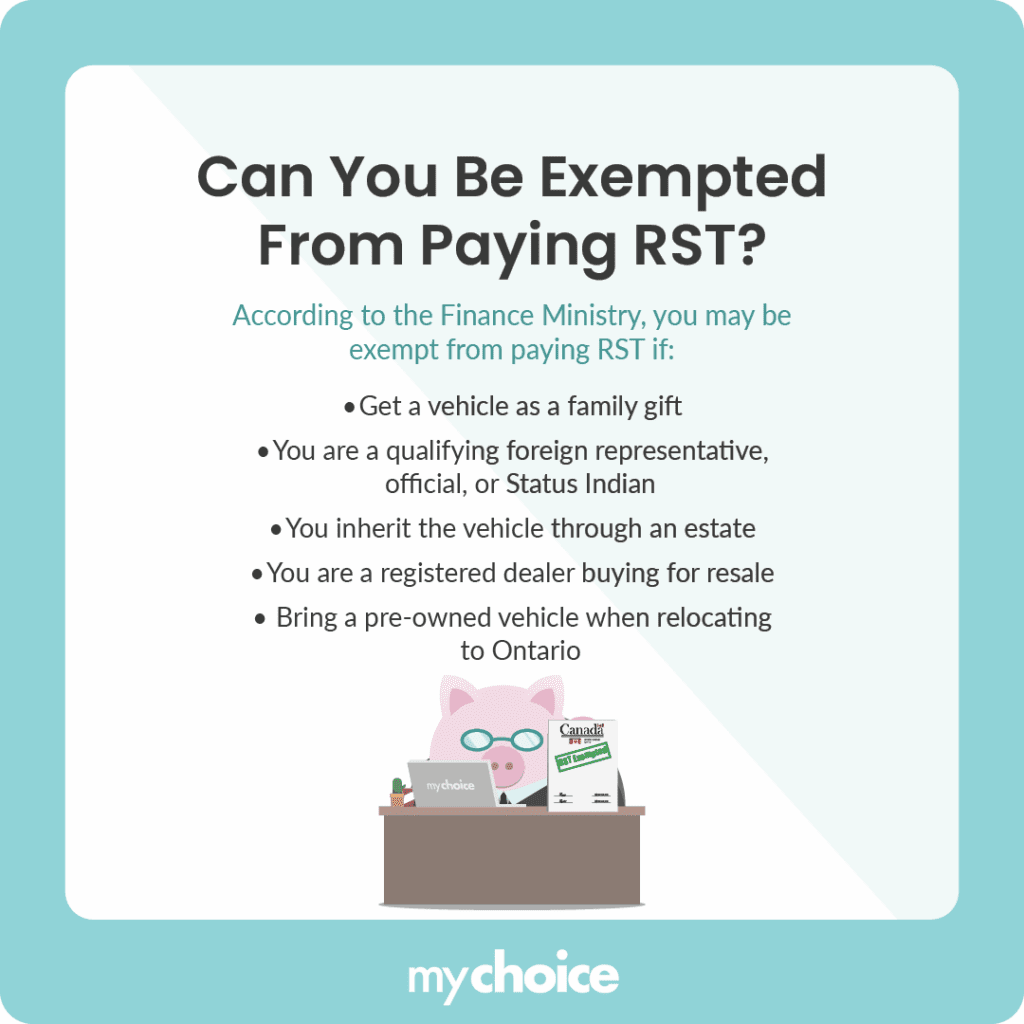
Can You Be Exempted From Paying RST?
According to the Finance Ministry, you can be exempted from paying RST if you:
- Receive a vehicle from a family member as a gift (the exemption covers qualifying family members only — spouses, parents, children, grandparents, grandchildren, siblings and certain in-laws — and you’ll need to file a Sworn Statement for a Family Gift of a Used Motor Vehicle at ServiceOntario; Source: Ontario.ca)
- Are a qualifying foreign representative/official or Status Indian
- Receive a vehicle as part of an estate bequest
- Are a registered motor vehicle dealer with a valid Ontario Motor Vehicle Industry Council number that is acquiring a vehicle for resale purposes
- Are relocating your home to Ontario and you are bringing in a vehicle you purchased before you moved
Are Auto Insurance Claims Taxable?
Auto insurance claims are usually tax-exempt.
If an insurance company gives you a settlement for any injuries or lost income/lost future earnings following a car accident, you don’t have to worry about paying taxes for this. This is because personal injury claims are considered pain and suffering compensation, which the Canada Revenue Agency (CRA) does not recognize as income. The same logic covers the property side — money that repairs or replaces your damaged vehicle restores what you lost rather than adding income. One caveat: once a settlement is in your hands, any interest or investment income it earns afterwards is taxable like any other.