









Auto theft is declining across Canada, but that doesn’t necessarily mean your car insurance premium will fall. Your rate still depends on other factors, such as your vehicle’s theft risk and location, broader insurance costs, and your individual driving history.
For our guide, we reviewed Statistics Canada’s 2025 police-reported crime release, Public Safety Canada’s current National Action Plan on Combatting Auto Theft, and FSRA’s guidance on Ontario rating factors and optional physical-damage coverage.
Keep reading to understand the latest theft trend, why your renewal may not move with the national average, and how to audit the price and coverage on your own policy.
Read More: See What Happens When a Stolen Car Is Recovered
What Declining Auto Thefts Mean for Insurance
Fewer vehicle thefts help reduce insurance claim costs over time, but a national decline does not guarantee an immediate discount on one policy. Your premium still depends on your specific vehicle, location, coverage, deductible and insurer.
Statistics Canada reported 83,652 motor-vehicle-theft incidents in 2025, a rate of 201 incidents per 100,000 people. The rate fell 16% from 2024, following a 16% decline in 2024. These are police-reported crime statistics, not insurance claims, and the national result can mask substantial differences by vehicle, neighbourhood and province.
Read More: See How Comprehensive Car Insurance Works in Ontario
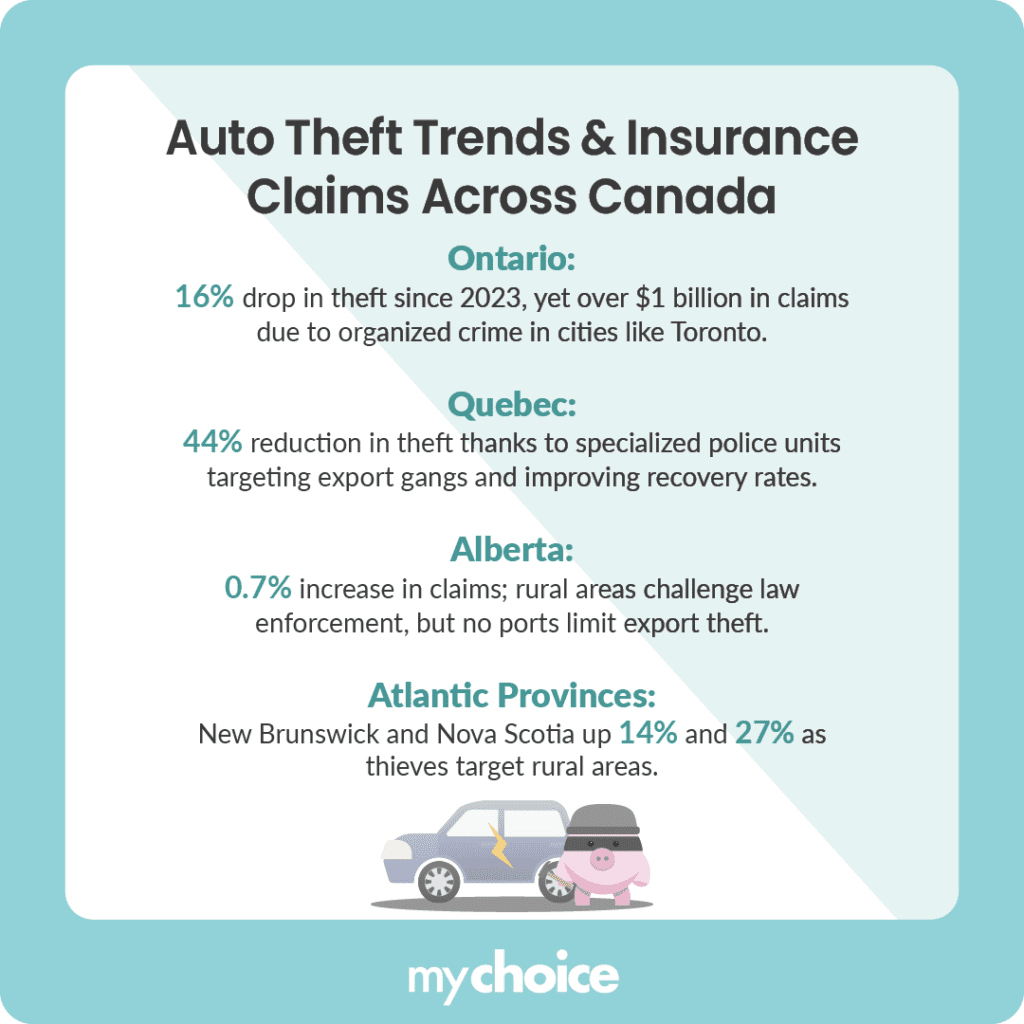
A Closer Look at Regional Differences
The national 2025 decline does not establish the same result in every province or city. Police-reported incidents, insurance claims and claim dollars measure different things, and local results can move differently from the national rate.
Use current provincial or police data for the location you are evaluating, and use the vehicle’s renewal or quote, not an old regional table, to assess the insurance effect. Statistics Canada’s release provides the current national benchmark.
How Does This Impact Your Insurance Rates?
Vehicle theft can affect premiums when insurers see higher theft-related claims for a particular vehicle or area. Fewer theft claims may eventually help reduce insurance costs for some vehicles or areas. But in Ontario, theft risk is considered alongside other factors such as repair costs, driving history, how the vehicle is used, coverage and deductibles.
Location:
Where you live can affect your premium because theft and insurance claims vary between areas. Ask your insurer which region your address belongs to and compare the same coverage and deductible.
Vehicle Type:
The exact year, make, model and trim matter more than a simple “luxury” label. A commonly sold vehicle can also be attractive to thieves, while parts cost, safety equipment and repairability affect the rest of the premium. Quote the exact vehicle before buying.
Insurance Provider Policies:
Different insurers may charge different premiums for the same vehicle and driver. Ask whether a theft surcharge, device condition or anti-theft discount applies to the exact vehicle, and get the revised premium in writing before paying for a device solely for insurance savings.
How to Check Your Renewal
Use these four checks to separate a possible theft-rating change from other changes to your policy.
- Check 1: Compare your old and new policy documents, including the vehicle, address, annual kilometres, drivers, coverage, limits and deductibles.
- Check 2: Ask your insurer which approved rating-factor or coverage changes explain the new price, including whether the vehicle’s theft rating, surcharge or device requirement changed.
- Check 3: If an anti-theft device is suggested, confirm the eligible device, installation standard, receipt requirements, subscription cost and exact premium difference before paying for it.
- Check 4: Compare quotes using the same drivers, coverage limits and deductibles. A cheaper quote with less coverage is not a fair comparison.
Read More: Learn How TAG Vehicle Tracking Works