









Your car insurance premium can increase even if you haven’t been involved in any accident. Rising repair costs, vehicle theft, severe weather, tariffs, inflation, and the type of vehicle you drive can all affect what insurers charge.
For this article, we reviewed FSRA’s dated Ontario average-premium series, the Government of Canada’s automobile tariff measures, the federal 2026 auto strategy, and Alberta’s automobile-insurance reform page to explain some of the factors putting pressure on auto insurance costs.
Keep reading to learn why car insurance rates increase, how repair costs, tariffs, and EVs affect premiums, and what to check for when you review your policy when it gets renewed.
Read More: Why Car Insurance Rates Can Rise Without an Accident
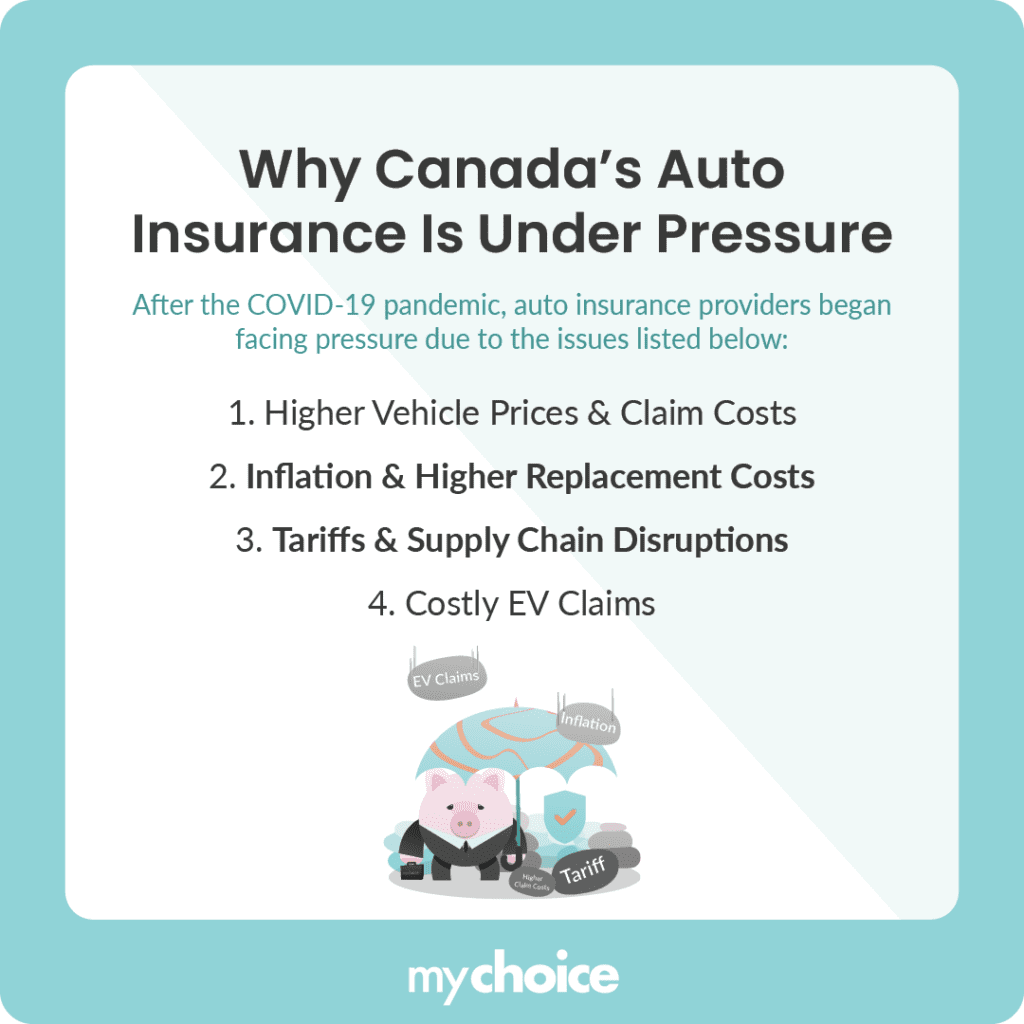
Why Are Canadian Auto-Insurance Costs Under Pressure?
Canadian auto-insurance prices face pressure from increasing repair claims, theft, weather, vehicle values, parts and labour, tariffs and provincial rule changes. National averages don’t tell you how much your own premium will change, so compare the same coverage for the exact vehicle and check the relevant regulator’s dated market or rate information.
Why Your Location Still Matters
Based on our analysis of 50,000 Ontario auto insurance quotes collected through the MyChoice platform since the start of 2026, a standard-profile annual quote was about $1,820 in Sarnia and $4,210 in Brampton. The driver, vehicle, coverage and deductibles were held to the same profile. This does not predict your price, but it shows why one national percentage cannot explain every renewal.
The exact make, model, model year and past claims and repair costs for that vehicle affect how much the vehicle costs in general to repair or replace and how likely it is to be stolen. Value alone doesn’t determine the premium.
Claim severity can influence future rate filings, but one collision-cost trend does not explain an individual premium change.
How Supply Chain Issues and Inflation Affect Insurance Costs
Parts and service prices and vehicle values are relevant inputs. CPI, used-vehicle prices, claim frequency and claim severity remain different measures, so they shouldn’t be compared as if they represent the same increase in insurance costs.
Longer repair times can increase rental or other transportation costs covered by the policy. Loss ratio, expense ratio and combined ratio measure different parts of insurer performance as well.
How Current Auto Tariffs May Affect Repair and Replacement Costs
Since April 9, 2025, Canada’s official automobile page has stated that 25% tariffs will be applied to non-CUSMA-compliant U.S. vehicles and to specified non-Canadian or non-Mexican content of compliant vehicles. Because tariff rules and applied products can change, their effect on insurance costs can also change over time.
Tariffs may affect particular vehicles and parts, but there isn’t reliable information on how much tariff increases everyone’s insurance premium by a specific percentage.
Read More: Impact of Trump’s Tariffs on the Insurance Market in Canada
How EV Repair Complexity Can Affect Some Claims
Federal policy changed in February 2026 when Canada announced it would repeal the EV Availability Standard and replace it with other plans and an aspirational 2040 goal. Insurance costs still depend on the specific vehicle and its claims history, separated from provincial rules.
Higher repair severity:
EV repair cost varies by model, damage, battery involvement, parts, labour and calibration. Compare insurance quotes for the specific vehicle you’re considering.
Rising write-off rates:
There is no single statistic that can predict whether an EV will be repaired or written off. The result depends on the model, damage, battery, whether the vehicle needs additional safety inspections, parts and labour, vehicle value, and the policy. Compare a model-specific quote and deductible instead of relying on unsupported national averages that may not apply to your vehicle.
Expensive battery replacements:
Battery repair or replacement costs depend on the vehicle and the extent of the damage. You should get an inspection by a qualified repair facility and avoid a generic pack-cost range.
Read More: How EV Repair Costs Can Affect Insurance
How to Read a Premium-Increase Headline
- Approved rate changes are not your renewal change. An insurer’s approved average rate increase isn’t an individual renewal increase. Check the relevant provincial regulator and insurer filings for the exact period.
- Alberta uses its own rate caps and reform timetable. Alberta’s 2023 measure was a rate-increase pause, but the province later used good-driver caps. Its current page states 7.5% for qualifying good drivers in 2026 and a different system when Care-First begins in 2027.
- Compare the exact EV before buying. Compare an EV and a similar gas-powered vehicle using the same driver, coverage and deductible. The type of battery itself does not determine which one costs more to insure.
- Check telematics privacy and deductible exposure. Depending on your province and insurer, mileage/telematics programs and deductible options have different privacy requirements and different amounts you have to pay out of your pocket after a claim. Choose them only after reviewing the program terms and affordable exposure.