









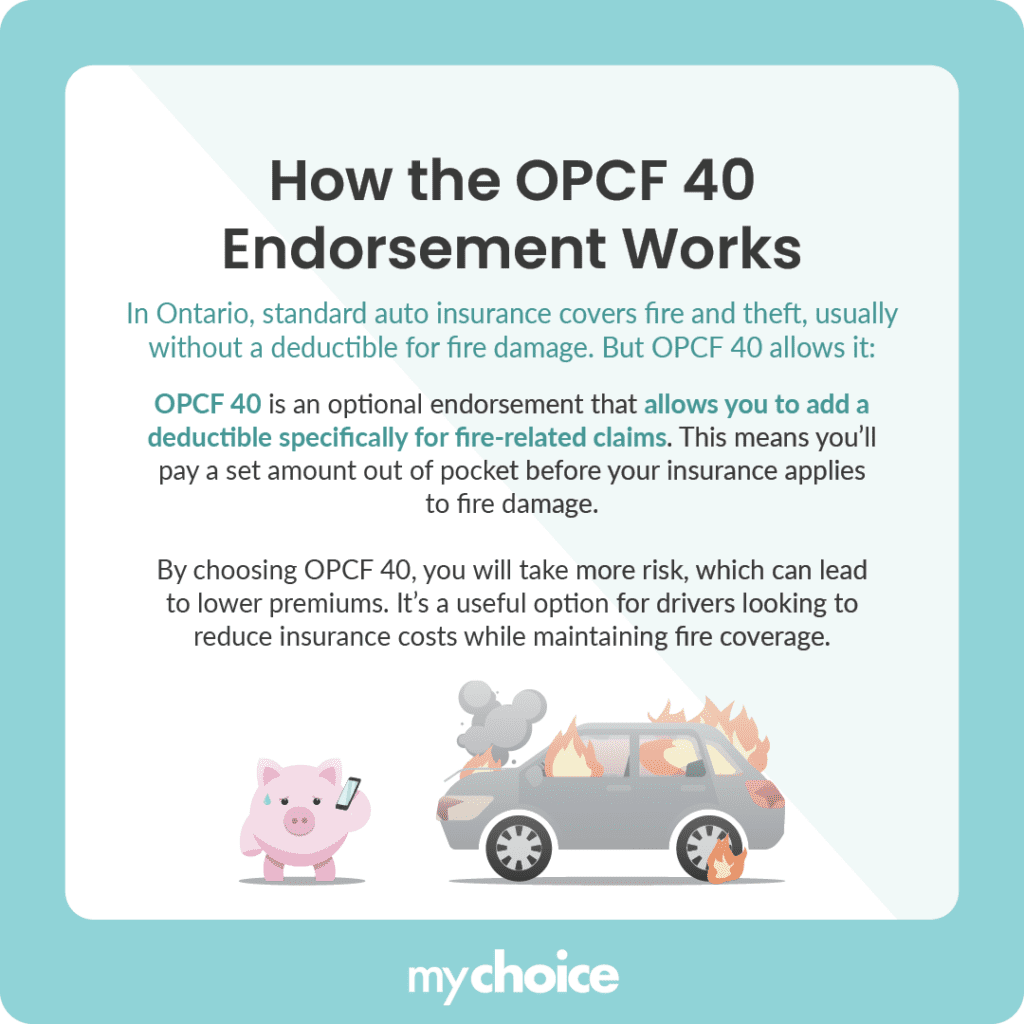
What is OPCF 40? It is an Ontario endorsement that makes each covered fire loss subject to the deductible shown for Specified Perils, Comprehensive or All Perils. The form does not promise a premium saving. Compare written quotes with and without the endorsement before accepting the extra out-of-pocket risk.
For this guide, our team opened FSRA’s one-page OPCF 40 form, checked it in the current Ontario forms directory and reviewed Section 7 of the Ontario Automobile Policy.
Keep reading to see exactly how the deductible works, how to measure any quoted saving and when the trade-off may be poor value.
Read More: Other Available Auto Insurance Coverages in Ontario
How Does OPCF 40 Work?
The endorsement applies only to the automobile identified on your certificate. For each covered fire claim under Section 7, you agree that the deductible shown for Specified Perils, Comprehensive or All Perils will apply. Every other policy term remains the same.
OPCF 40 changes the deductible. It does not add fire coverage to a policy that lacks the relevant loss-or-damage coverage, broaden the causes of loss or guarantee that the claim will be paid.
Will OPCF 40 Lower Your Premium?
Only an otherwise identical quote can answer that. The official form does not state a saving. Ask the insurer for the annual premium with and without OPCF 40, using the same vehicle, drivers, coverage and other deductibles.
A lower premium is possible if the insurer’s filed rates produce one. Price the annual saving against the extra amount you would pay after each covered fire claim. Do not assume that adding OPCF 40 offsets the cost of OPCF 20, OPCF 43 or another endorsement.
How Do You Calculate the Break-Even Point?
Divide the added fire deductible by the annual premium saving. The result is the number of claim-free years required for the premium difference to equal one deductible.
Illustration only: if the endorsement saves $40 per year and creates a $1,000 fire deductible, $1,000 divided by $40 equals 25 years. Substitute the figures from your quote. If the saving is $0, there is no premium break-even benefit.
When Might OPCF 40 Make Sense?
The decision depends on the actual saving and your ability to pay the deductible without borrowing. Vehicle value, the physical-damage coverage selected and your broader budget also matter. A high-value vehicle, enclosed parking or low wildfire exposure does not prove that a fire deductible is a good choice.
| Check | Question to answer |
|---|---|
| Annual premium difference | What is the written saving on an otherwise identical quote? |
| Fire deductible | How much would you owe for each covered fire claim? |
| Cash available | Could you pay that amount on short notice? |
| Vehicle and coverage | Would the likely settlement after deductible still provide useful protection? |
| Other endorsements | Are their costs and benefits being assessed separately? |
Read More: See How the OPCF 43 Depreciation Waiver Works
What Should You Confirm Before Signing?
Confirm the vehicle to which OPCF 40 applies, the effective date, the deductible shown on the certificate and the premium difference. Keep the endorsement with your policy. Ask the insurer or broker to explain how the deductible would apply if one event damages more than one insured vehicle or involves another type of loss.
Read More: Learn How Comprehensive Car Insurance Covers Fire and Other Perils