









Ontario Policy Change Forms 23A and 23B (OPCF 23A/23B) help protect the financial interest of your lender when you finance a vehicle. When you need to finance a vehicle, the financing institution might require you to add one of them to your auto insurance policy before approving a loan. Those endorsements make sure the lenders are protected if the vehicle is damaged or declared a total loss.
To explain how OPCF 23A works, we reviewed FSRA’s guidance regarding this endorsement, the Ontario Automobile Policy (OAP 1), and Ontario’s Personal Property Security Act. We used these sources to distinguish lender protection from vehicle ownership, explain how loss-payee coverage works, and clarify why OPCF 23A does not provide gap insurance or transfer ownership of the insured vehicle.
Read More: A Guide to Ontario Policy Change Forms (OPCFs)
Why Lienholder Protection Matters
The borrower is generally the vehicle owner, while the lender holds a registered security interest under the financing agreement. The endorsement protects that financial interest, but it does not make the lender the vehicle’s legal owner in every case.
The OPCF 23 endorsement protects the lender’s stated financial interest. It does not provide gap insurance, promise that the loan will be repaid in full, or change the borrower’s financing terms. Those duties and consequences come from the finance agreement.
OPCF 23A: More Than Just a Finance Requirement
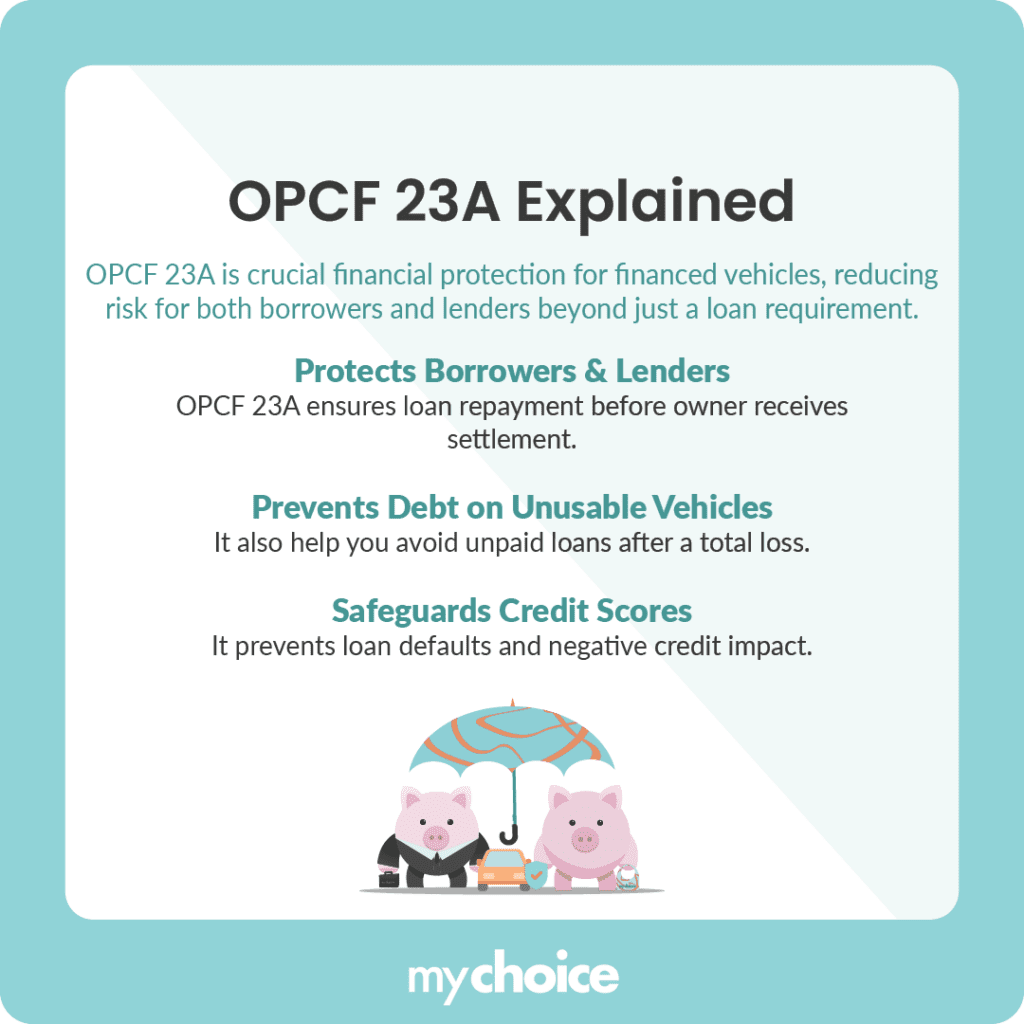
OPCF 23A serves as essential financial protection for individuals who have financed vehicles. Many vehicle owners misunderstand OPCF 23A as just another checkbox lenders require on the loan agreement. However, it’s more than just a simple requirement before you can take a loan. It significantly minimizes financial risk for both borrower and lender.
OPCF 23A guarantees your lender gets paid if your financed vehicle is damaged or declared a total loss. Payment remains subject to the policy, deductible, settlement value and outstanding secured interest.
The endorsement protects the lienholder’s interest in insured proceeds. It is not credit-score insurance and does not eliminate the borrower’s obligation to keep making payments under the loan agreement.
What Happens When You Skip OPCF 23A?
If the finance agreement requires lienholder protection, failing to maintain it may breach that agreement. Consequences depend on the contract and applicable law, while the endorsement itself does not impose repossession, interest-rate or legal penalties.
OPCF 23B vs. OPCF 23A: Key Differences
While OPCF 23A focuses on financial recovery after a loss, OPCF 23B focuses on protecting the lienholder in case your policy lapses.
- OPCF 23B ensures that losses are directly payable to the lienholder if the vehicle is not repaired or replaced up to the extent of their financial interest. OPCF 23B also protects the lienholder’s interest against invalidation due to breaches of statutory conditions, exclusions, misrepresentations, or even fraud by the insured.
- In contrast, OPCF 23A specifically addresses the financial distribution following vehicle loss or damage. This endorsement specifies that insurance payments directly satisfy any outstanding debt owed to your lender without involving these additional protective provisions outlined in OPCF 23B.
Depending on the specifics of the financing agreement, you may be required to add either OPCF 23A or OPCF 23B to your auto insurance policy.
How OPCF 23A Interacts with Other Coverages
OPCF 23A works seamlessly alongside standard vehicle insurance coverages like comprehensive and collision policies. The endorsement modifies the terms of your primary coverage, allowing insurers to issue joint payments and mandating lienholder notifications about policy changes. OPCF 23A enhances your existing coverage by ensuring that the financial interests of your lender are prioritized during the settlement process.
If you finance your vehicle, having both gap insurance and OPCF 23A can reduce the financial risk to you and your lender, but OPCF 23A does not replace gap insurance. These coverages serve different purposes. OPCF 23A protects the lender’s financial interest by modifying how claim payments are made under your existing policy, while gap insurance may cover some or all of the difference between your insurance settlement and the outstanding loan balance after a total loss.
Read More: Gap Insurance: What Is It and Do I Need It?