









Driving while impaired by cannabis is an offence under Canada’s Criminal Code. The law also sets limits for tetrahydrocannabinol (THC) in a driver’s blood, and exceeding them is an offence even if the driver does not feel impaired.
Our editors reviewed the federal Blood Drug Concentration Regulations, Health Canada’s cannabis-impairment guidance, Ontario’s cannabis-and-driving rules, and FSRA’s auto-policy exclusions guide.
We break down Canada’s THC limits in drivers’ bloodstreams, Ontario’s own roadside rules, how police may test drivers, and potential insurance implications of collisions or Criminal Code convictions.
What Are the Cannabis-Impaired Driving Rules in Ontario?
Roadside suspensions, criminal charges, and criminal convictions for cannabis-impaired driving are different events that have different legal tests, timing, and consequences.
Under federal law, it’s illegal to drive when your ability to operate a vehicle is impaired by cannabis in any degree. Federal law also prohibits drivers from driving or having driven within the previous two hours while above certain THC blood levels.
Ontario’s zero-tolerance rules apply to some drivers, including young and novice drivers, commercial drivers, and some people who operate certain types of road-building equipment.
Federal Cannabis Limits and Criminal Penalties
| Federal rule | Blood concentration within two hours of driving | Criminal consequence |
|---|---|---|
| Lower THC offence | The person’s THC level measured within two hours of driving is 2 ng or more but less than 5 ng of THC per mL of blood. | Summary offence with a maximum $1,000 fine. |
| Higher THC offence | 5 ng or more of THC per mL of blood | If guilty under subsection 320.14(1), higher penalties for repeat offenders; minimum fine of $1,000 for a first offence. |
| Combined alcohol and THC offence | The offence is having 50 mg or more of alcohol per 100 mL of blood plus 2.5 ng or more of THC per mL, measured within two hours of driving. | An offender could be charged with the alcohol and THC offence described in subsection 320.14(1). Repeat offences carry an increased penalty. For a first offence the minimum fine is $1,000. |
| Impaired operation | Does not require a particular THC concentration where a person’s ability to operate a vehicle is impaired to some degree. | Penalties are outlined in Subsection 320.14(1). Keep in mind, penalties are more severe where an offence involves injury or death. |
The federal government sets these limits and criminal penalties. A court decides criminal guilt. Ontario can impose roadside and licensing penalties before a decision is made.
Ontario’s Zero-Tolerance Groups
Ontario’s zero-tolerance rules apply to drivers who are 21 or under, drive with a G1, G2, M1 or M2 licence, require an A-to-F licence or Commercial Vehicle Operator’s Registration to drive, and operate road-building equipment. Repeat offences can lead to increasing alcohol and drug-related suspension periods, administrative penalties, and education and treatment programs.
Authorized medical-cannabis users are exempt from Ontario’s zero-tolerance rule around THC. This doesn’t include federal impaired driving laws and the federal blood-drug offences. Having medical authorization to use cannabis doesn’t allow drivers to drive impaired.
How Long After Using Cannabis Is It Safe to Drive?
No set period of time is considered safe to drive after consuming cannabis. Some effects can last for hours. Health Canada advises cannabis users to make alternate transportation arrangements before consuming cannabis and not to drive after using.
Factors including how cannabis is consumed, dose, potency, whether other drugs or alcohol are also consumed and personal physiology all come into play. Guidelines such as waiting until the ‘same day’ or ‘next morning’ cannot assure drivers they’re safe or within legal limits to drive.
Never drive if you feel any effects from cannabis. Feeling normal does not ensure cannabis levels in your blood are under the legal limit.
How Police Check for Cannabis-Impaired Drivers
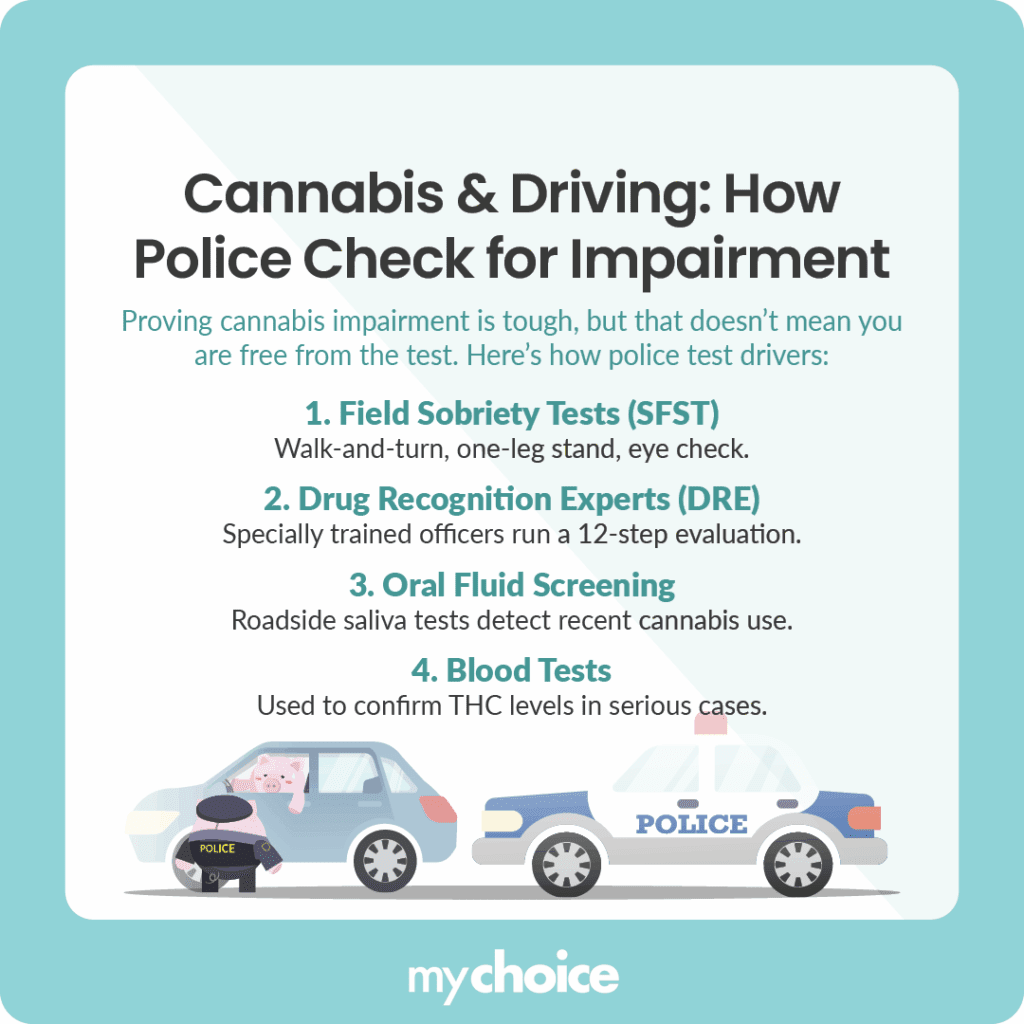
| Step or tool | What it is used for | What may follow |
|---|---|---|
| Driving observations and roadside questions | The goal of both observations and questions is to try and determine if there is evidence of impairment and gather facts. | Dependent on the observations from the driver’s driving and responses to roadside questions and where legally authorized an approved screening device and/or sobriety test may be demanded. |
| Oral-fluid screening device | Used to detect recent use of certain drugs in oral fluid. | Additional investigation may follow use of an Oral-fluid screening device. An Oral-fluid screening test result is not a test of actual blood-concentration. |
| Standardized field sobriety tests | Divided attention and coordination are examples of indicators that are assessed using Standardized field sobriety tests. | Arrest or additional testing may follow, depending on the evidence. |
| Drug Recognition Expert evaluation | A structured evaluation by a trained officer. | A demand for a bodily-fluid sample may follow where authorized. |
| Blood sample | Blood-drug levels in relation to federal blood-drug offences. | A blood sample may be used as evidence in a criminal case. |
Read More: Understand Vehicle Impoundment After an Impaired-Driving Charge
Why Cannabis-Impaired Driving Is a Big Insurance Problem
| Event | Possible insurance effect | What to verify |
|---|---|---|
| Charge or roadside suspension | A charge is not a conviction. Your insurer may ask whether you can drive or about any material change in circumstances. | Verify policy reporting duties and whether the vehicle can be lawfully driven. |
| Conviction | Availability of regular-market insurance or high-risk insurance depends on insurers’ rules on file; convictions can affect insurance rating and eligibility. | Get quotes from more than one insurer/broker. Make sure you know the date of conviction, date of licence reinstatement etc. |
| Collision while impaired | FSRA notes that your insurer has the right to deny paying out on claims for vehicle loss/damage if alcohol/drug use prevented you from controlling your vehicle or if you are convicted of certain offenses. | What exclusion or denial applies in the collision? What happened? What coverages are available? |
| Injured people | Statutory accident benefits (separate analysis required) and liability issues. | Policy; claim decision; legal advice about a serious loss |
What an impaired-driving conviction can do to an Ontario premium
Based on 50,000 insurance quotes collected since the start of 2026, a driver with an impaired-driving conviction could expect a hefty increase in premiums. The average Ontario annual premium for a driver with an impaired driving conviction was $5,661 compared to a driver without one at $2,345, representing an increase of $3,316 or 141.4%. Unfortunately, we don’t know if the data reflects alcohol-impaired convictions, cannabis-impaired convictions or both.
Get apples-to-apples quotes as soon as possible, and ask about high-risk options.
Read More: See How Car Insurance Works After a DUI Conviction
Read More: See How Driving Records Affect Ontario Car Insurance
Medical Cannabis and Driving: What Changes?
Please note that medical authorization for cannabis use only applies to the exception in Ontario’s zero-tolerance law. It will not protect you from an impaired-operation charge, does not change the federal blood limits, does not guarantee insurance coverage after a loss and is not clearance to drive.
- Plan and talk with your prescriber or pharmacist about interactions or impairment; do not treat a dosing schedule as legal driving clearance.
- Arrange a designated driver, public transit, a taxi or another place to stay before consuming cannabis.
- Do not combine cannabis with alcohol or another impairing medication or substance and then drive.