









If you’re involved in a car accident outside your home province, your home province’s rules may not apply to every part of your claim. For example, if you live in Newfoundland and Labrador but are injured in a Nova Scotia crash, Newfoundland and Labrador’s rules may not apply to every part of your claim. The accident location and the type of damages can change which rule applies.
The Hillyer v. Tilley case shows how this can work when Newfoundland and Labrador residents are injured in a Nova Scotia collision. For this article, our team reviewed the Newfoundland and Labrador Court of Appeal’s Hillyer v. Tilley decision, Nova Scotia’s Automobile Accident Minor Injury Regulations, and the Superintendent of Insurance’s 2026 indexed-cap bulletin.
Keep reading to learn what Hillyer decided, why the accident year matters, how a tort cap differs from policy benefits and what to preserve after an out-of-province collision.
Read More: Learn About Car Insurance in Nova Scotia
Why Nova Scotia’s Minor Injury Cap Applies in Newfoundland Cases
Nova Scotia’s minor-injury cap can apply when a Newfoundland and Labrador resident is injured in a Nova Scotia collision because the cap forms part of Nova Scotia’s substantive law. The amount is tied to the accident year. For an accident occurring in Nova Scotia in 2026, the indexed cap is $10,862.
What the 2026 Cap Does and Does Not Limit
The cap applies to non-monetary loss, such as pain and suffering, for all injuries that meet the statutory minor-injury test. It does not automatically cap every part of a claim, such as proven income loss, treatment costs or property damage. Entitlement to those losses depends on the governing law and evidence.
For accidents on or after April 28, 2010, each injury is assessed separately. A sprain, strain or qualifying whiplash-associated disorder may fall within the minor-injury rules unless the evidence establishes the required serious impairment. The injured person bears the burden of proving that an injury is not minor with appropriate medical evidence.
Hillyer v. Tilley was decided in 2024, but it concerned a bus that collided with a bridge near Antigonish, Nova Scotia, on March 13, 2005. The people making the claims lived in Newfoundland and Labrador, and the bus was licensed and insured there.
At the time of that crash, Nova Scotia capped non-pecuniary damages for a minor injury at $2,500. Newfoundland and Labrador had no equivalent legislated cap. The dispute was whether Nova Scotia’s cap governed claims litigated in Newfoundland and Labrador.
The Court of Appeal held that the cap limited a substantive right, so Nova Scotia law applied to the minor-injury non-pecuniary damages claims. The decision did not turn the historical $2,500 figure into the current cap; the indexed amount for the accident year controls.
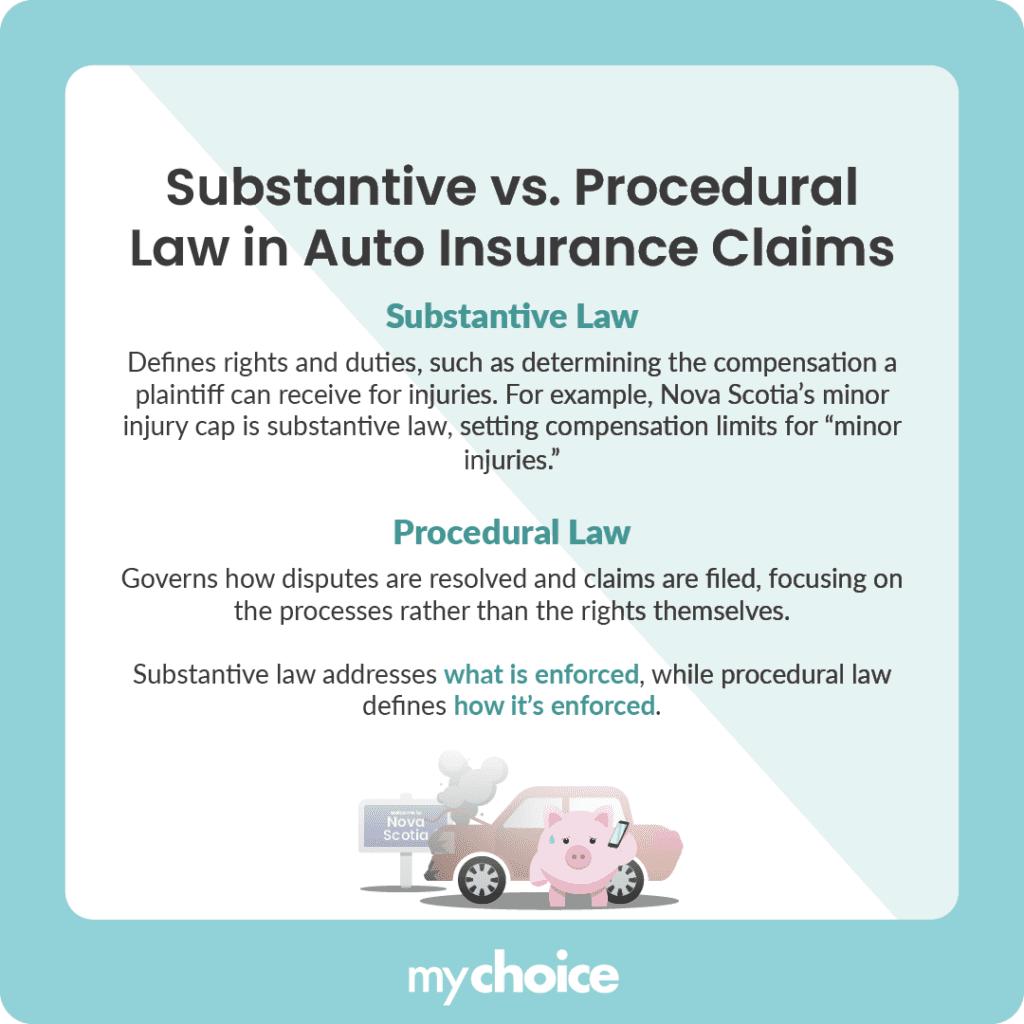
Understanding Substantive vs. Procedural Law in Auto Insurance Claims
The difference between substantive and procedural law helps explain which rules apply to an auto insurance claim involving more than one province. Here’s a quick breakdown of how the two differ:
- Substantive law defines legal rights and responsibilities. In this context, it helps determine the compensation available for an injury, including whether a statutory minor-injury cap limits non-pecuniary damages.
- Procedural law deals with how a claim moves through the legal system, including court process and filing requirements. It generally concerns enforcement rather than the underlying right.
In Canadian conflict-of-laws analysis, the substantive law of the place where the wrong occurred generally governs, while the forum’s procedural rules govern how litigation is conducted. Hillyer treated the damages cap as substantive because it limits the extent of the right, not merely the court process.
Implications for Drivers Travelling Between Provinces
Hillyer shows why the accident location matters, but an interprovincial claim still requires a fact-specific conflict-of-laws analysis. Do not assume that every host-province rule applies in exactly the same way to every benefit or head of damages.
The plaintiffs lived in Newfoundland and Labrador, which had no equivalent cap. Residence alone did not prevent Nova Scotia’s rule from applying to the accident.
First-party policy benefits and a tort claim against another person are separate. Accident benefits, disability coverage or travel-related policy benefits may respond to defined losses, but they do not remove Nova Scotia’s statutory cap on non-pecuniary damages for a qualifying minor injury.
What This Means for Your Auto Insurance Coverage
Review your auto insurance policy to understand how interprovincial accidents might be handled and whether your coverage is adequate in light of differing provincial laws. Here’s what you can do:
Do Not Assume Extra Coverage Removes the Cap
Accident-benefit or disability coverage may help with other accident-related losses, but it does not remove Nova Scotia’s statutory tort cap.
Check your policy’s conditions on cross-provincial travel:
Notify your insurer promptly and ask which accident benefits, vehicle coverage and reporting duties apply outside your home province. Keep this policy question separate from any tort claim against another person.
Review claims processes in areas you frequently travel:
Understand how to file a claim in a province you regularly drive in, just in case you get involved in an accident out of your home province. Knowing what documentation you need and what steps to take can speed up your claim process.
Stay informed about provincial laws:
Learn about any important differences in different provinces you frequently visit. This can help you understand how an out-of-province accident could affect your claim.
What to Do After an Out-of-Province Collision
Use these steps to preserve evidence and protect both the insurance claim and any legal claim that may arise:
- Get medical attention and describe all symptoms. Keep treatment, travel and income-loss records.
- Report the collision to police when required and notify the insurer promptly under the policy.
- Preserve photographs, witness details, repair records and correspondence.
- Seek legal advice in time to protect applicable notice and limitation periods. The correct deadline depends on the claim and province.
Read More: Learn About Car Insurance in Newfoundland and Labrador