









How does a car insurance deductible work? What is the ideal deductible amount? How does it impact your premium? In this article, we give you the information you need to understand car insurance deductibles.
What Is a Car Insurance Deductible?
A car insurance deductible is the amount you have to pay when you file a covered claim.
For example, let’s say that you’re making a claim for a $1,000 repair on your car with a $100 deductible. The total amount you can claim from your insurer will be $900. The other $100 will have been deducted from the claimable amount and paid by you, hence the term “deductible.”
How Do Car Insurance Deductibles Work?
Car insurance deductibles can work in two ways:
- After confirming the total cost of repairs for your car, your insurance company may issue you a cheque amounting to the total cost of repairs, minus your deductible.
- Many insurance companies have ties with repair shops, and going to one of them could make the claims process easier. In these cases, your insurer may pay the shop directly for the costs of repair up to your claimable amount. You will then have to settle the rest with the shop upon picking up your car.
In both cases, while your insurer will shoulder the brunt of the cost, the deductible amount will come from you.
When Do You Pay a Car Insurance Deductible?
Having a deductible can be helpful for costly repairs. But what happens when the cost of repairs totals less than your deductible?
Insurers take your deductible into account before shouldering any costs. If your deductible is higher than the cost of repairs, it may be more economical to pay out of pocket instead of filing a claim.
Types of Auto Insurance Deductibles
Some of the most common types of auto insurance deductibles are:
Collision Insurance Deductible
Collision insurance covers the cost of repairing or replacing your vehicle if it gets damaged in an accident.
Comprehensive Insurance Deductible
Comprehensive insurance covers repairs or replacement of your car in the case of other types of damage, such as vandalism, fire or theft. The deductible shown on your policy normally applies.
Disappearing Deductible
A disappearing, or vanishing, deductible may be available as an optional feature. For each year you do not file a claim, your deductible is reduced by an amount that varies by insurer.
Not all insurers offer this option, and you may need to qualify.
Make sure to talk to your insurance broker and ask the right questions so you can get the best deal for you.
How Does a Deductible Impact Your Premium?
You can think about insurance premiums and insurance deductibles as having an inverse relationship. When one goes up, the other generally goes down.
Your insurer may offer lower premiums if you agree to pay a higher deductible, which could save you money in the long run.
On the other hand, having a higher deductible means that you’ll have to shell out more each time you make a covered claim. Setting your deductible too high could work against you in practice.
Let’s say you get involved in an accident and the total cost of repairs is less than your deductible. In this situation, it may be more economical to pay for the repair out of pocket.
A higher deductible could lower your premium, but setting it too high could defeat the purpose of having the coverage in the first place.
Which Auto Deductibles Appear Most Often In MyChoice Quotes?
Based on our analysis of 50,000 auto insurance quotes collected through the MyChoice platform since the start of 2026, a $1,000 physical-damage deductible was the most frequently recorded choice, representing 61.9% of the deductible selections we could compare. The next most common were $500 at 14.9%, $2,000 at 14.6%, and $2,500 at 5.9%.
Popularity does not make a deductible right for you. Price the same policy at each available amount, calculate the annual saving, and reject any option you could not pay from available cash immediately after a claim.
Factors to Consider When Setting Your Car Insurance Deductible Amount
Financial Capacity
Pick a deductible you can afford to pay upfront. Ask yourself how much you can budget each month for your insurance premium. Can you afford to pay a little more?
Location
If you live in an area with lower traffic and accident rates, it may be a good opportunity to pick a higher deductible. Busy cities often call for lower deductibles.
Frequency of Claims
If you expect to make more than one claim, a lower deductible can reduce your out-of-pocket costs.
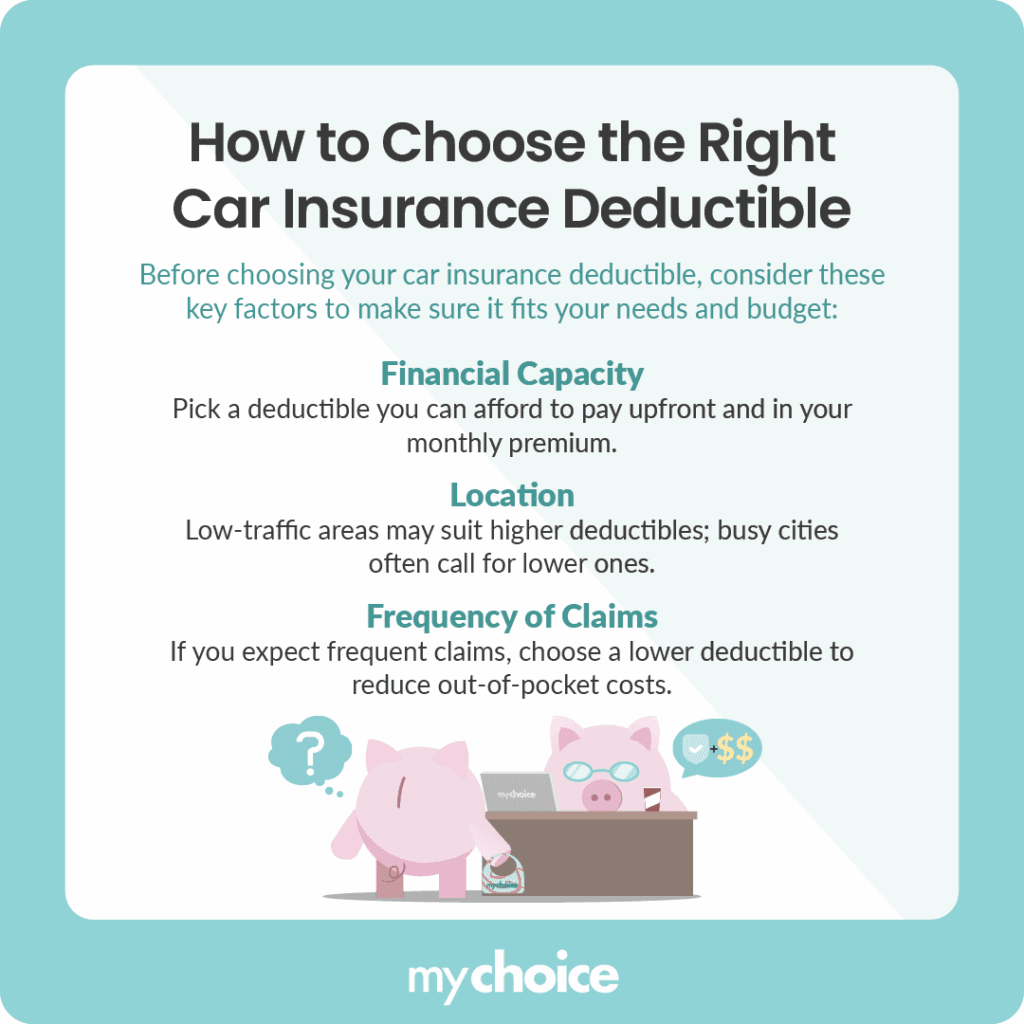
Take the time to consider your financial situation so you can select a realistic deductible amount.
The Bottom Line
There are many factors to consider when choosing a car insurance deductible. You’ll have to assess your financial situation, driving history and the options available from your insurer.
With these things in mind, you can have a policy that works for you before you hit the road.