









Unfortunately, even if water damage is covered, you may still have to pay part or all of a water-related repair bill because the cause is excluded, your deductible applies, or sub-limits and/or a separate deductible apply to that type of water.
To help you decipher it all, we’ve put together this guide using the Financial Consumer Agency of Canada’s disaster-insurance guide, the Insurance Bureau of Canada’s water-damage guide, the Insurance Bureau of Canada’s Severe Weather Centre, and Public Safety Canada’s flood-damage checklist.
Why Might You Pay Out of Pocket for Water Damage?
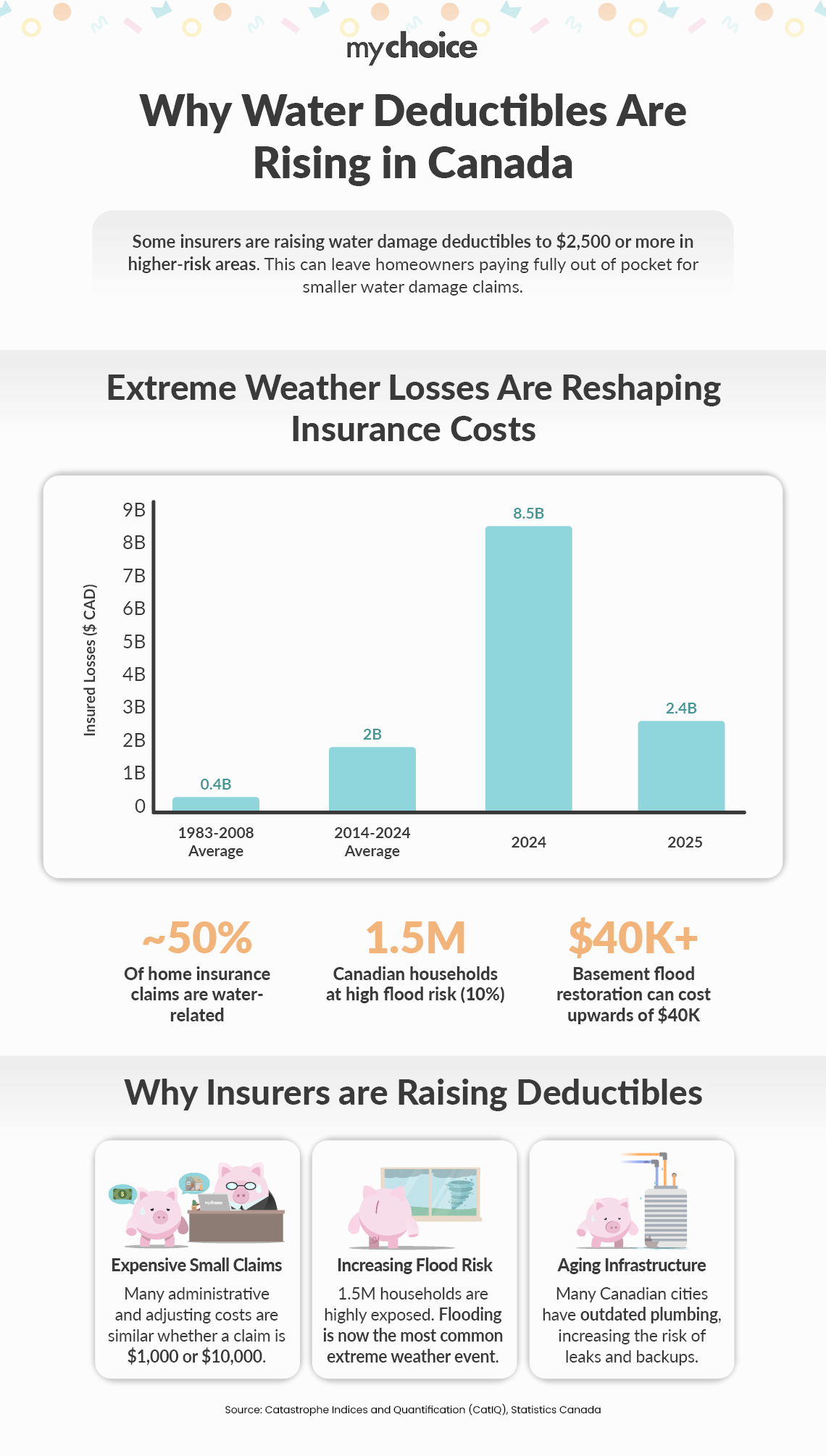
You’ll be responsible for any deductibles. If the damage from an eligible claim equals or is less than the deductible, the insurer may make no payment.
In some circumstances, you may have to pay some costs, such as when the cause of the damage isn’t covered, or the claim cost exceeds your coverage. For example, you may not receive a payout for water damage caused by seepage, wear and tear, or poor maintenance.
It’s important to understand what type of water damage is covered and the terms that apply to your specific cause of loss. Keep in mind that your home deductible might not apply to all water-related events. For example, damage caused by flooding from a storm or a backup from sewers or drains may be offered as an option with specific coverage limits and deductibles. Deductibles for flooding are often higher than for other covered losses and may be set in dollars or as a percentage, according to the Financial Consumer Agency of Canada.
Read Water Coverage as Four Separate Risks
| Cause of damage | Typical starting point | What to find in your policy |
|---|---|---|
| Sudden indoor escape | Depending on the policy, a burst pipe or broken or failed appliance may be covered. | Covered peril, base deductible, damaged property and appliance-repair exclusion |
| Sewer backup | Sewer-backup coverage may require an add-on. | Endorsement, limit, deductible, sump-pump wording and exclusions |
| Overland flood | Flood coverage or enhanced-water coverage is usually an option. | Eligibility rules, insurance limit, deductible and additional living expense coverage |
| Repeated seepage or maintenance | Often left out when the condition develops gradually or is predictable. | Seepage, leakage, wear, mould and maintenance exclusions |
Remember that general points are not promises of coverage. Always try to understand the declaration, policy, and exclusions as a whole.
Read More: Compare Overland Water Coverage and Flood Insurance
Why Your Out-of-Pocket Share May Increase
Flood risk can demonstrably affect availability, cost, coverage limits, and deductibles.
Compare recent declaration pages with previous years’ policies, line by line, to determine whether there has been an increase. Document changes, including what changed, the previous and new value, whether it is a dollar amount or a percentage, and whether it applies to buildings and/or contents.
Read More: See How Sewer Backup Coverage Works
What Current Quote Data Can and Cannot Show
Median costs for itemized sewer backup coverage are $129/year. The median cost for itemized overland water coverage is $100/year.
Our analysis of thousands of home insurance quotes collected on MyChoice since the beginning of 2026 shows that a $1,000 deductible is the most common, appearing on 67.3% of quotes. A $2,500 deductible appears on 19.8% of quotes, and a $2,000 deductible appears on 10.0% of quotes. This isn’t evidence of increasing deductibles; it’s a snapshot of deductibles right now.
Why Water Claims Can Become Expensive Quickly
The IBC says that insured losses from severe weather exceeded $2.4 billion in Canada in 2025. Inflation-adjusted losses have been high, totalling $37 billion from 2016 to 2025 compared to $14 billion over the previous decade.
When a Small Water Loss May Fall Below the Deductible
Start with an emergency repair estimate, the applicable deductible and the policy’s settlement basis. The simple calculation below assumes the cause and all listed damage are covered. It does not include depreciation, limits, tax, betterments or excluded work.
| Illustrative covered damage | Applicable deductible | Amount remaining before other adjustments |
|---|---|---|
| $1,800 | $2,500 | $0 |
| $8,000 | $2,500 | $5,500 |
A small apparent loss can grow after wet materials are opened. Contact the insurer or broker before treating the first contractor estimate as final, and ask whether a call is recorded as an inquiry or claim. If the policy requires prompt notice or emergency steps to prevent further damage, follow those duties even while you compare the likely settlement.
Read More: Read the Guide to Choosing a Home Insurance Deductible
What to Check Before a Water Claim
As soon as it’s safe, shut off the source of the water. Keep people away from areas with electrical or other contamination hazards. Take all reasonable steps to minimize losses. Unless safety concerns require it, try not to dispose of property without first taking pictures of the source of the water, the direction of travel, and the affected property.
Collect all of the facts you’ll need to evaluate your policy. Identify the part of your policy that addresses the kind of loss you’ve suffered, and review related endorsements, policy limits, deductibles and exclusions. Get mitigation and repair recommendations in writing. Ask contractors to identify possible hidden damage and any immediate repairs that can’t wait.
Deciding whether to make a claim? Get the answers to these insurance-related questions before you decide: How will the insurer determine the amount it will pay? How soon do you need to report the claim? Are you required to use approved contractors? Balance expected recovery minus the deductible against your ability to pay for repairs. Don’t file a claim based on the assumption that premiums will rise in the future.