









Raising your deductible may save money on your home insurance premium. However, after a covered loss, you’ll pay more out of pocket.
Homeowners may find more than one deductible on their declarations page. Some deductibles work differently than the ones you choose from the menu when you’re shopping for an insurance policy, such as catastrophe deductibles.
We analyzed the Financial Consumer Agency of Canada’s home-insurance guide, its disaster-insurance guide, FSRA’s property-insurance questions for consumers, and Insurance Bureau of Canada’s explanation of home-insurance rates to arrive at our take.
How Should You Choose A Home Insurance Deductible?
Some perils have different deductibles. If a lender has an interest in your property or you belong to a condominium or strata, these parties may impose coverage or deductible requirements. Review them before changing your deductible.
Choose the amount of additional loss that you’re prepared to pay when you make a claim in exchange for lower annual premiums. Whatever you choose, make sure you can pay it without borrowing or missing essential bills. Don’t rely on a rule-of-thumb amount such as $500, $1,000, or $2,000. Get written quotes from the same insurer, for the same property and coverages, with only the base deductible changed. Compare them.
How Do Home Insurance Deductibles Work?
Your deductible is the amount of a covered loss you’re responsible for before the insurer pays. Typically, a deductible isn’t an upfront fee to have a claim considered. Instead, the deductible is usually deducted from your settlement amount.
| Covered loss | Applicable deductible | Simplified result |
|---|---|---|
| $8,000 roof damage | $1,000 | The homeowner retains $1,000, and the insurer’s share of the roof damage, before policy adjustments, is $7,000. |
| $20,000 kitchen fire damage | $5,000 | The homeowner retains $5,000. The insurer’s share, before policy adjustments, is $15,000. |
| $800 hail damage | $1,000 | Because the total loss is less than or equal to the deductible, a claim payment may not be made. |
List Every Deductible On The Policy
| Policy item | What to record | Why it matters |
|---|---|---|
| Base property deductible | Include dollar amount and what type(s) of losses it applies to. | This may be an amount the homeowner can choose. |
| Water and sewer backup | Dollar or percentage amount, limit and water endorsement | A separate deductible or limit may apply. |
| Wind or hail | Dollar or percentage amount. Geographic trigger | Wind or hail losses may not be subject to the base policy deductible. |
| Earthquake | Percentage, coverage limit used for the calculation, and any minimum, if applicable. | 5% to 20% of the endorsement limit may apply to earthquake coverage, FCAC says. Earthquake coverage deductibles can be substantial. |
| Condo or strata assessment | Loss-assessment and deductible-assessment limits and deductibles | The condo/strata corporation will have its own assessments/charges that are separate from your own unit policy. |
| Liability and special items | Indicate if a property or separate deductible applies or if there is no deductible. | Not all coverage parts will use your base property deductible, particularly when it comes to liability and certain special items. |
Read the policy terms governing your deductibles. For example, if a wind event is followed by sewer backup, you may have one deductible, more than one deductible, or specific policy language that applies. Plan for the highest potential aggregate of deductibles, not just the highest deductible.
Different Types Of Home Insurance Deductibles
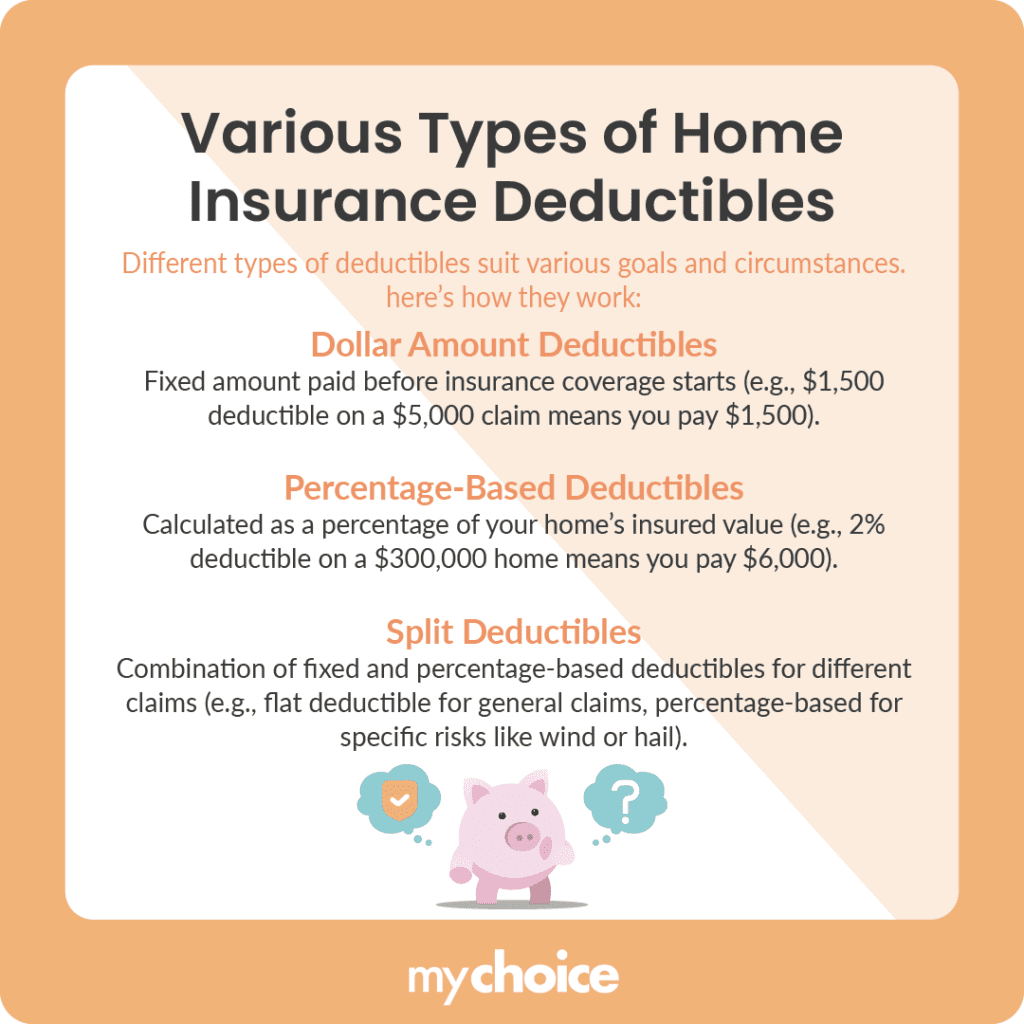
| Type | How it is calculated | Decision warning |
|---|---|---|
| Flat dollar | A flat-dollar deductible is an explicit sum. Example: $1,000. | A flat-dollar deductible may be available for the base policy, but the options vary. |
| Percentage | A percentage deductible is a specific percentage of the coverage limit or value described in the policy. | Sometimes, especially for decisions concerning earthquakes or other catastrophes, the percentage may not be freely selectable. |
| Different by peril | The policy specifies a dollar or percentage amount for each type of loss. | Never assume there is just one policy-wide deductible. The amount of the deductible varies by peril, per the policy. |
Percentage deductibles may not always be advantageous for those with higher-value properties. For example, say your policy includes an earthquake coverage limit of $800,000 and a 2% deductible. In this case, the deductible would be $16,000. So, if there’s $50,000 of covered earthquake damage, your household would be responsible for the deductible.
Households should make sure they can pay the deductible amount before agreeing to a percentage-based deductible.
Read More: See How a Percentage Earthquake Deductible Works
Deductibles Vs. Premiums: Finding The Right Balance
Formula: break-even years = (new deductible minus current deductible) divided by annual premium savings. This is a simple comparison, not a prediction of claim frequency, future premiums or renewal decisions.
Compare premiums using the same coverage limits, valuation methods, endorsements, and payment schedules. Record the full annual premium rather than only the monthly difference.
For each deductible option, determine how much additional loss you’d retain. For example, if your current deductible is $1,000 and the proposed deductible is $2,000, with $200 in annual savings, you’d retain an incremental $1,000 in losses. It would take five claim-free years of $200 savings to recover that amount.
Next, eliminate any deductibles you couldn’t pay if necessary, no matter how quickly you’d break even on premiums.
Read More: Read Why Water-Damage Deductibles Are Rising in Canada
Which Home Deductibles Appear Most Often In MyChoice Quotes?
Based on thousands of home insurance quotes collected through the MyChoice platform since the beginning of 2026, a $1,000 deductible has been the most common, included in 67.3% of quotes. The next most common has been $2,500 (19.8%), followed by $2,000 (10.0%) and $5,000 (2.2%).
Again, just because something is the most common doesn’t mean it’s right for you. We recommend getting quotes for the annual premium at each deductible your insurer offers and using our break-even analysis to determine which is most affordable. Limit your choices to deductibles you could pay out of pocket in the event of a loss without going into debt.
Choosing The Right Deductible For Your Needs
Risk Tolerance:
If you have stable finances, strong savings, or a healthy emergency fund, consider a higher deductible to pay less in premiums each year. On the other hand, if an unexpected expense would stretch your finances, go with the lower deductible.
Whichever deductible you choose, make sure you have that amount available to pay out of pocket.
Claim History:
If you’ve had a lot of small losses in the past, that doesn’t mean that you necessarily want a low deductible. Remember that options and premiums vary. Get some quotes.
Keep in mind that claims history may affect future pricing. It’s best to insure against losses you can’t absorb.
Home Value:
Ordinary deductibles are not based on the market value of your home. If your deductible is a percentage of coverage, it is calculated according to the limit or value named in the contract. The larger your coverage, the larger your deductible can be.
A Deductible Worksheet For Renewal
List all deductibles, limits, and endorsements from your declarations page.
What deductibles are available? Request quotes with the same coverage at various deductibles.
For each increase/decrease in the deductible, how much are the annual savings? How much more of a loss am I keeping? How many years would it take to make up for that with premiums saved (break-even)?
For percentage deductibles, what are the dollar amounts based on the policy limits?
Read the policy: If one loss or multiple losses happen at the same time, is there one deductible or more than one? What constitutes one loss or multiple losses? What happens when similar losses happen more than once?
If a corporation or lender has insurance requirements, factor them into your decision.