









Home break-ins can happen anywhere, anytime, but recent statistics show that some cities in Canada may be less likely to experience this type of crime than others. While this doesn’t always directly translate into lower average home insurance premiums, insurers consider local claims experience when assessing risk, which can include claims related to theft and break-ins.
Regardless of where you live, there are several steps homeowners can take to reduce break-in risk and avoid the stress of going through a burglary. Some insurers may also offer discounts for approved home security systems.
To evaluate how break-in risk relates to home insurance premiums, we analyzed the latest Statistics Canada police-reported crime data, as well as proprietary MyChoice quote data on average home insurance premiums in certain cities.
Where Are Break-Ins Most Common in Canada?
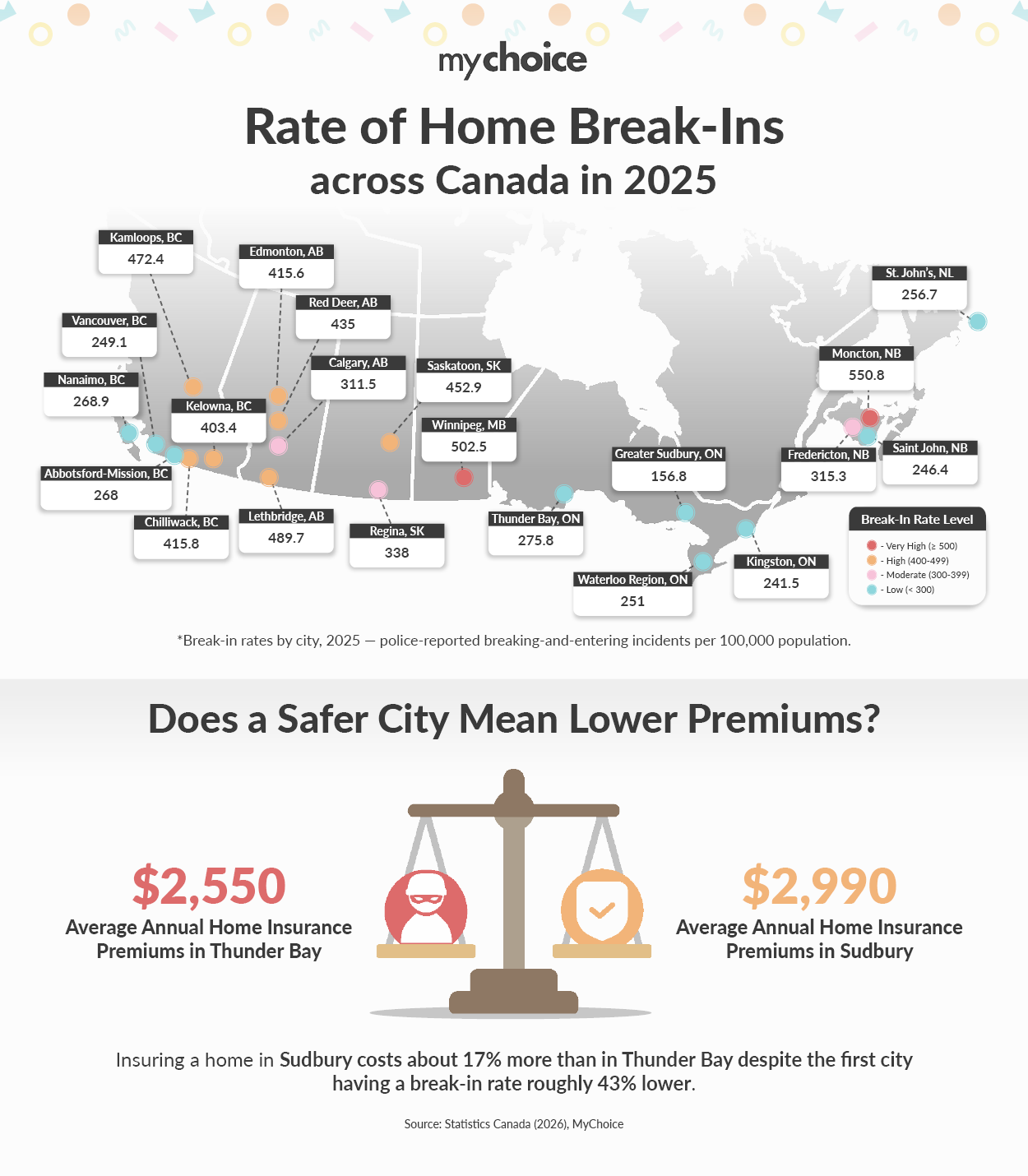
In 2025, Canada averaged 264 police-reported break-ins per 100,000 population, or 109,753 total incidents. According to government data, the rate of total breaking and entering was down in all provinces and territories last year and has been steadily declining over the last 10 years — down more than 40% since 2015.
Moncton had the highest police-reported break-in rate among the Canadian CMAs reviewed in 2025, at 550.8 incidents per 100,000 residents. Winnipeg ranked second at 502.5, followed by Lethbridge at 489.7.
Ontario cities were generally lower on the list. Thunder Bay recorded 275.8 incidents per 100,000, while Greater Sudbury recorded 156.8.
Which Canadian Cities Have the Lowest Break-In Rates?
Several cities recorded break-in rates significantly below the national average in 2025.
Among the CMAs reviewed, Barrie recorded the lowest break-in rate at 103.8 incidents per 100,000 people, about 61% below the Canadian average. Sherbrooke followed at 132.7, roughly 50% below the national rate
Trois-Rivières, Que., Halifax, N.S., and Sudbury, Ont. are all more than 40% below the national average in terms of the rate of breaking and entering.
How Break-In Risk Affects Home Insurance
Your home insurance premium is based on a number of factors, including the risk profile of your property and its location — as the Insurance Bureau of Canada explains, every neighbourhood in Canada has different risks, and insurers track the number, type and cost of claims by neighbourhood to understand the likelihood of future claims. This can include factors like severe weather events and crime.
If your area has experienced a jump in claims related to property crime, there is a chance that the average cost of home insurance may go up. But the risk that homes in your neighbourhood might be broken into is just one factor that goes into this.
For example, while Sudbury has some of the lowest break-in rates among the Canadian CMAs reviewed, the city’s average home insurance premiums are costlier than those in cities like Kingston and Peterborough, Ont., which have higher rates of breaking and entering.
The difference is particularly clear when comparing Sudbury and Thunder Bay since both cities are located in Northern Ontario. Sudbury recorded 156.8 break-ins per 100,000 people in 2025, roughly 43% lower than Thunder Bay’s rate of 275.8. Yet the average annual home insurance premium in our dataset is $2,990 in Sudbury compared with $2,550 in Thunder Bay, making Sudbury homes about 17% more expensive to insure.
| City | 2025 Break-In Rate | Avg. Annual Home Insurance Premium |
|---|---|---|
| Lethbridge, AB | 489.7 | $2,911 |
| Red Deer, AB | 435.0 | $3,323 |
| Calgary, AB | 311.5 | $2,779 |
| Thunder Bay, ON | 275.8 | $2,550 |
| Kingston, ON | 241.5 | $2,244 |
| Peterborough, ON | 192.0 | $2,312 |
| Greater Sudbury, ON | 156.8 | $2,990 |
| Barrie, ON | 103.8 | $2,275 |
Break-in rates alone don’t determine home insurance premiums. Insurers consider a much broader range of property and location risks when pricing coverage.
Generally, theft and property damage resulting from a home break-in are covered under comprehensive insurance policies up to set limits, but for certain larger-value items, such as jewelry or antiques, you may need to purchase an additional rider.
Read More: Why Home Insurance Costs Are Higher in Northern Ontario
How to Reduce Your Home’s Burglary Risk
Regardless of where you live or your city’s overall break-in statistics, there are several steps you as a homeowner can take that can help deter thieves and reduce your individual risk that a break-in will happen on your property. These range from installing low- or high-tech options, like:
- Security systems, ranging from DIY, self-monitored models to full smart setups with video, professional monitoring and emergency dispatch.
- Smart doorbells that allow you to speak to visitors remotely, giving the impression that you’re home even when you’re out.
- Lighting, whether motion sensor lights or smart lighting, such as smart plugs, switches or bulbs that turn lights on randomly to make it seem as though the home is occupied.
Some insurers offer home insurance discounts for approved security or monitored alarm systems, although the amount and eligibility requirements vary by insurer.
Good homeowner habits or a security checklist also go a long way to preventing break-ins, including:
- Ensuring your windows and garage door are closed and locked when you leave the house and first-floor windows are closed at night.
- Making sure your doors, including patio doors, have reliable locks and deadbolts.
- Asking someone to shovel your driveway, bring in flyers or mow your lawn if you’re away for an extended period.
Should Crime Rates Influence Where You Buy a Home?
Break-in rates and other crime statistics are a consideration when it comes to where to purchase a home. In addition to how these may impact your insurance premium, it may also be important to consider whether crime rates could affect your property value in the future.
Ultimately, the neighbourhood or city you choose has to be somewhere where you enjoy a high quality of life and peace of mind — a place where you can explore local amenities and get involved in community activities, where you’re comfortable walking and letting your kids play.