









E-bikes seem to be everywhere in Canadian cities, whether people are using them for fun, to run errands or as an efficient way to commute to work. But how does insurance coverage work if your e-bike is damaged, stolen or involved in an accident?
To help e-bike owners understand how or whether their e-bikes are covered in case of theft, damage or personal liability under a home, condo or renter’s insurance policy, we examined Ontario’s regulations for e-bikes as well as how accidents involving e-bikes are often treated for insurance purposes. We also took a look at policy details and some of the actions and risks that may exclude a bike from coverage.
Are E-Bikes Covered as Personal Property?
While most home, condo and tenant insurance policies exclude ‘motorized vehicles’ from coverage under personal property or contents coverage, qualifying e-bikes may be listed as an exception, so as long as it meets specific criteria, there’s a chance your e-bike is insured under your policy, up to a certain limit.
Many policies cover e-bikes in case of theft, whether at home or away from home (for example, when they’re locked to a bike rack), or accidental damage from a covered peril like fire or vandalism, but this varies by insurer and depends on the type of bike you own.
For example, a policy may only cover an e-bike that is road legal. If you make modifications to an e-bike, it will likely not be covered.
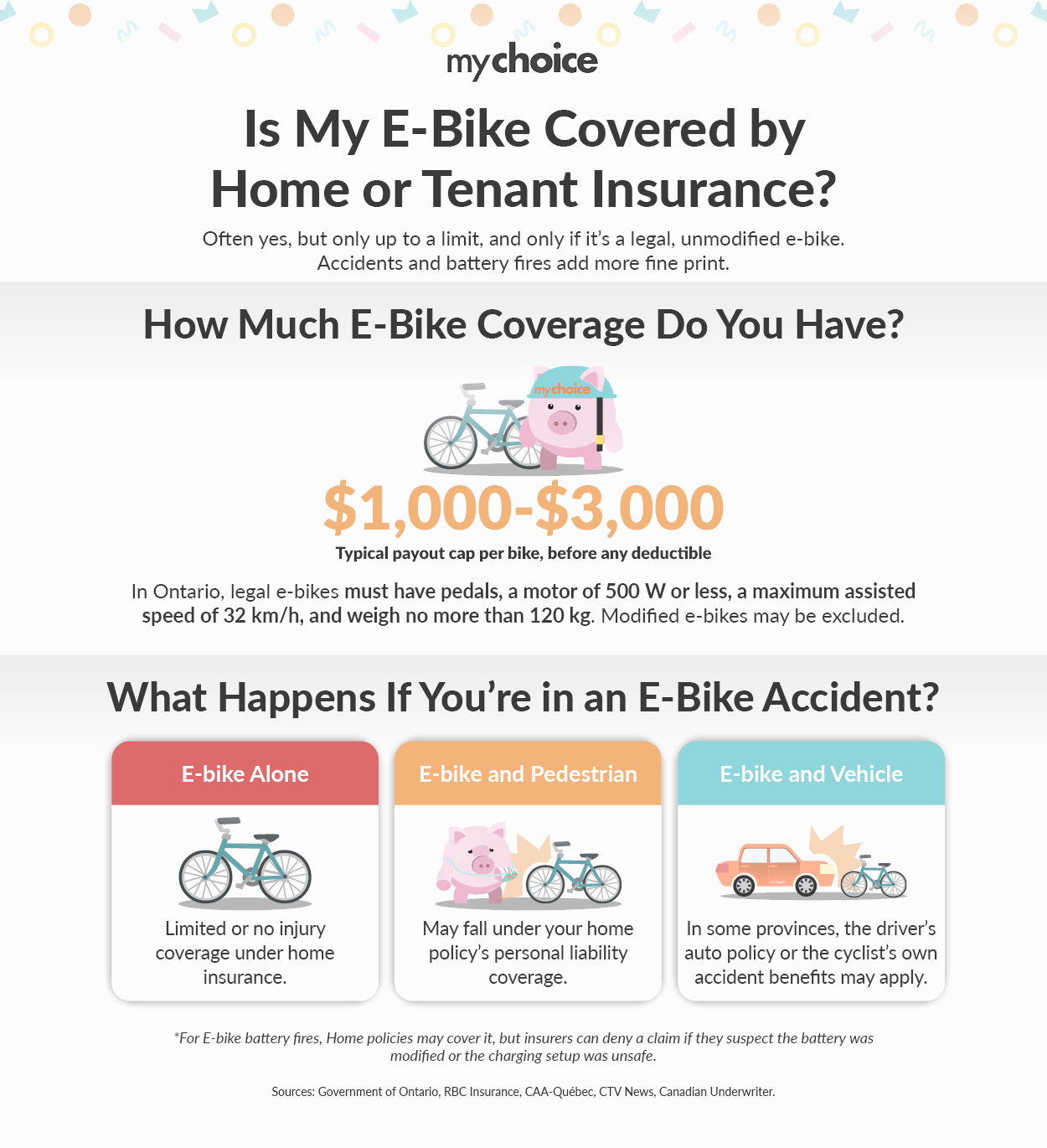
How Much Will Insurance Pay for a Stolen E-Bike?
As with other high-value items like jewellery and art, bicycles and e-bikes are frequently singled out as a separate subcategory under the personal property or contents coverage of many home and tenant insurance policies and subject to caps.
In this case, insurance would pay up to a certain limit for a stolen e-bike, which, especially for higher-end bikes, may not be enough to cover the full value. A deductible may also apply.
Does Personal Liability Cover an E-Bike Accident?
Personal liability may cover injuries or damage you cause to others, but not your own injuries.
An accident involving:
- An e-bike alone may have limited or no coverage under home insurance when it comes to injuries. These are likely covered by supplementary plans through your employer, a private disability plan or even a tort claim against another responsible party, if applicable. Depending on the cause of the accident, damage to your bike may or may not be covered under your home insurance.
- A pedestrian and an e-bike, as one Ontario law firm notes, may be included under your home insurance policy’s umbrella personal liability coverage.
- A vehicle and an e-bike, in certain provinces, may involve the driver’s auto insurance policy or the cyclist’s own auto insurance accident benefits, if they have any.
In Ontario, however, changes to the automobile insurance regulations that took effect in July added new restrictions to who is covered under accident benefits, including e-bike riders, as Canadian Underwriter notes.
As e-bikes are not considered automobiles, riders may be unable to access optional benefits such as income replacement unless they qualify under their own or a family member’s auto policy. Mandatory medical, rehabilitation and attendant-care benefits may still be available after an accident.
Does the E-Bike Meet Ontario’s Legal Definition?
In Ontario, e-bikes are regulated by the Ministry of Transportation but are not considered motor vehicles. To be road legal, an e-bike has to have:
- a maximum assisted speed of 32 km/hr
- a maximum 500-watt motor
- a maximum weight of 120 kg
- attached pedals
- two independent braking systems
- no modifications that allow it to go faster or be more powerful
E-bike riders also have to be at least 16 years old and wear an approved bicycle or motorcycle helmet.
If you remove the pedals, the ministry will consider your e-bike to be a motor vehicle, which may require registration, insurance and appropriate licensing to operate.
E-bikes that have been modified to allow for additional speed or power will also likely be excluded from home insurance coverage.
What About Battery Fires?
As with other devices in your home like laptops and power tools, e-bikes are powered by lithium-ion batteries, which have raised fire risk concerns in many municipalities as they can ignite quickly and cause explosions.
In Toronto, for example, 97 lithium-ion battery incidents had been reported by September 9, 2026, according to Toronto Fire Services.
As Toronto Fire told CBC News, the batteries in e-bikes and scooters “especially when overcharged, modified or damaged” have led to the rapid increase in these fires.
Home insurance policies may cover battery fires originating from e-bikes, but this can depend on the circumstances. As one law firm notes, for example, insurers may deny claims if they suspect a battery was modified or a charging setup was unsafe.
When Should You Buy Additional E-Bike Coverage?
As with other valuable items in your home, you may be able to schedule your e-bike on your home insurance policy, which means you’re adding it as a separately insured item. Purchasing an additional endorsement for an e-bike or any valuable item will raise your premium every month, but coverage will depend on the endorsement’s terms.
To figure out whether additional coverage is worth it, determine whether your policy pays for the e-bike’s replacement cost or its actual cash value (including wear and tear and depreciation), and compare this number against the sublimits for bicycle coverage under your policy. If there is a significant difference, it may be worth scheduling your e-bike.