









If you’ve fallen victim to a convincing email link, been part of a data breach or somehow given up sensitive personal information to online fraudsters, you’re not alone.
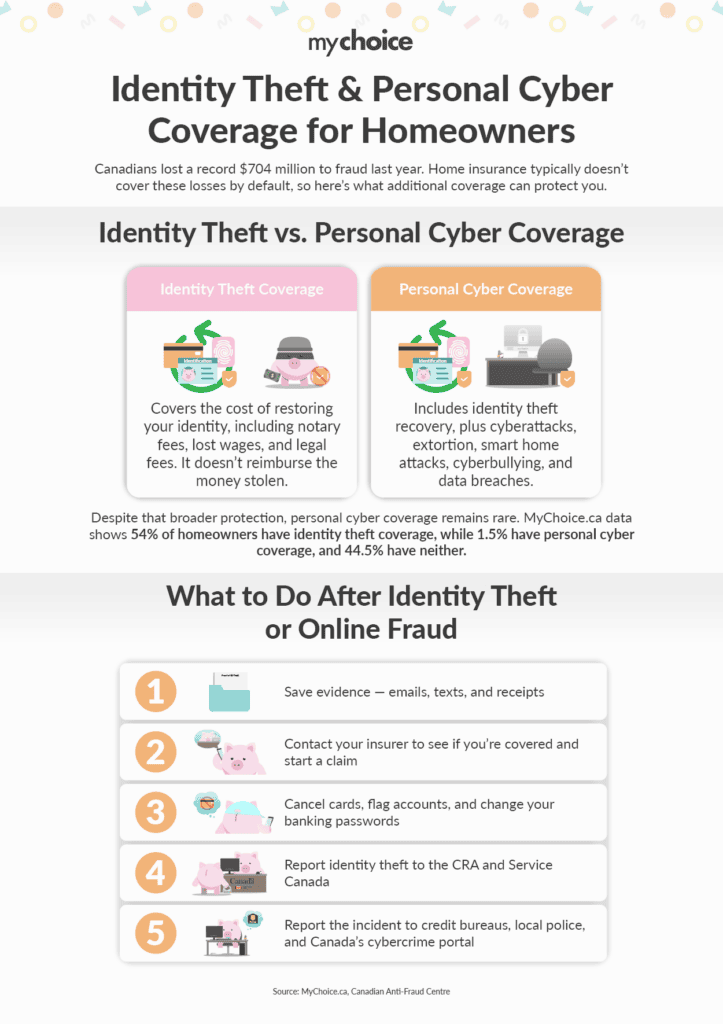
Cybercrime and identity theft are growing problems in Canada, resulting in millions in financial losses for individuals and businesses each year – last year, Canadians lost a record $704 million to fraud, according to the Canadian Anti Fraud Centre, as well as hours spent dealing with the aftermath, whether trying to recover stolen funds or reclaim compromised information.
Some homeowners may be surprised to learn that in some cases, their home insurance may offer valuable tools and support to help recover from cyber incidents, but it’s important to understand what your existing policy covers and how broader identity theft and personal cyber protection works.
To create this guide, we reviewed MyChoice data, information from the Canadian Anti-Fraud Centre, the Autorité des marchés financiers and the Insurance Bureau of Canada as well as policy particulars to provide a detailed look at the options available to help Canadian homeowners decide which coverage may better fit their risks and understand what to do after identity theft, online fraud or a cyberattack.
Do Home Insurance Policies Cover Identity Theft and Online Fraud?
Not usually. Some home insurance policies cover identity theft recovery costs as standard, but most do not.
Generally, there are two endorsements that homeowners can add to their home insurance policy to protect against these types of incidents – identity theft and personal cyber insurance. Each provides coverage against different types of online fraud.
With an identity theft add-on, your insurer will pay for your expenses to restore your identity – for example, notary fees, correspondence costs, lost wages, credit card application fees and any professional fees or court fees. This endorsement generally doesn’t cover actual financial losses as a result of fraud, such as a loan taken out in your name, business losses or fraudulent charges covered by your credit card.
Commercial cyber risk coverage has been available to protect businesses against the risk of cyberattacks for some time, but homeowners also now have the option of adding personal cyber coverage to their home insurance policy, which often provides broader protection than an identity theft endorsement alone.
For example, cyber coverage includes identity theft recovery but also protects against the costs incurred to recover from cyberattacks or malware, extortion, attacks on your smart home systems, cyberbullying and data breaches, including ransom costs or reimbursing money lost during a phishing scheme.
With both identity theft coverage and personal cyber, some insurers may also provide access to additional support, such as legal services or specialists to help you restore your identity or credit.
Read More: Explore Home Insurance Coverage in Canada
Identity Theft vs. Personal Cyber features
| Identity theft coverage | Personal cyber coverage | |
|---|---|---|
| Median premium (MyChoice data) | $30/year | $75/year |
| Common coverage limits (MyChoice data) | $25,000 | $25,000 |
| Covers expenses related to recovery of stolen identity (notary fees, correspondence costs, lost wages, court fees, etc.) | Yes | Yes |
| Covers costs incurred as a result of a data breach | No | Yes |
| Covers losses/costs resulting from cyberattack | No | Yes |
| Covers cyber-related extortion costs | No | Yes |
| Covers costs to recover from cyberbullying | No | Yes |
| Offers resources/experts to support homeowners after identity theft or cyberattack | Yes | Yes |
Which Coverage Should I Choose?
At the moment, identity theft coverage is the most popular choice amongst Canadian homeowners — according to MyChoice data, just over half of homeowners (54%) carry active identity theft coverage as an add-on to their home insurance policies. This number is much lower for personal cyber protection, with only 1.5% of homeowners currently choosing this endorsement.
Identity theft coverage can be a good option for homeowners who are worried about the risks and logistics of identity theft recovery and want to have a base level of support in place, in case their information is compromised.
At the same time, with cyber threats growing against many Canadians and businesses, personal cyber coverage might be something to consider as a next level of protection for any homeowner — but particularly if you have family members who may be at risk of cyberbullying, if you shop and bank online regularly, store a lot of personal information digitally or if your home uses smart features.
What to Do After Identity Theft or Online Fraud
If you have been the victim of identity theft or online fraud, your first step is to make sure you have proof and documentation- emails, text messages or receipts, says the Canadian Anti-Fraud Centre.
If you have personal cyber or identity theft protection through your home insurance provider, you’ll also want to get in touch with them as soon as you are aware of the fraudulent activity, so you can start a claim and take advantage of any support and services they provide to help you respond to and recover from the attack.
Get in touch with your financial institution to cancel cards, place flags on your accounts and change your passwords. If you were a victim of identity theft, it’s also important to report the incident to government agencies such as the Canada Revenue Agency and Service Canada.
You should also report the fraud to the credit bureaus and file a report with your local police, as well as through the government’s online cybercrime and fraud reporting tool.