









Whether working from home affects insurance depends on the work, whether it is a business, who owns the equipment, whether inventory, clients, or employees enter the home, whether the home receives deliveries, and whether the work creates new liability; our team reviewed the federal home-insurance guide, CCOHS’s remote-work guidance, the federal workplace-injury reporting guide, and the federal list of provincial workers’ compensation boards to explain these factors.
This guide will teach you how to identify your remote-work setup, what questions to ask your employer and insurer, and the difference between home and tenant insurance. It also includes what to do if you get injured while working from home.
Does Working From Home Affect Home Or Tenant Insurance?
Desk-based work as an employee is less of a concern to insurers than operating a business from home. Don’t assume every employee must report a laptop at the kitchen table. On the other hand, if you run a business from your home, you must report this to your insurer and answer any questionnaire about this accurately.
If you’ve changed your working setup at home, contact your insurer or broker in writing to confirm whether you need to tell them anything and whether you’re adequately insured. Policies and application criteria vary.
Classify Your Work Setup
| Setup | Facts that matter | First call |
|---|---|---|
| Employee doing desk-based work | I have a formal remote-work agreement with my employer, work from home using employer-provided equipment, don’t serve or receive customers, don’t store any business-related inventory/stock, and don’t have any employees at the home. | Employer: Equipment provisions, what to do in event of a workplace injury. Insurer: As required by the terms of your policy. |
| Employee receiving clients or goods | How often do you have visitors? Are there deliveries and how many/often? Do you receive/handle samples? What equipment, if any, do you have? Are you authorized by your employer to work from home? | Classify your work setup, speak with your employer and insurer before starting activity. |
| Self-employed digital or professional work | Ask yourself a number of questions. Where does my revenue come from? Am I paid for advice/services? Do I own business equipment? Do I have contracts? What are my professional/cyber liability exposures? | Home or tenant insurer and a commercial broker or insurer. |
| Home business with stock, tools or customers | Think about the value of your stock, deliveries, renovations, signage, number of employees, business vehicles, whether you allow visitors. | Before you operate, notify/consult with your insurer. There may be municipal rules or lease/condo restrictions regarding your work setup. |
| Higher-hazard activity | Which of these best describes what you do for work? Food, childcare, beauty, manufacturing, repairs, chemicals, regulated? | Which specialist insurer and any relevant licensing, zoning, fire and safety authorities apply to your work setup? |
Risks Faced By WFH Employees
A personal cyber endorsement may cover certain WFH risks. It wouldn’t, however, cover business or employer responsibilities.
Business interruption is only payable when there’s an insured cause of loss and subject to the policy wording, maximums, time frames, and proof of earnings.
Will My Home Insurance Cover Working From Home?
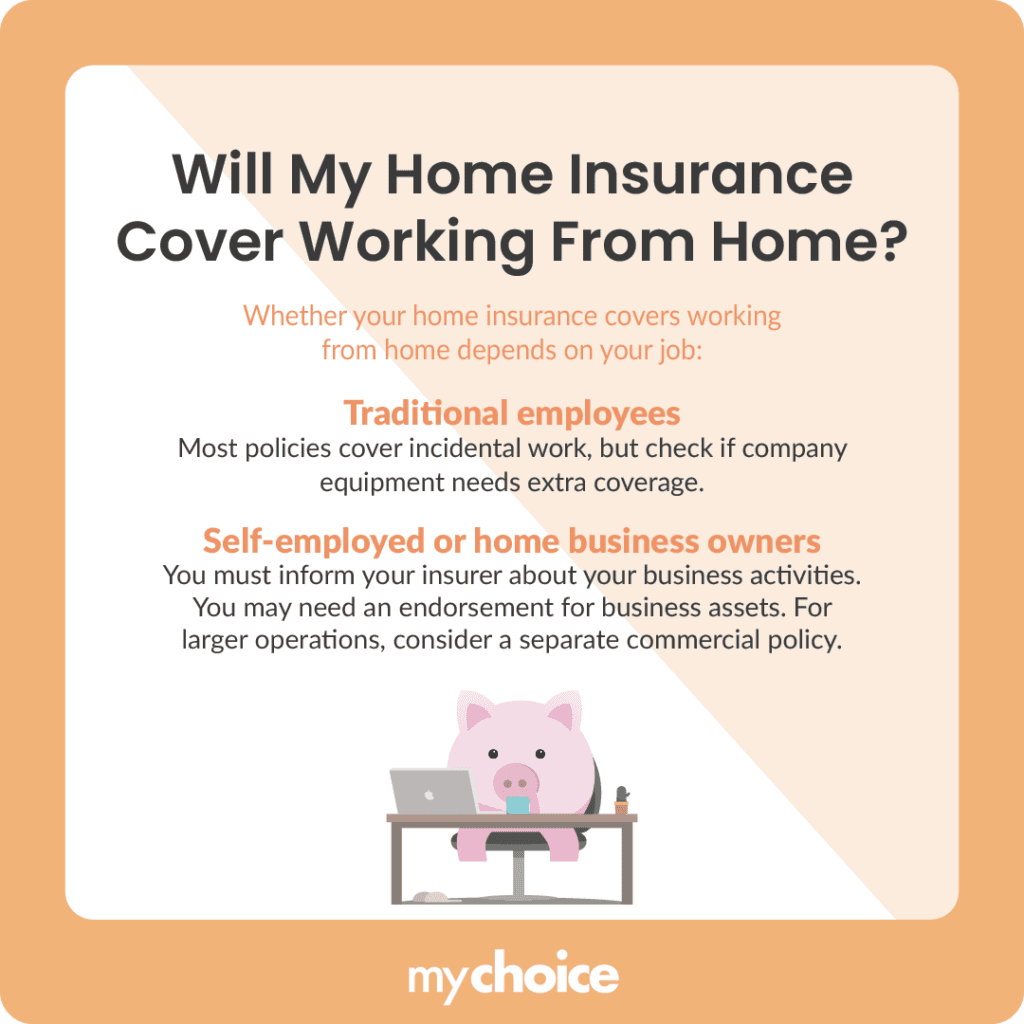
Typically, a home insurance policy covers the residence, personal property, and personal liability.
However, if you operate a business from home, tell your insurer and review the exact endorsement or commercial policy. Federal consumer information explains that home insurance is not a substitute for business insurance and may provide only limited coverage for business-related property.
Make sure to discuss adequate coverage for the building, business property, customers, completed operations, and lost business income.
Will My Tenant Insurance Cover Working From Home?
Tenant insurance typically covers personal possessions, additional living expenses following a covered loss, and personal liability. However, since you’re working from home, check with your insurer to see how personal computers are treated compared with work-related computers, especially when your employer owns them.
Ask about liability for visitors or clients, coverage for property away from the home, coverage limitations on business-related possessions, and exclusions. Endorsements for home-based businesses may be available, but terms may differ for homeowners and renters. Tenant insurance does not cover the landlord’s building or a business by default.
What If I Don’t Tell My Insurer I’m Working From Home?
Never conceal the fact that you have a home-based business and never answer questions inaccurately when completing an insurance application. Be sure to describe the activities you engage in – don’t simply identify yourself as a freelancer or remote worker. Get responses from your insurer/broker in writing. Keep copies.
| Activity change | Ask the insurer |
|---|---|
| Clients, patients or students visit | Do I need business liability coverage? Participant injury coverage? Higher limits? |
| Inventory, tools or samples increase | Have you told your insurer you’re working from home? It’s worth checking your policy for on- and off-premises limits and the conditions relating to theft and valuation. |
| You hire someone | Which regulations apply? Would your home insurer say injuries to your employee are excluded? Could your home insurer say business liability is excluded? |
| You add signs, renovations or a separate entrance | Could there be changes to occupancy, construction, municipal approvals or the total replacement cost of the building? |
| You make, repair, store or sell goods | Do you have adequate product liability coverage? Completed operations coverage? What about fire protection, hazardous-materials storage and use, theft, etc.? |
| You begin deliveries or business driving | Can I use my personal auto policy or do I need commercial coverage? |
Read More: See How Home-Based Business Insurance Works in Canada
Workers’ Compensation
If a worker is injured, provincial workers’ compensation boards or a federal process will use their own criteria to determine if the injury is work-related.
If injured: get medical attention, tell your supervisor immediately and use the board and employer incident or injury report forms for the province where the worker is usually employed, with information on the time, task, location, etc.
Should I Get Additional Insurance If I Work From Home?
Buy additional coverage to fill a gap. Availability and eligibility vary by the situation and insurer.
Some businesses that work from home have very little risk and may be okay with a home-office policy endorsement. Other businesses may require standalone commercial insurance policies if they keep expensive items at home, allow visitors, provide professional advice, sell products, employ people, manufacture items or make deliveries.
Read More: Review Business Insurance Options for Consultants
Questions To Ask Before You Change Coverage
- What is the limit on business property? How is property valued? How much coverage is there for property away from the premises?
- Who owns each computer, tool, sample, and other item of inventory? Individuals? Companies?
- Do any clients, patients, students, contractors, couriers, employees, etc., come to the home?
- What type of liability is at issue: personal, employer, professional, product, cyber, commercial general liability, etc.?
- Which causes of loss must apply before business-income coverage responds? Is there a waiting period before business-income coverage responds?
- What written policy or endorsement change is required, and when does it take effect?