









Running a business changes how you use your property. Home businesses can pose liability, income, equipment, inventory and cyber risks. Home insurance isn’t necessarily set up to cover these risks. In some cases, an endorsement to your home insurance may be enough, but you may need a separate commercial policy. Tell your insurer about your business before relying on either.
In this guide, our editorial team referenced the Financial Consumer Agency of Canada’s home insurance guide, the Insurance Bureau of Canada’s business-coverage guide and the Government of Canada’s permit and licence finder.
Do You Need Insurance for a Home-Based Business?
FCAC recommends that if you operate a business from your home, you let your home insurer know. You may require additional coverage for business-related property and activities.
Depending on the nature and extent of the risk, a low-risk business may be eligible for a home-business endorsement. More extensive operations may require commercial insurance. This may be the case if customers or employees visit your home, you keep large amounts of business property there, manufacture goods, provide professional advice or work away from home.
Coverage limits vary between insurers. Do not assume business property or liability is covered because you have home insurance, even if:
- your business is incorporated;
- your business operates from one room in your home; or
- your business is considered small-scale.
Read More: Read How Working From Home Can Affect Home Insurance
Unique Risks for Modern Home-Based Businesses
Thanks to technology and evolving work models, more Canadians are running businesses from home with ease and flexibility. In 2022, there were 1.19 million small businesses in Canada, many of which operated out of a home base. Still, you might not anticipate certain risks, including the following.
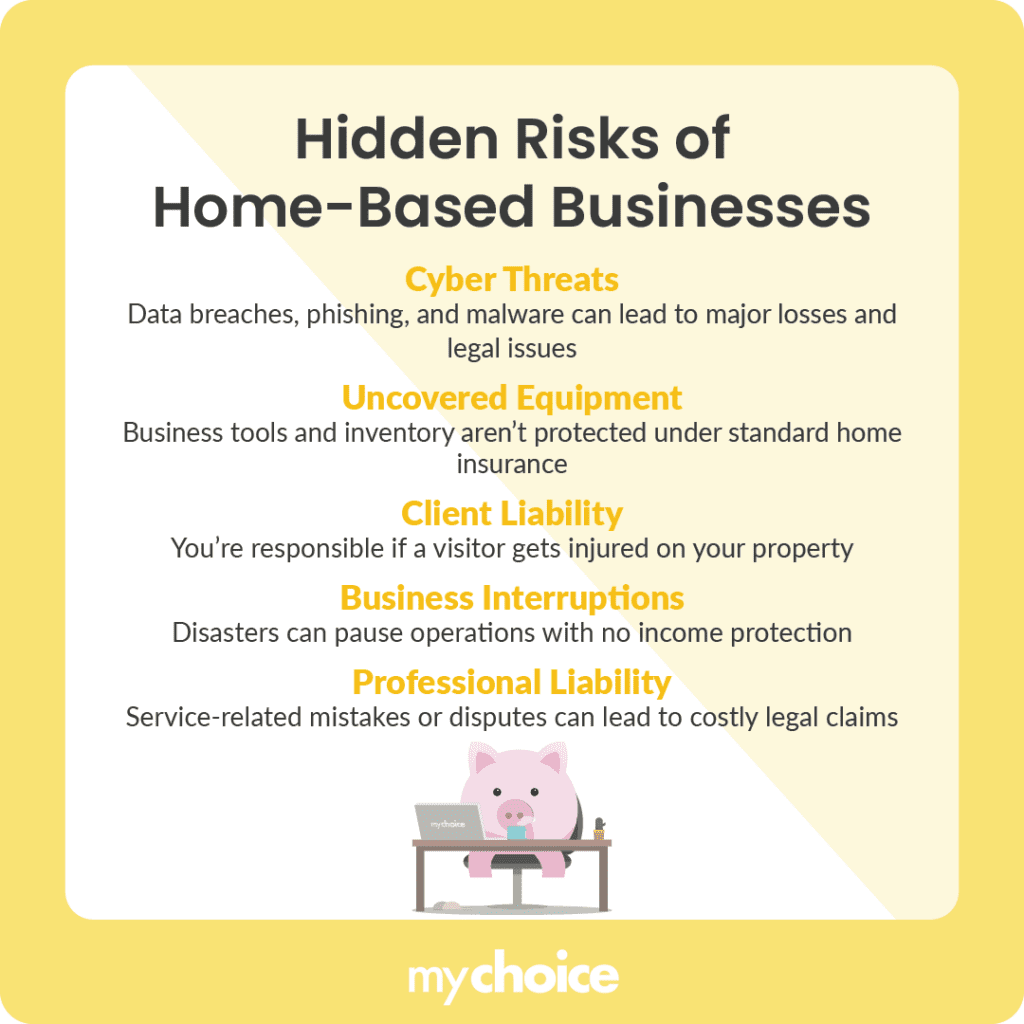
Cybersecurity and Data Breaches
As technology evolves, so do the skills of those who use it unethically. Thriving businesses are prone to becoming targets of phishing emails, malware infections, and hacked Wi-Fi networks, as hackers often steal personal data and financial information. These attacks can significantly damage your reputation and cause legal consequences.
Inventory and Equipment Damage
While a regular home insurance policy will cover fire, theft, and water damage to your personal items, it may not cover losses you experience with business equipment like handmade products or expensive tools.
Client Delivery-Related Liabilities
If clients visit your home office, you can be liable for any injuries they experience. Business-related slips may be excluded or limited under a home policy; confirm the coverage with the insurer.
Business Interruptions
Natural disasters and power outages can suddenly halt your business operations, leaving you to recover lost income without the help of an insurance plan.
Professional Liabilities
Suppose you run a service-based business like a consultation firm, coaching company, or design agency. Even the slightest misunderstanding can lead to costly claims, and regular home insurance won’t cover the legal repercussions of your clients claiming you cost them financial losses.
Which Coverage Options Fit a Home-Based Business?
Ultimately, the best insurance for a home-based business will depend on what you do. While there isn’t a single suitable policy for every business, there are flexible options you can customize to your services, including the following.
Home-Based Business Endorsement
A home-based business endorsement makes a good add-on if you already have a home insurance policy. It’s best for hobby-style businesses, early-stage startups, and freelancers with minimal equipment, as it offers limited coverage for tools and liabilities.
It may not suffice for in-person client meetings at your home or if you have a sizable inventory.
Commercial General Liability (CGL) Insurance
If your business hosts in-person client consultations, commercial general liability is one coverage to discuss. It may respond to covered claims involving client injury or product-related harm, subject to the policy’s terms, limits and exclusions.
Professional Liability Insurance for Errors and Omissions
If you’re a consultant, IT professional, designer, accountant, or other service provider, there may come a time when clients claim your products or services caused them financial losses. Should that be the case, professional liability insurance can cover legal defences, settlements, and judgments.
Commercial Property Insurance
For product sellers, drop shippers, content creators, and crafters, commercial property insurance can help protect physical assets. It can cover damage and losses to equipment and tools such as CPUs, specialized equipment, and other inventory.
Cyber Liability Insurance
Nowadays, even bigger businesses run operations at home, and technology plays a significant role in a business’s success. However, these technologies can fall victim to cyberattacks. Fortunately, cyber liability insurance can protect businesses managing sensitive client information on cloud-based systems by protecting against data breaches and covering the fallout of potentially hacked systems.
Read More: Explore Business Insurance Options
What’s Covered By My Home vs. Business Insurance Policy?
| Type of Insured Loss | Personal home policy | Business coverage to discuss |
|---|---|---|
| Fire damages the house | May cover residential property based on the disclosed occupancy, subject to the policy | Commercial property coverage for business equipment, stock and improvements |
| Client slips during an appointment | Exclusions or limits may apply to business activities | Commercial general liability |
| Advice causes a client’s financial loss | Professional services may be excluded from personal liability coverage | Professional liability or E&O |
| Customer data is stolen | Household identity-theft coverage isn’t the same as business cyber insurance | Cyber incident response, liability and interruption |
| Covered damage stops operations | Additional-living-expense coverage is not business-income coverage | Business-interruption coverage with the required insured trigger |
Business-interruption insurance doesn’t cover every decrease in revenue. It is limited to specified losses following an insured cause. Waiting periods, restoration periods, limits and covered expenses may also apply. Ask how the proposed coverage would treat losses involving a home office, utility outage or supplier disruption.
Read More: Review Startup Insurance Needs for a Home-Based Business
Permits, Licences and Property Rules
Insurer approval does not exempt you from obtaining licences or meeting other requirements.
Use BizPaL to find out whether federal, provincial, territorial or municipal permits and licences are required. Find out whether zoning rules apply. If you rent or live in a condo, review your lease, declaration, bylaws and condo rules.
Questions to Ask Before You Buy Coverage
- Does it cover everything involved in my operation, such as products, advice, employees and customers?
- Are there exclusions for professional liability, cyber liability, product liability or product recalls?
- Does it include business-income coverage? What events are covered?
- Is there a waiting period before business-income coverage applies, and how long does it last?
- Does it cover property kept at home, in transit or in temporary workspaces?
- Does it cover tools, stock, demo units and customer property?
- Is a higher property limit required during peak season?
- Does my commercial or personal auto insurance cover business use or deliveries?
- Which changes must I report, such as higher sales, additional employees, visitors, new equipment or more inventory?