









Workplace injuries have an economic impact in the billions of dollars a year in Canada, and far-reaching consequences for employees and businesses alike.
Key Injury Statistics in Canada
Over the longer term, there are some signs that the rate of workplace injuries appears to be declining across Canada.
Indeed, every province and territory reported lower injury rates in 2023 compared to the average rate from the three previous years, with Alberta, Quebec and Newfoundland and Labrador showing the greatest decreases, as a 2025 Report on Work Fatality and Injury Rates in Canada shows.
Federally regulated employers have also experienced an improvement in safety performance compared to 2019, with nearly a 10% decline in disabling injuries overall since the pre-pandemic era.
But while trends look to be improving over a longer period, the immediate year-over-year data shows a reversal in some areas.
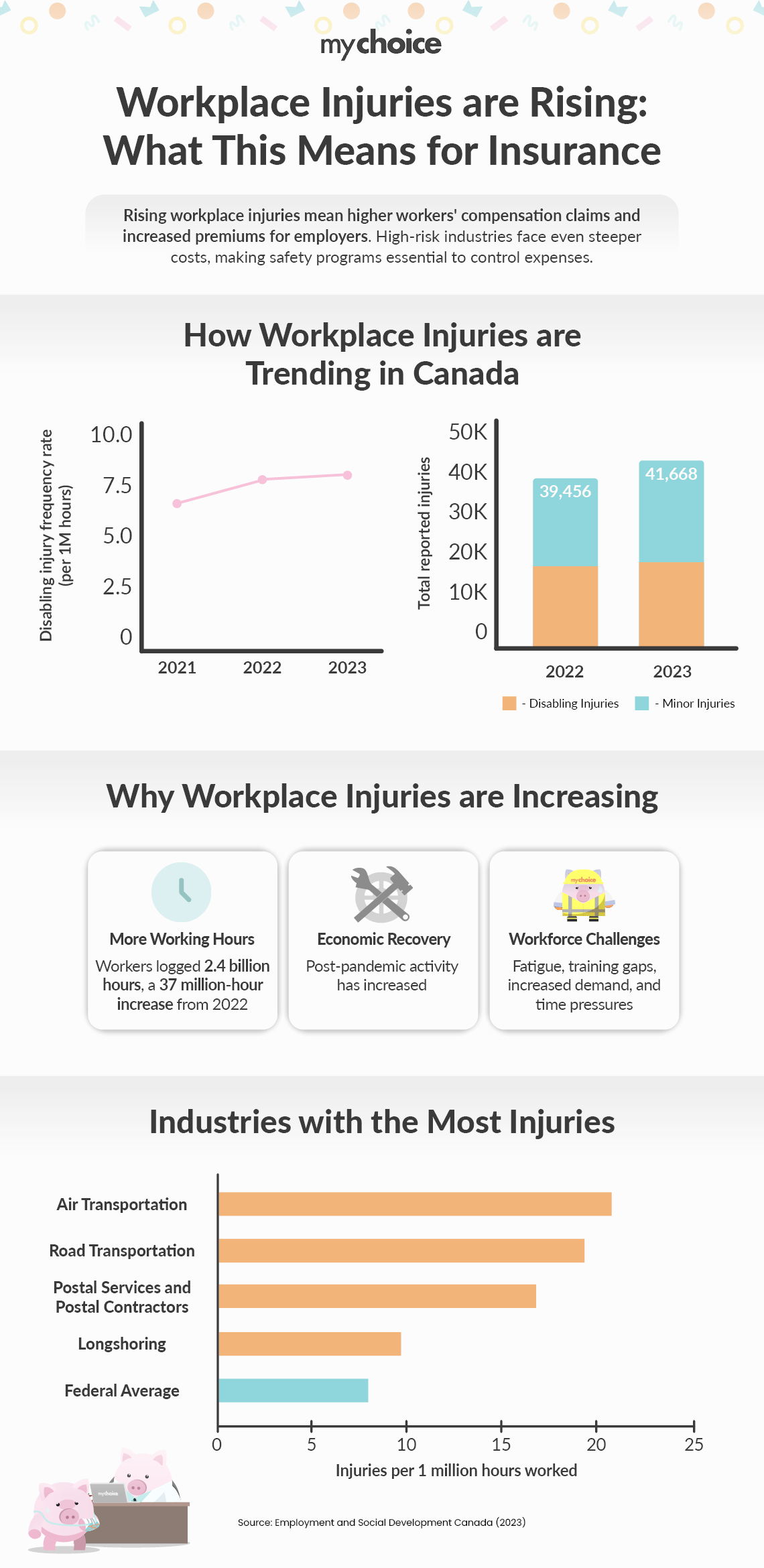
For federally regulated industries, the number of work-related injuries and hours worked climbed in 2023, with 41,668 reported over 2.4 billion hours worked, compared to 39,465 in 2022.
This includes 18,796 disabling injuries—up 665 from 2022—and 22,801 minor injuries.
Across the country, workers’ compensation boards reported 1,056 workplace fatalities in 2023, one of the highest numbers recorded in recent years.
The “Volume vs. Rate” Paradox—What Is Behind the Recent Increase?
As Employment and Social Development Canada notes in its 2023 report on occupational injuries in the federal jurisdiction, the most recent data available, there is a positive correlation between an increase in hours worked and a greater number of injuries in certain sectors. But that isn’t the whole story.
This relationship is complex and varies by industry, they say. The number of workplace injuries can also be impacted by other factors like safety practices, job complexity, fatigue, stress, training and skill level.
“Organizations with strong safety cultures and rigorous adherence to workplace health regulations often report fewer workplace injuries, regardless of the number of hours worked,” says the report.
Industry-Specific Risk in Canada
The federal government measures risks and safety performance via the Disabling Injury Frequency Rate (DIFR)—the number of disabling injuries per 1 million hours worked.
Federally, the DIFR was 7.77 in 2023—lower than 2019’s rate of 9.39.
Still, four industries recorded average DIFR values that were higher than the federal rate, although there can be significant variation depending on province or territory:
- Air Transportation: 21.38
- Road Transportation: 19.24
- Postal Services and Postal Contractors: 16.43
- Longshoring, Stevedoring, Port, Harbour Operations and Pilotage: 9.75
This, notes the government, represents the first time that the Air Transportation industry has had the highest DIFR federally since 2008.
At the same time, while postal services and contractors remained above the federal-jurisdiction rate, their DIFR has decreased significantly since 2019, which, says the government, suggests workplace safety is improving.
Industries under federal jurisdiction reporting the largest shares of total disabling injuries in 2023 were:
| Industry | Number of disabling injuries | Percentage of total |
|---|---|---|
| Road Transportation | 6,813 | 36.2% |
| Air Transportation | 4,413 | 23.5% |
| Federal Public Services, Public Service Departments and Crown Corporations | 3,218 | 17.1% |
| Postal Services and Postal Contractors | 1,514 | 8.1% |
| Communications | 1,041 | 5.5% |
Source: Employment and Social Development Canada
Outside of federally regulated sectors, the health care and social assistance industry was responsible for more than a quarter of all lost-time claims reported in 2023, according to the Association of Workers’ Compensation Boards of Canada (AWCBC). These were mainly listed as “traumatic injuries to muscles, tendons, ligaments, joints, etc.”
The manufacturing and construction industries also each reported more than 10% of total claims. Indeed, in the last five years, says WorkSafeBC, the serious injury rate in manufacturing has been 44% higher than the average across all industries in the province.
What Does This Mean for Employers and Insurers?
Most employers are required to pay premiums to provincial workers’ compensation insurance plans, such as WSIB in Ontario. Individual premium rates hinge on a number of factors, such as your industry, with certain sectors dealing with higher premium rates as a result of more injury claims.
In Ontario, WSIB also assigns your business a risk band that represents your individual risk, using insurable earnings, claims costs and the number of allowed claims over a six-year period.
For other commercial coverage, the effect depends on the policy, exposure and claims history.