









Depending on your situation and contractual arrangements, a student living away from home may get tenant insurance through a parent’s policy, a residence program, or their own tenant policy. And don’t assume one roommate’s policy will cover others.
For this update, our editorial team reviewed Insurance Bureau of Canada’s student tenant insurance guidance, IBC’s guide to home and tenant coverage, the federal home insurance guide, and the federal first-apartment guide.
Do Students Need Tenant Insurance in Canada?
Tenant insurance can protect your belongings and cover specified additional living expenses resulting from a covered loss. It can also respond to covered claims if you accidentally injure someone or damage property.
Some leases and residence agreements require student renters to show proof of tenant insurance.
Get written confirmation of whether another policy covers you.
Why Do Students Need Tenant Insurance?
| Protection | What it may do | What to verify |
|---|---|---|
| Contents | Pay for covered loss or damage to belongings you own | Named or broad perils, replacement cost or actual cash value, deductible, special limits and off-premises coverage |
| Personal liability | Respond when you are legally responsible for covered injury or property damage | Liability limit, accidental damage to the rented unit, exclusions and who is an insured person |
| Additional living expenses | Pay eligible added costs when a covered loss makes the insured home unfit to live in | Whether existing coverage includes the school location; the trigger, dollar or time limit, and how the residence is treated |
Liability coverage doesn’t mean that if someone is injured in your room, tenant insurance automatically pays their medical bill.
It applies to covered legal responsibility under the policy wording.
Does My Parents’ Home Insurance Policy Still Cover Me?
Speak to your insurer or broker and get written confirmation stating who is covered, the address where they are staying at school, and the level of coverage.
As a guide, IBC advises that a student under 21 may be able to remain on their parents’ or guardians’ home insurance policy while living away from home during the school year, although this is not followed by all insurers, ages or policies.
| Question for the parent-policy review | Why it matters |
|---|---|
| Is the student an insured person at this age and enrolment status? | Definitions may refer to dependency, age, full-time study or temporary absence |
| Is the residence or off-campus address covered? | Location, residence type and length of stay may affect the extension |
| What contents limit and deductible apply away from home? | A location or off-premises limit may be lower than the household contents limit |
| Do liability and additional living expenses extend? | A contents extension does not prove every other protection follows the student |
| How are a bike, jewellery, instrument or expensive electronics treated? | Special limits, security conditions or a separate endorsement may apply |
| What changes must be reported? | Part-time study, financial independence, a new address, roommates, a sublet or a long absence can change the answer |
What Coverage Should I Get as a Student in Canada?
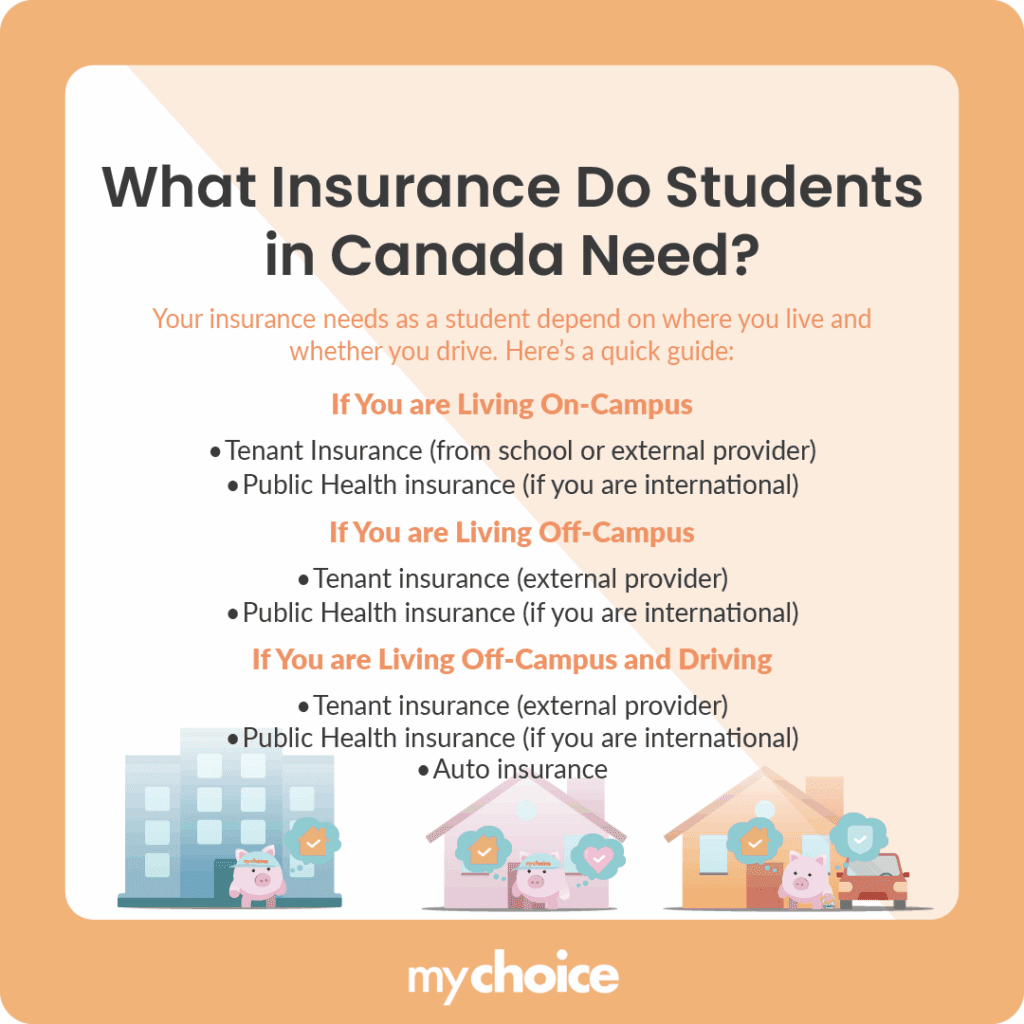
| Living arrangement | Coverage check |
|---|---|
| Living at home | Confirm the student remains an insured household member and that higher-value school property fits the limits |
| Campus residence | Read the residence agreement, ask whether a group plan exists, and compare it with any parental extension or separate policy |
| Off-campus alone | Compare contents, liability, accidental unit damage, additional living expenses, deductible and proof requirements |
| Off-campus with roommates | Roommates usually need their own policies, unless the insurer confirms a shared arrangement and makes each person’s rights clear |
| Summer vacancy or study abroad | Before you leave, make sure you know the conditions relating to absence or vacancy, including any requirements for unoccupied rooms, storage and coverage while you’re away |
Read More: Learn How Tenant Insurance Covers Water Damage
A Student Inventory Can Be Larger Than Expected
| Example category | Hypothetical replacement cost |
|---|---|
| Laptop, monitor and accessories | $2,300 |
| Phone and tablet | $1,400 |
| Bicycle and riding gear | $1,100 |
| Clothing and footwear | $2,500 |
| Furniture, bedding and kitchen items | $1,700 |
| Course, sports or music equipment | $1,600 |
| Total | $10,600 |
Make sure you’ve looked into special limits on your insurance. Some items or categories may have a limit that is lower than what it would cost to replace them.
Keep a student inventory. It may be bigger than you think. The figure here is just an example, not a suggestion as to how much is enough. Include current replacement costs, photos, model and serial numbers, and receipts for major items.
What Can Student Renters Use as a Price Check?
Add up what it would cost to replace everything in your rental, and make sure you’re getting enough coverage rather than choosing $40,000 just because it is common. Check the limits on particular items like electronics and bicycles that might be included. Then compare prices to find the coverage amount that makes sense for you.
We looked at thousands of tenant insurance quotes collected on MyChoice since the beginning of 2026. $40,000 was the most frequently recorded contents limit, appearing in 91.5% of the tenant quotes we reviewed. With that limit, a $1,000 deductible and no reported claims, the median price of tenant insurance comes to $433.08 per year ($36.09 per month).
Can You Share Your Policy With Roommates?
Some insurers will allow unrelated people who live together to be included on one tenant insurance policy.
Check who is considered an insured and who is listed as an additional interest, contact or occupant on the policy, as these terms mean different things in terms of rights. Find out who can make changes to or cancel the policy. Find out who gets claim proceeds.
IBC recommends that each roommate have their own tenant policy. Separate policies help avoid confusion over liability, ownership, claims history and policy cancellation. Confirm whose belongings and liability are insured, including property in shared rooms. Let the insurer know when a roommate leaves or moves in because an updated lease doesn’t necessarily update the insurance policy.
Read More: See How Renters Insurance Works With Roommates
Can You Get Tenant Insurance Discounts as a Student?
Not necessarily, as the cost of tenant insurance depends on location, building, coverage amount, deductible, claims history and insurer.
However, you may be eligible for a discount based on group or student insurance, a good claims record, home security discounts, multiple-policy discounts, and other promotions from insurance companies. Always compare the cost of insurance along with the final coverage.
What Happens If You Sublet Your Room?
Subletting a room affects insurance coverage because it changes the occupant and may change the property and risk. Check provincial regulations, review your lease and make sure you have the required authorizations before subletting your room. Contact your broker or insurer and let them know about your intentions. Ask whether you can leave your belongings there. Find out about vacancy provisions in the policy and how liability works. Your subtenant should obtain their own tenant insurance.
Read More: Read How to Break a Lease Early in Ontario
Questions to Compare Before Buying
- Who is insured, at which address and for what dates?
- Are belongings settled at replacement cost or actual cash value, and must you replace them before receiving the full amount?
- What are the contents, liability and additional living expense limits, deductible and special limits?
- How are accidental damage to the rented unit, bicycles, electronics, jewellery and property away from the residence treated?
- What must be reported about roommates, subletting, part-time study, long absences or a move?