









Planned renovations do not automatically end an Ontario tenancy. For repairs or renovations, an N13 can be used only when the work requires a building permit and vacant possession of the rental unit; it is not an eviction order. An N13 can also be used for demolition or conversion to non-residential use.
This guide is based on our team’s review of the Landlord and Tenant Board’s N13 form and instructions, the LTB’s Interpretation Guideline 12, Toronto’s Rental Renovation Licence Bylaw guidance and Hamilton’s Renovation Licence and Relocation Bylaw guidance.
Can My Landlord Evict Me For Renovations In Ontario?
An N13 is a notice and does not constitute an eviction. You can continue to remain in your rental unit if your landlord serves you with an N13 and you are entitled to challenge their assertion at a Landlord and Tenant Board (LTB) hearing. For renovations, the work must require both a building permit and vacant possession.
If you do not voluntarily leave, the landlord can apply to the LTB for an eviction. A landlord must generally serve Form N13 at least 120 days before the termination date.
The termination date must fall on the last day of a rental period and cannot occur before the end of a fixed-term lease. More time may apply where a tenant owns a mobile home or the rental unit is in a land-lease community.
Should You Pause Tenant Insurance During Renovations?
If you’re temporarily relocating during renovations, don’t automatically stop or cancel your tenant insurance. You may still need personal liability coverage.
You may also need coverage for any possessions you leave in the home or put into a storage unit. Cancelling your policy could leave you uninsured and create a gap in your insurance history.
What Should You Tell Your Insurer?
Contact the insurer before leaving. Tell the insurer why you’re moving out of your home, how long you’ll be gone and whether your contractor(s) will have access to the home. Also, tell them where you’ll store your personal property, whether you’ll be renting another home, and whether you intend to move back when the renovation is complete.
Ask how they define “vacant” and “unoccupied.”
Depending on the circumstances, an insurer may continue the policy as-is, change coverage, change the address or add policy conditions. It might ask for another policy for your temporary home.
What Should You Do After Receiving An N13?
Do You Have To Move Out When You Receive An N13?
An agreement to end the tenancy is a separate document. It may affect your rights and entitlements. Get advice before signing an N11.
No, the N13 states that you are not required to move out if you do not agree.
After serving an N13, the landlord can apply to the LTB, which will set a hearing. The landlord must prove the need for vacant possession, the stated work, and permits or reasonable steps to obtain them.
If the tenant remains, only an enforceable order can authorize eviction. Receiving the notice does not mean an order has been issued.
If the tenant wants to move out, they can end the rental agreement on a minimum of 10 days’ written notice on a Form N9.
What Rights Do Tenants Have During Renovations In Ontario?
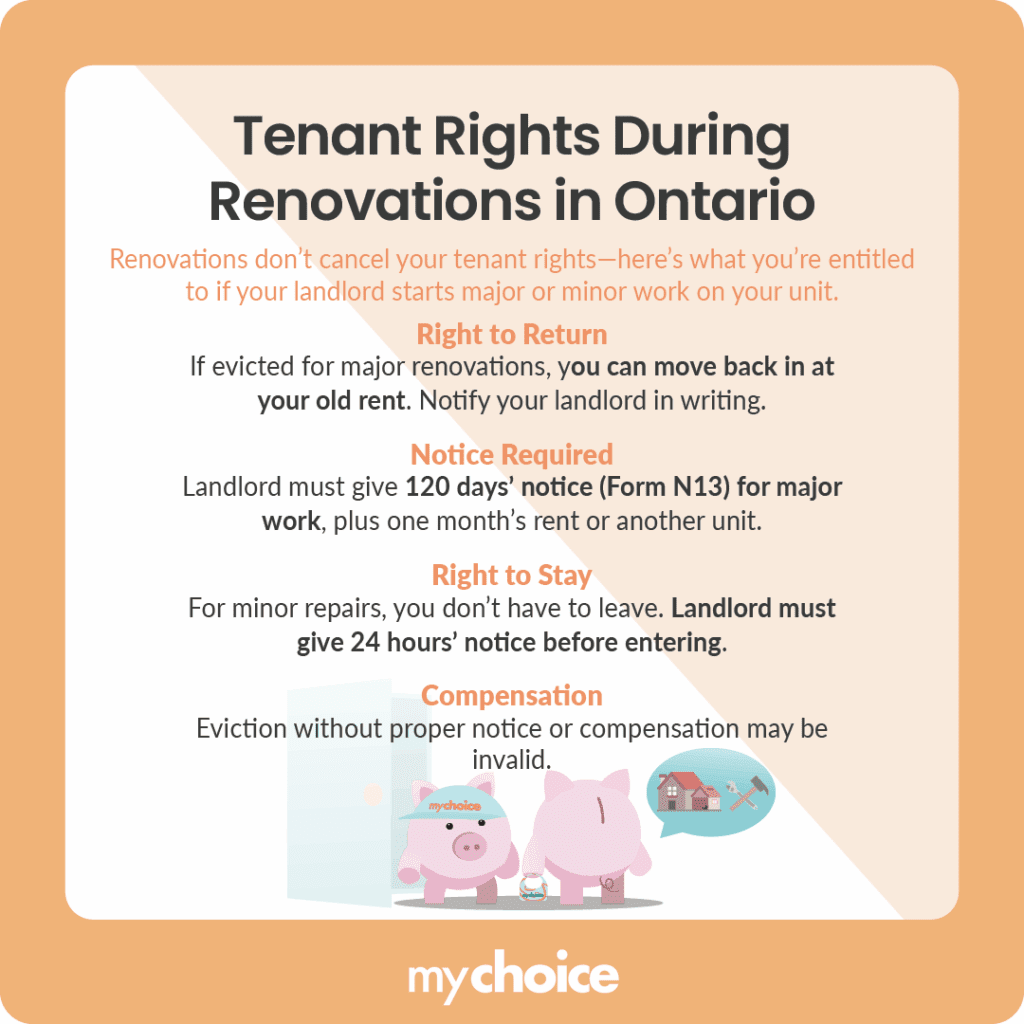
Read More: See Ontario’s Rules for Landlord Entry
Right To Stay During Some Renovations
Minor or cosmetic work does not satisfy the N13 renovation test merely because it is inconvenient. If repairs do not require the unit to be vacant, the tenancy continues, and the landlord remains subject to repair, maintenance, health, safety and entry rules.
Generally, to do repairs, a landlord must give the tenant written notice with a reason, date, and time between 8 a.m. and 8 p.m. for entry, with at least 24 hours’ notice. Different rules apply to emergency entries or entries with a tenant’s consent.
Right To Compensation
| Repair or renovation situation | Provincial compensation shown on Form N13 |
|---|---|
| You do not plan to return, residential complex has 5 or more units | The compensation is three months’ rent or another rental unit acceptable to you. |
| You do not plan to return, residential complex has fewer than 5 units | One month’s rent or another rental unit acceptable to you. |
| You plan to return, residential complex has 5 or more units | The lesser of (a) an amount corresponding to three months’ rent or (b) rent for the period of repair/renovation. |
| You plan to return, residential complex has fewer than 5 units | If the rental unit is being repaired or renovated, the payment is the lesser of one month’s rent or the rent for the duration of the repairs or renovation. |
The chart is not specific to the reason indicated in Form N13, which is why we recommend looking at the reason checked off on the notice. Different rules apply to termination for demolition/conversion, mobile homes, and care homes. It indicates where compensation is required, which must be paid by the termination date, and exceptions to compensation, such as work ordered under an Act or law.
Right To Return
In some cases, tenants may have a right of first refusal under the Residential Tenancies Act, meaning they can return to their unit when repairs or renovations are finished. Rent cannot exceed what the landlord could lawfully have charged if you had not moved out.
Notify the landlord in writing before moving out. A practical notice can state:
I am exercising my right of first refusal under section 53 of the Residential Tenancies Act and intend to reoccupy [unit and address] when the repairs or renovations are complete. My current mailing and email addresses are [details]. Please send every completion and reoccupancy notice to both addresses.
Also, if your address changes while you’re living elsewhere, you must send your landlord written notice. Save proof of delivery for all of your notices.
As of September 21, 2026, new rules add notice requirements for landlords after a tenant exercises the right of first refusal, including an estimated completion date and notice when the unit is ready to reoccupy.
LTB Guideline 12 says a former tenant may use a T5 application if your landlord won’t let you move back into your home when renovations are completed. This depends on the facts of each case and is subject to the filing deadline.
Does My Landlord Have To Pay For My Hotel During Unit Repairs?
Don’t make reservations for an extended stay assuming your landlord will pay for it. No single province-wide Ontario rule requires your landlord to pay all your hotel bills while your apartment is being repaired.
It depends on what happened and whether or not your landlord violated their duties to maintain the rental. It also depends on whether a Landlord and Tenant Board (LTB) decision applies and whether your landlord agrees to pay your hotel bill. Some municipalities also have relocation bylaws.
Ask your landlord in writing about accommodation or a rent-gap proposal. Keep receipts. Get tenant-law advice if the rental is unsafe or the landlord refuses urgent repairs.
Will Insurance Pay For Temporary Accommodation?
Some policies cover belongings, liability, and additional living expenses, but make sure you know what is included. Additional living expense coverage usually depends on an insured peril that makes your home uninhabitable; temporary accommodation could then be included. Planned renovations, delays and maintenance issues, such as mould, are not automatically covered. Your policy will identify the causes that trigger additional living expenses, the maximum amount payable, the duration, the deductible, and whether the insurer must approve it in advance. Ask whether the insurer must approve costs in advance.
Take photos of your belongings before work commences, report any damage promptly, and keep good records, including communications with your landlord, information from contractors, permits, accommodations, and receipts.
Read More: See How Tenant Insurance Handles Water Damage
Municipal Protections: Does Your City Have Extra Safeguards?
| City | Status checked for this update | What the local rule adds |
|---|---|---|
| Toronto | Rental Renovation Licence Bylaw is in force. | A landlord who wants to undertake qualifying renovation work in accordance with the provincial process described above must apply for a licence within seven days after issuing an N13 and comply with the city’s requirements regarding notice, accommodation, rent-gap or compensation to tenants. |
| Hamilton | Renovation Licence and Relocation Bylaw 24-055 has been in force since January 1, 2025. | After issuing an N13, the landlord must apply for a renovation licence within seven days and comply with documentation and relocation requirements of the city. |
| Other Ontario municipalities | Rules vary and may change. | To find local rules, search for renovation licence, renoviction, or tenant relocation on your municipality’s website or call bylaw services. |
In addition to the Residential Tenancies Act, some cities include rental protections in their municipal bylaws. For example, Toronto and Hamilton have tenant protections outlined in their respective bylaws.
Read More: Learn About Tenant Insurance in Ontario
The N13, LTB hearing and provincial rules about a right of return still apply.