









Many homeowners are surprised to find out that service lines are their responsibility. If they get damaged, repairs can be expensive and may not be covered by the municipality or a standard home insurance policy.
Who Is Responsible for Service-Line Repairs?
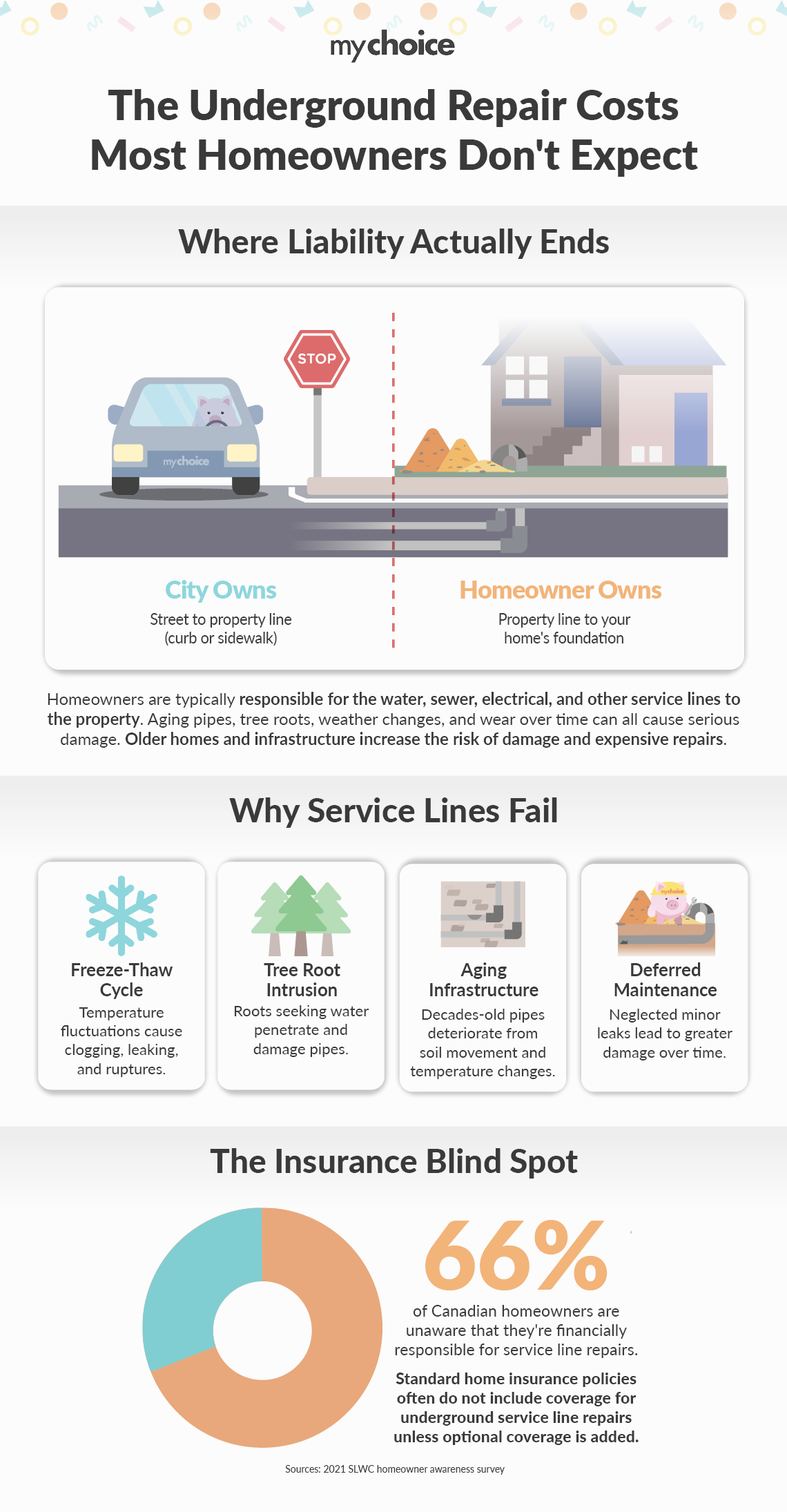
In many municipalities, homeowners are responsible for the underground water and sewer lines that run from the property line to the home. Responsibility boundaries vary, so check with your municipality or utility.
Service-line failures can happen without warning because of freeze-thaw cycles, shifting soil, old pipes, corrosion or tree roots.
Repairing an underground line can get expensive because the work may require excavation, permits, skilled workers and heavy equipment.
The Insurance Blind Spot
Underground service lines may not be covered under your home insurance policy, leaving you responsible for repairs or replacement.
In many cases, an endorsement can be added to your home insurance policy to cover service-line repairs up to a stated amount.
What Is Service Line Coverage?
Service-line coverage is an extra option that may be added to a home insurance policy. Depending on the insurer, the endorsement may cover sewer or septic lines, water lines, underground electrical or telecommunications lines, and ground-loop piping.
Many homeowners only discover the gap after receiving a large excavation bill.
Some municipalities partner with external providers, such as Service Line Warranties of Canada, to offer residents optional repair plans for private water and sewer or septic lines. The responsibility boundary and available plans vary by municipality.
These plans may operate differently from insurance policies and are often structured as repair service agreements.
Some insurance endorsements may also cover outdoor property damaged by a service-line failure or excavation, such as landscaping or a driveway. Coverage depends on the policy wording.
Sewer Backup Coverage vs. Service Line Coverage
| Sewer-backup coverage | Service-line coverage | |
|---|---|---|
| Type of coverage | Optional insurance endorsement | Optional insurance endorsement or service agreement |
| What it covers | Water or sewage damage inside the home caused by a sewer backup or overflow | Repair or replacement of covered outdoor service lines between the home and the municipal connection point |
| What it may pay for | Cleaning and replacing damaged floors, walls or furniture, subject to the policy | Excavation, pipe repair or replacement and certain outdoor restoration costs, subject to the endorsement or agreement |
| Coverage amount | Coverage amounts vary | Coverage amounts vary. |
Sewer-backup coverage deals mainly with resulting damage inside the home. Service-line coverage deals mainly with the damaged underground line. Depending on what happened, one, both or neither may apply.
Why Service Lines Are at Risk
Water and sewer service lines can clog, leak or rupture. These problems may result from freeze-thaw cycles, soil movement, corrosion or tree-root intrusion. Failing to address minor leaks can also lead to greater damage later.
Underground wiring and cables can also deteriorate or develop faults.
In some Canadian cities, the age of the infrastructure is another concern. In many cases, pipes are decades old, putting them at risk of deterioration from soil movement, temperature changes and demand.
Why Repairs Become Expensive
Because service lines are underground, repairs may require excavation, specialized labour, equipment and permits.
The County of Brant says a water-line replacement averages $2,600 in its service area. This is a local figure rather than a Canadian average.
The cost can vary widely depending on the type and age of the pipe, the extent of the damage, its depth and how difficult it is to access. Removing and restoring driveways, landscaping or other surfaces can add to the bill.