









Thousands of Canadians have become pool owners over the last few years—an investment that can bring a lot of summer fun for homeowners and their families and maybe even be a unique selling feature later on.
But from a home insurance standpoint, in-ground pool owners have additional responsibilities and may also face higher costs than their non-pool-owning neighbours.
The Pandemic Pool Boom
With travel and gatherings cancelled, and Canadians stuck at home during the uncertainty of the COVID-19 pandemic, many decided their best bet was to invest in creating a backyard oasis by installing a pool.
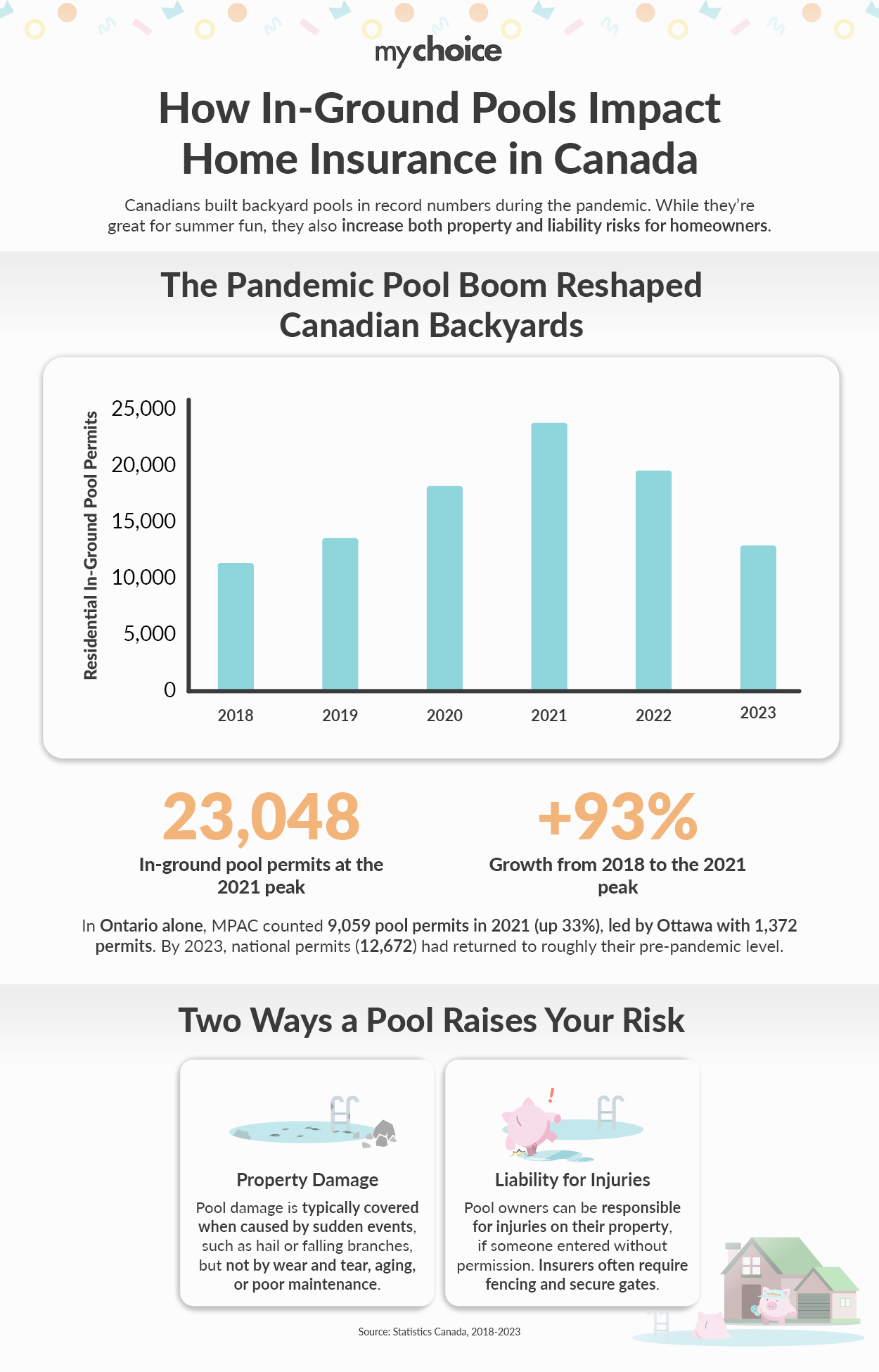
StatsCan started collecting data on permits issued for residential in-ground swimming pools in 2018. That year, 11,945 residential in-ground pool permits were issued. Fast forward to the peak of the pandemic in 2021, and more than 23,000 pool permits were issued across the country, including more than 9,000 in Ontario. The years 2020 and 2022 also saw surges in pool construction compared to pre-pandemic years. Thousands of permits were issued in 2023, but the number returned to pre-COVID levels.
| Permit category | 2019 | 2020 | 2021 | 2022 |
|---|---|---|---|---|
| Single dwelling building total | 12,439 | 18,288 | 22,496 | 16,757 |
| Multiple dwelling building total | 379 | 532 | 552 | 465 |
| Total residential and non-residential | 12,818 | 18,820 | 23,048 | 17,222 |
Source: Statistics Canada.
Why Pools Change Insurance Risk
Pools impact insurance risk on two fronts.
One is the potential for property damage. In-ground pools are considered permanent fixtures on your property. Depending on the insurer and policy wording, in-ground pools may be covered under dwelling coverage or other structures coverage, subject to policy limits, exclusions and conditions.
But like with other elements of your property, your insurance policy will likely only cover sudden and accidental damage to the pool, caused by a falling tree branch or a hailstorm, for example. Any damage to the pool or its components resulting from wear and tear or a lack of regular maintenance generally won’t be covered.
The other insurance risk from pool ownership is the significant liability exposure for homeowners, from slips and falls on the pool deck to diving accidents and drowning.
A pool-related injury may fall under your policy’s personal liability coverage, subject to its terms and limits.
In Ontario, for example, homeowners are subject to the Occupiers’ Liability Act, which sets out that homeowners or tenants have a legal obligation to take reasonable care to ensure that people entering their property are reasonably safe.
In many municipalities, pool owners must meet several safety criteria, such as installing a fence or enclosure around the perimeter of the pool and a self-latching gate, which often require building permits and inspections. Insurers may require homeowners to comply with these regulations to maintain coverage and to ensure the pool is as safe and secure as possible for everyone, especially minor children.
Between April 2011 and April 2023, the Canadian Hospitals Injury Reporting and Prevention Program (CHIRPP) reported 1,109 drowning-related cases. Children aged nine and under accounted for nearly 80% of reported cases, highlighting the elevated risks pools and other water environments can pose for young children.
The Liability Exposure Most Homeowners Overlook
Given this risk, some homeowners choose to have higher liability limits on their home insurance policies, for example, by adding a liability umbrella policy to cover the increased hazards that come with backyard pools.
Some pool owners may also look to rent out time in their pool to others through apps. Before you do this, it is important to check with your insurer as to whether this activity is covered under your policy. In some cases, insurers and municipalities consider this to be a commercial use, which may not be covered under your home insurance policy, or may require a separate endorsement, if available.
How Much Does a Pool Impact Home Insurance?
Having a backyard pool may increase your premium. The effect depends on the insurer, pool features and liability coverage selected.
At an additional cost, some insurers offer endorsements to cover damage from freezing weather, ice and snow to your pool’s structure.